


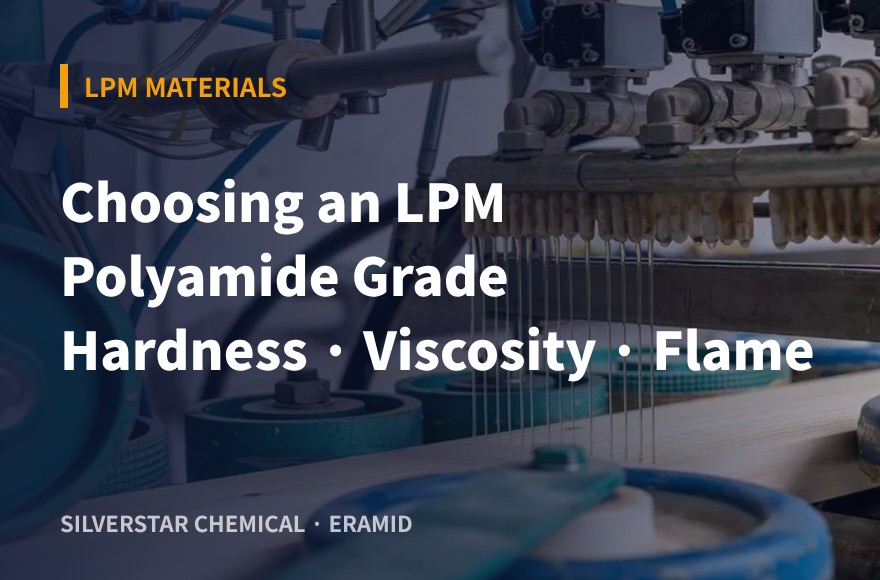
The best material for low pressure overmolding of PCBs is usually a thermoplastic polyamide hot melt grade chosen by four properties: hardness, melt viscosity, service temperature range and flame rating. There is no single grade that suits every board, so engineers fix the non-negotiable requirements first (temperature and flame rating) and then match hardness and viscosity to the part and the process. Low pressure molding (LPM) injects molten polyamide into a mold at low pressure to encapsulate PCBs, sensors, connectors and wire harnesses. One material handles sealing, insulation, strain relief and the final shape at the same time, so a poor grade choice tends to show up as several problems at once: short shots, cracking, softening at temperature or poor adhesion. This guide explains each of the four criteria and ends with a practical selection checklist.
Key takeaways
- Temperature range and flame rating come from the product specification, so fix them first and choose within them.
- Hardness trades vibration damping against shape retention; viscosity trades gap filling against the heat the components can tolerate.
- Datasheet values are tied to test conditions, so compare like with like and confirm with trial moldings of the real part.
Why grade selection matters in low pressure molding
Most materials used for LPM are dimer acid based thermoplastic polyamide hot melts. When heated they flow at low viscosity, and when they cool they set within seconds to tens of seconds and hold their shape. Within this family, grades range from soft and flexible to hard with high heat resistance, depending on molecular design and formulation.
The catch is that these properties are linked. In general, a grade with a higher softening point also needs a higher processing temperature, and a very soft grade with good low-temperature flexibility tends to hold its shape less well at high temperature. Adding flame retardants can shift viscosity and mechanical properties as well. Rather than choosing on one number, it is more efficient to lock in the requirements that cannot change and then balance the rest. For the process side, see Low Pressure Molding Process Parameters.
Hardness: Shore A and Shore D
The hardness of LPM polyamides is normally reported as Shore hardness, measured with a durometer to methods such as ISO 868 or ASTM D2240. Softer grades are expressed on the Shore A scale and harder grades on Shore D. As a general picture, LPM grades span from a rubber-like Shore A feel to a rigid plastic feel in the Shore D range. Readings taken instantly and after a dwell time (for example 15 seconds) can differ, so check that values were measured the same way before comparing.
- Softer grades absorb vibration and thermal expansion mismatch well. They are common for cable grommets, strain relief and sensors that see large temperature swings, and they often keep flexibility better at low temperature.
- Harder grades suit parts where the molding forms part of the housing and needs shape retention, scratch resistance and dimensional stability during assembly. The harder the grade, the more carefully thermal shock cracking and interface delamination should be checked.
- Mid-range grades are a common starting point for PCB protection that needs both damping and shape retention.
For cable and harness parts specifically, see Low Pressure Molding for Wire Harnesses and Cable Strain Relief.
Melt viscosity: filling, pressure and processing temperature
Melt viscosity describes how easily the molten material flows through the mold. For hot melts, apparent viscosity is usually measured with a rotational viscometer at a stated temperature, for example to ASTM D3236, and reported in mPa·s (cP). LPM grades typically sit in the range of a few thousand mPa·s at a measurement temperature around 200°C, although individual grades can be lower or higher. Because viscosity changes strongly with temperature, numbers measured at different temperatures cannot be compared directly.
Lower viscosity fills narrow gaps and the space under component leads more easily and can be injected at lower pressure, which reduces stress on solder joints and fragile parts. If the viscosity is too low, however, material escapes at the parting line and causes flash. Viscosity can also be lowered by raising the melt temperature, but that adds thermal load to heat-sensitive components and to the material itself. The practical approach is to choose a grade that fills the narrowest gap within the temperature the components can tolerate, and then use gate location and venting to cover the rest.
How viscosity links to voids, short shots and flash is covered in Troubleshooting Low Pressure Molding, and gate and vent design in Low Pressure Molding Mold Design.
Service temperature range: softening point, cold flexibility and heat aging
The service temperature range is the upper and lower limit of the environment the part will actually see. Thermoplastic polyamides soften and eventually melt as temperature rises, so the upper limit is judged from the softening point and shape retention at temperature. Softening point is measured by the ring and ball method (ASTM E28) or an automated method (ASTM D3461), and LPM grades generally fall somewhere in the 150 to 200°C range. Because the softening point is close to where the material starts to flow, the continuous use limit is normally set well below it.
- High temperature: exposure time matters as much as the peak temperature. Check how hardness and adhesion change after heat aging.
- Low temperature: as the material stiffens below freezing, expansion mismatch can cause cracks or delamination. Automotive parts are commonly specified down to several tens of degrees below zero.
- Thermal cycling: thermal shock tests that alternate hot and cold confirm whether the interfaces with the board, components and cable jacket survive.
Where moisture is also a concern, Waterproofing Electronics with Hot Melt explains how IP ratings relate to molding design.
Flame rating: UL 94 class and thickness
Electrical and electronic parts often carry a flame rating requirement. The common reference, UL 94, classifies materials as HB, V-2, V-1 or V-0 based on how quickly a test bar self-extinguishes after flame application and whether it drips flaming particles; V-0 is the most demanding of the vertical burn classes. The key point is that a rating is tied to the thickness at which it was tested. The same material can rate differently when thinner, so confirm that the thinnest molded wall of the part falls within the rated thickness.
Flame retardant grades can differ from their base grades in viscosity, hardness and adhesion because of the additives. Whether the formulation is halogen-free is also a frequent question in current specifications. The background is covered in Halogen-Free Flame Retardant Hot Melts.
Best material for low pressure overmolding of PCBs: a selection checklist
When engineers ask for the best material for low pressure overmolding of PCBs, the useful answer is a sequence rather than a single product. Lock in the requirements that cannot change (temperature, flame rating, substrates), then tune the properties that can be adjusted to the part and the process (hardness, viscosity).
LPM polyamide grade selection checklist
- ✔ Temperature range: upper and lower limits, and exposure time
- ✔ Flame rating: UL 94 class and the thickness it was rated at
- ✔ Substrates: PCB, PVC, PA6, metal or others to bond
- ✔ Hardness: vibration damping or shape retention
- ✔ Viscosity: narrowest gap versus component heat limit
- ✔ Environment: oil, fuel, damp heat or UV exposure
Working from the top down narrows the candidate grades quickly.
| Criterion | Value to check | Watch point |
|---|---|---|
| Hardness | Shore A or D | Same dwell time |
| Viscosity | mPa·s and test temperature | Compare at one temperature |
| Temperature | Softening point, limits | Include exposure time |
| Flame | UL 94 class | Rated thickness |
| Adhesion | Per substrate | Surface condition |
Once the list is down to two or three candidates, run trial moldings with the actual board and mold, followed by reliability tests such as thermal shock, damp heat and water immersion. If you are comparing LPM with other encapsulation routes, see PCB Encapsulation Options and Low Pressure Molding vs Potting.
LPM polyamides from SILVERSTAR CHEMICAL
- SILVERSTAR CHEMICAL has produced polyamide hot melts in-house since 2011 and carries out raw material selection, formulation and quality inspection itself under the ERAMID brand.
- Its solvent-free LPM polyamides are used to protect PCBs, sensors, connectors and wire harnesses, with UL 94 V-0 flame retardant grades and grades with thermal stability up to 200°C. They allow shorter cycles than potting.
- Formulations are VOC-free and halogen-free, and viscosity and formulation can be developed for the application. The company holds ISO 9001 and ISO 14001 and exports to the United States, Japan, Europe and Asia.
Hardness, viscosity and softening point data by grade, and the scope of available test data, are provided on request. See the LPM solution page for applications and the SILVERSTAR CHEMICAL company FAQ for company information.
Frequently Asked Questions
Q. What is the best material for low pressure overmolding of PCBs?
For low pressure overmolding of PCBs, thermoplastic polyamide hot melts are the material family most commonly used, but there is no single grade that suits every board. The right grade is chosen by service temperature range, flame rating, the substrates to bond, hardness and melt viscosity, and is confirmed with trial moldings and reliability tests on the actual part.
Q. Is a harder or softer LPM grade better?
It depends on the part. Softer grades absorb vibration and thermal expansion mismatch and are common for grommets, strain relief and sensors with large temperature swings. Harder grades suit parts that need shape retention and dimensional stability. Harder grades should be checked carefully for cracking and delamination under thermal shock.
Q. How should melt viscosity values be compared?
Compare viscosity values measured at the same temperature, because melt viscosity changes strongly with temperature. Values are usually given in mPa·s from a rotational viscometer. Lower viscosity fills narrow gaps more easily but increases the risk of flash, and raising the melt temperature to lower viscosity adds heat load to the components.
Q. If I use a UL 94 V-0 grade, is my part V-0?
Not automatically. A UL 94 rating applies at the thickness it was tested at, so the thinnest molded wall of the part must fall within the rated thickness. Flame requirements for the finished product are confirmed separately under the applicable product standard and certification process.
Q. Can SILVERSTAR CHEMICAL help select an LPM grade?
SILVERSTAR CHEMICAL manufactures solvent-free LPM polyamides under the ERAMID brand, including UL 94 V-0 flame retardant grades and grades with thermal stability up to 200°C. Share the part type, temperature range, flame requirement, substrates and current process conditions, and suitable grades and the scope of available data will be provided on request.
If you are selecting an LPM polyamide grade for a new part or reviewing problems with your current material, send the part type and geometry, service temperature range, flame requirement, substrates and current melt temperature and pressure. We will review suitable ERAMID grades. Contact our technical team · Tel +82-55-337-8841 · snschem@snschem.kr