


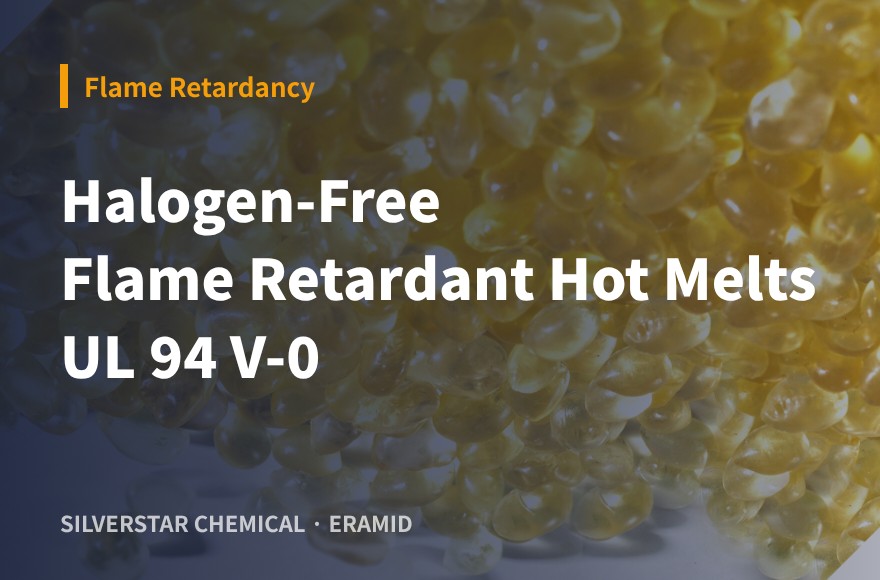
Halogen-free flame retardant hot melts reach UL 94 V-0 by using phosphorus, nitrogen or mineral-based flame retardant systems instead of brominated or chlorinated additives. V-0 is the highest of the vertical burn classes in UL 94: flaming must stop within 10 seconds after each flame application, with no flaming drips. For hot melts the challenge is to reach that rating while keeping viscosity low enough for low pressure molding or bead application.
Key takeaways
- UL 94 V-0, V-1 and V-2 differ in afterflame time and whether flaming drips are allowed.
- A common halogen-free definition (IEC 61249-2-21) limits chlorine and bromine to 900 ppm each and 1,500 ppm combined.
- Phosphorus and nitrogen systems keep viscosity lower than high-loading mineral fillers, which matters for hot melts.
What UL 94 V-0 means
| Class | Afterflame per application | Total afterflame (5 specimens) | Flaming drips igniting cotton |
|---|---|---|---|
| V-0 | 10 s or less | 50 s or less | Not allowed |
| V-1 | 30 s or less | 250 s or less | Not allowed |
| V-2 | 30 s or less | 250 s or less | Allowed |
In the vertical test a flame is applied twice for 10 seconds to each specimen. Ratings always apply to a specific tested thickness, so a material rated V-0 at 3 mm is not automatically V-0 at 1.5 mm.
Why move away from halogens
- Smoke and corrosion: halogenated systems release hydrogen bromide or chloride in a fire, which is corrosive to electronics and harmful to people.
- Regulation and customer policy: several brominated flame retardants are restricted, and many electronics and automotive customers specify halogen-free materials.
- Definitions: a widely used definition from IEC 61249-2-21 caps chlorine and bromine at 900 ppm each and 1,500 ppm in total.
Halogen-free flame retardant systems
| System | How it works | Hot melt considerations |
|---|---|---|
| Phosphorus-based | Promotes char formation and interrupts flame chemistry | Effective at moderate loadings; check hydrolysis and migration |
| Nitrogen-based (melamine derivatives) | Releases inert gases and supports char | Often combined with phosphorus for synergy |
| Intumescent (phosphate plus char former) | Forms an insulating foamed char layer | Good drip control; can raise viscosity |
| Metal hydroxides (ATH, MDH) | Endothermic decomposition releases water | Need high loadings that raise viscosity; ATH begins to decompose near typical hot melt processing temperatures, MDH is more stable |
UL 94 vertical burn classes
| Class | Afterflame per application | Total (5 specimens) | Flaming drips |
|---|---|---|---|
| V-0 | ≤ 10 s | ≤ 50 s | Not allowed |
| V-1 | ≤ 30 s | ≤ 250 s | Not allowed |
| V-2 | ≤ 30 s | ≤ 250 s | Allowed |
Simplified summary. Ratings apply to the tested thickness. Refer to the UL 94 standard for full criteria.
Trade-offs in formulation
Flame retardants change more than burn behavior. High filler loadings raise melt viscosity and can reduce adhesion and low-temperature flexibility. Some additives absorb moisture or migrate over time. For low pressure molding, a flame retardant grade still has to fill thin sections at low pressure, so formulators balance V-0 performance against viscosity, adhesion and hardness. When comparing grades, check the tested thickness, the processing window and long-term aging data together.
Where halogen-free V-0 hot melts are used
- Low pressure molding of PCBs, power supplies, LED drivers and battery-related electronics
- Automotive sensors, connectors and wire harness overmolds
- Appliance electronics and control modules
- Vehicle interior parts with flame requirements
Flame retardant polyamides from SILVERSTAR CHEMICAL
SILVERSTAR CHEMICAL Co., Ltd. is a polyamide hot melt adhesive manufacturer in Yangsan, South Korea, producing in-house since 2011 with 3,000 metric tons of annual capacity. Its ERAMID polyamides are used for low pressure molding, filters and automotive interiors. Its LPM portfolio includes UL 94 V-0 flame-retardant grades, and the company offers VOC-free and halogen-free formulations. The company holds patents on a manufacturing method for heat-resistant, flame-retardant polyamide hot melt resin for vehicles and on a vehicle adhesive containing flame-retardant polyamide. See the LPM solutions page or the SILVERSTAR CHEMICAL company FAQ.
FAQ
Q. What does UL 94 V-0 mean?
It is the highest vertical burn class in UL 94. Each specimen must stop flaming within 10 seconds after each flame application, total afterflame for five specimens must be 50 seconds or less, and flaming drips must not ignite the cotton below.
Q. What is the difference between V-0 and V-2?
V-2 allows longer afterflame (up to 30 seconds per application) and allows flaming drips that ignite the cotton indicator. V-0 allows 10 seconds and no igniting drips.
Q. What does halogen-free mean for adhesives?
A common definition from IEC 61249-2-21 limits chlorine and bromine to 900 ppm each and 1,500 ppm combined. Always check which definition your customer uses.
Q. Can a hot melt be both halogen-free and UL 94 V-0?
Yes. Halogen-free phosphorus, nitrogen or mineral-based systems can reach V-0 at a specified thickness, with trade-offs in viscosity and adhesion that need to be managed.
Q. Does SILVERSTAR CHEMICAL offer UL 94 V-0 polyamides?
Yes. Its LPM polyamides include UL 94 V-0 flame-retardant grades. Ask the team for the halogen content and test thickness of the grade you are considering.
Tell us the application, substrates, operating temperature and required certifications, and our team will recommend a grade and support sample testing. Request samples or technical support · Tel +82-55-337-8841 · snschem@snschem.kr