


Eco-friendly adhesive solutions for automotive use are adhesives that keep cabin emissions low and avoid solvents, mainly solvent-free hot melts, low-VOC water-based systems and solvent-free reactive adhesives, chosen and verified against the emission tests carmakers apply to interior parts. For interior trim the practical question is not whether an adhesive is "green" in general, but whether the bonded part passes the VOC, fogging and odor limits of the vehicle program while still holding at summer cabin temperatures. This article explains what makes an interior adhesive low-emission, compares the main solvent-free options, and outlines how claims are tested.
Key takeaways
- Low emissions inside the cabin, no carrier solvents and less waste in the plant are the three practical tests of an eco-friendly interior adhesive.
- Hot melts, water-based and solvent-free reactive adhesives each cut solvent use, but differ in speed, heat resistance and energy use.
- Claims are proven with material and part-level emission tests such as VDA 278, VDA 276, ISO 12219, DIN 75201 and VDA 270, as specified by each carmaker.
What makes an automotive adhesive eco-friendly
In automotive interiors, "eco-friendly" usually combines several concrete properties rather than a single label:
- No carrier solvent: the adhesive does not rely on organic solvents that evaporate during application, which removes a major source of workplace exposure and plant emissions and often the need for solvent extraction or recovery.
- Low cabin emissions: once the part is installed, the adhesive adds little to volatile organic compounds (VOC), semi-volatile fogging compounds, aldehydes and odor in the cabin.
- Safer chemistry: where flame retardancy is required, halogen-free systems are generally preferred over halogenated ones.
- Less material and waste: precise application, little purge waste and no drying ovens lower the material and energy footprint per part.
- End-of-life thinking: thermoplastic bonds that can be reheated, or mono-material designs, can make separation easier when parts are recycled.
Our article on what VOC-free means for hot melt adhesives covers how to read emission claims in more detail.
Why cabin air quality drives adhesive choice
A car cabin is a small, closed volume full of polymer parts: seat foams and fabrics, headliners, door panels, carpets, consoles and the adhesives that hold them together. Parked in the sun, interior surfaces can become very hot, which speeds up the release of volatile and semi-volatile substances. Some of them cause the "new car smell", some can irritate, and heavier compounds can condense on the windscreen as fog and reduce visibility.
Because of this, vehicle makers set limits on emissions from interior materials and whole components, and several markets have guidelines for vehicle interior air quality. Adhesives are a small share of the part by weight, but they are often applied hot, sit directly under decorative surfaces and can contribute measurably to test results. That is why adhesive selection for headliners, door panels and seats is increasingly tied to emission data as well as to bond strength. Our guide to hot melt adhesives for automotive headliners and door panels covers the bonding side.
Eco-friendly adhesive solutions for automotive use compared
Most interior bonding today moves toward one of three solvent-free routes. The comparison below is general; actual performance depends on the specific formulation and process.
Three solvent-free routes for interior bonding
| Option | How it sets | Main trade-off |
|---|---|---|
| Hot melt | Cools to solid | Heat limit |
| Water-based | Water dries off | Drying energy |
| Reactive | Chemical cure | Cure time |
General comparison. Actual performance depends on formulation and process.
| Option | Strengths | Watch points |
|---|---|---|
| Hot melt (thermoplastic) | Fast set, no drying, reworkable | Heat limit near softening point |
| Water-based | Low solvent, sprayable | Drying energy and time |
| Reactive (e.g. moisture-cure) | High heat resistance after cure | Curing time, handling of reactive groups |
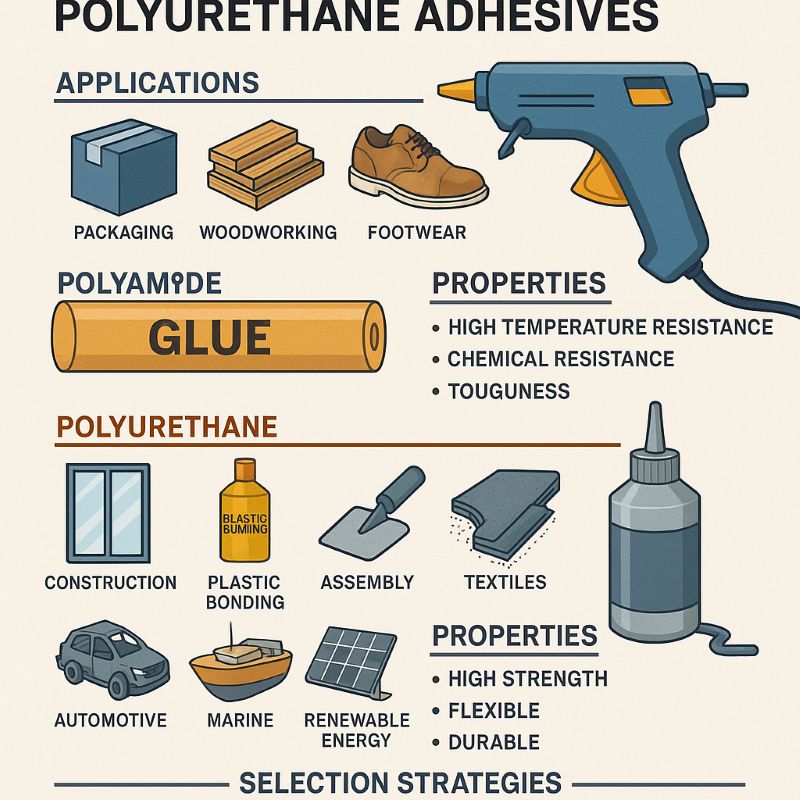
Hot melts are applied molten and set by cooling within seconds, so there is nothing to dry and lines can run fast. The base polymer determines heat and chemical resistance; polyamide hot melts generally have higher softening points than EVA or polyolefin types, which matters for parts near windows or roofs. Water-based adhesives replace solvents with water and suit large sprayed areas, but water must be removed with time or heat, which adds energy use. Solvent-free reactive adhesives, such as moisture-curing types, combine hot application with a chemical cure for higher heat resistance; our comparison of polyamide vs polyurethane (PUR) hot melt explains that trade-off.
How low-emission claims are tested
Emission claims mean something when they are tied to a test method and limit. Common methods in automotive interiors include:
- Material-level VOC and fogging: a small sample is heated in a thermal desorber and released compounds are analyzed by GC/MS. VDA 278 is a widely used method of this type.
- Component-level emissions: whole parts are placed in a test chamber and emitted compounds are collected and analyzed, for example VDA 276 or parts of ISO 12219.
- Fogging: condensable compounds that would fog the glass are measured, for example under DIN 75201.
- Odor: trained panels rate odor intensity, for example under VDA 270.
Carmakers often have their own specifications built on these methods, with different limits and sample preparation. For an adhesive supplier, the useful data set is material-level results under the specified method plus support for part-level tests on the finished assembly, because the adhesive interacts with the substrate and the bonding process.
Process choices that cut emissions and waste
Even a low-emission grade can perform poorly if the process is not controlled. A few practical points generally make a difference:
- Keep melt temperature within the recommended window: overheating and long residence times in the melt tank can degrade the polymer and raise volatile content and odor.
- Apply just what the bond needs: controlled bead, dot or spray patterns cut both material use and the emission load per part.
- Avoid drying ovens where possible: hot melts that set by cooling remove the drying step entirely, saving energy and floor space.
- Reduce purge and start-up waste: stable temperatures and clean equipment reduce discarded material.
- Think about separation: thermoplastic bonds can often be released with heat, which can support repair or recycling of components.
Formulation also matters at the raw material level. Our overview of bio-based polyamide hot melts discusses how renewable feedstocks fit into interior adhesive choices, and halogen-free flame retardant hot melts covers flame-retardant options without halogens.
SILVERSTAR CHEMICAL's polyamide hot melts for interiors
- SILVERSTAR CHEMICAL has produced polyamide hot melts in-house since 2011 and handles raw material selection, formulation and quality inspection itself under the ERAMID brand.
- Its automotive interior grades are used for seats, headliners, door panels, consoles, instrument panels and door pillars, with VOC- and halogen-free formulations, high bond strength and heat and chemical resistance.
- The company holds ISO 9001 and ISO 14001, has 27 patents and certifications including a process for eco-friendly modified polyamide hot melt resin and a biodegradable polyamide hot melt containing biomass, and exports to the USA, Japan, Europe and Asia.
Data for specific grades and emission standards is available on request. See the automotive solution page and other applications page, or read the SILVERSTAR CHEMICAL company FAQ.
Frequently Asked Questions
Q. What are eco-friendly adhesive solutions for automotive use?
Eco-friendly adhesive solutions for automotive use are bonding materials that cut emissions and waste across the part's life: solvent-free systems such as hot melts and many water-based or reactive adhesives, formulations with low VOC and fogging emissions inside the cabin, halogen-free chemistries where flame retardancy is needed, and designs that use less material or ease end-of-life separation. Whether a given adhesive qualifies is shown by emission test data on the material and the finished part, not by the label alone.
Q. Why do automotive interiors need low-emission adhesives?
The cabin is a small, closed space that heats up in the sun, so volatile and semi-volatile compounds from trims, foams, fabrics and adhesives can build up in the air, cause odor and condense as fog on the windscreen. Carmakers therefore set emission limits for interior materials and parts, and adhesives are part of what is tested.
Q. How are emissions from interior adhesives measured?
Common approaches include thermal desorption of small material samples to measure VOC and fogging compounds (for example VDA 278), chamber tests on whole components (for example VDA 276 or parts of ISO 12219), fogging tests such as DIN 75201 and odor panels such as VDA 270. Each carmaker specifies which methods and limits apply, so the method should be agreed before testing.
Q. Is a solvent-free hot melt automatically low-emission?
Not automatically. A hot melt contains no carrier solvent to evaporate, which removes a major emission source, but low-molecular components, residual monomers or degradation from overheating in the melt tank can still add to VOC and fogging results. Grade selection, correct application temperature and emission testing on the bonded part are still needed.
Q. Can SILVERSTAR CHEMICAL supply hot melts for automotive interiors?
SILVERSTAR CHEMICAL manufactures ERAMID polyamide hot melts in-house, including grades for automotive interior bonding such as seats, headliners, door panels, consoles, instrument panels and door pillars, with VOC- and halogen-free formulations. Share the substrates, process and the emission standard you must meet, and the team will advise on suitable grades and the scope of available data on request.
If you are moving an interior part to a solvent-free or lower-emission adhesive, send us the substrates, the current process and line speed, the service temperature and the emission specification you must meet. We will review suitable ERAMID grades and the scope of available data. Contact our technical team · Tel +82-55-337-8841 · snschem@snschem.kr