


The role of wax in hot melt adhesive formulation is mainly to lower melt viscosity and to control open time and set speed, while the tackifier improves wetting and adhesion and the antioxidant protects the adhesive from heat and oxygen in the melt tank and in service. Together with the base polymer, these three ingredients decide how a hot melt flows, how quickly it grabs, how long it stays stable at application temperature and how the finished bond behaves. This article explains what each one does, what happens when there is too much or too little, how they interact and why the balance looks different for EVA, polyolefin and polyamide hot melts.
Key takeaways
- Wax sets viscosity and speed: it thins the melt and crystallizes quickly on cooling, which shortens open time and speeds up set.
- Tackifier sets grab and adhesion: it improves wetting and hot tack and tunes the glass transition temperature of the blend.
- Antioxidant sets stability: small amounts keep the adhesive from darkening, thickening or charring during hours at melt temperature.
What goes into a hot melt formulation
A typical hot melt is a blend built around a thermoplastic base polymer. The polymer provides cohesive strength, flexibility and much of the heat resistance. Other ingredients are added to adjust how the adhesive behaves during application and in use:
- Base polymer: for example EVA, polyolefins, styrenic block copolymers or polyamides. It is the backbone of the bond.
- Tackifier: a low-molecular-weight resin that improves wetting and specific adhesion.
- Wax: a crystalline, low-viscosity material that controls viscosity and set speed.
- Plasticizer or oil: used in some systems to soften the adhesive or extend open time.
- Antioxidant and other stabilizers: protect the formulation from thermal and oxidative degradation.
The proportions vary widely by polymer family and application. Packaging hot melts may contain large shares of tackifier and wax, while some engineering hot melts are mostly polymer. Stabilizers are normally used at low levels; formulation guides commonly cite figures in the range of about 0.1 to 3 percent as an example. A broader overview of raw materials is in What Is Hot Melt Adhesive Made Of? Polymers, Resins, Waxes and Additives.
The role of wax in hot melt adhesive formulation
Wax is often the ingredient that makes a hot melt fast. Its effects come from two properties: it has a very low viscosity when molten, and it crystallizes sharply when it cools below its melting range.
- Lower viscosity: wax thins the melt so it can be pumped, sprayed or extruded at a practical temperature. Lower viscosity also helps the adhesive wet porous substrates such as paper and nonwovens.
- Faster set and shorter open time: as the adhesive cools, the wax crystallizes and builds strength quickly. This is what allows high-speed packaging and assembly lines to move a part within seconds.
- Heat resistance: the melting point of the wax influences the temperature at which the bond softens, so a higher-melting wax can raise heat resistance.
- Less blocking: wax can reduce surface tack after cooling, which helps when adhesive-coated parts are stacked.
Different waxes behave differently. Paraffin waxes generally melt lower and set sharply. Microcrystalline waxes are more flexible and can extend open time slightly. Synthetic waxes such as Fischer-Tropsch and polyethylene waxes generally have higher melting points and are used when faster set or better heat resistance is needed.
There is a cost to adding wax. Because wax is crystalline and has little strength of its own, too much of it can make the adhesive brittle, reduce adhesion to smooth or non-porous surfaces and weaken performance at low temperature. Too little wax can leave the adhesive too viscous to apply or too slow to set for the line.
Tackifiers: wetting, tack and adhesion
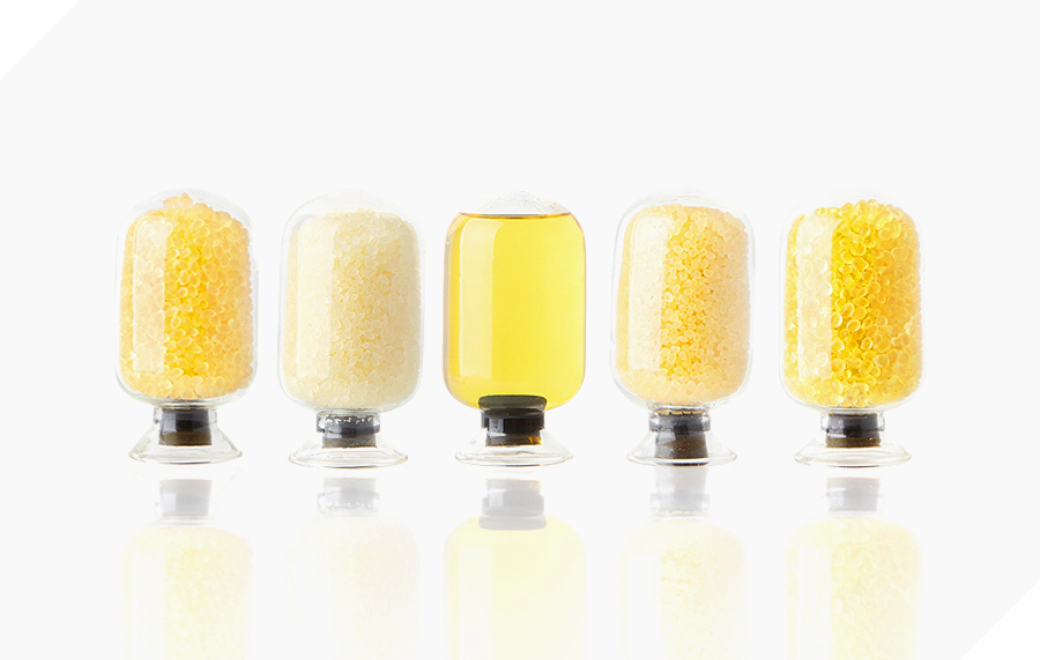
Tackifiers are amorphous resins with a relatively low molecular weight. When blended with the base polymer they lower the melt viscosity somewhat, but their main job is to improve how well the molten adhesive wets the substrate and how strongly it grabs while still warm. This property is often called hot tack.
Tackifiers also change the glass transition temperature of the blend. Raising it tends to increase stiffness and can lengthen the time the adhesive stays workable, while lowering it keeps the adhesive more flexible at low temperature. Formulators use this to tune open time, peel behavior and cold flexibility together with wax.
Common tackifier families include rosin esters, aliphatic hydrocarbon resins (often called C5 resins), aromatic hydrocarbon resins (C9), hydrogenated versions with better color and stability, and terpene resins. The key requirement is compatibility: a tackifier that does not mix well with the base polymer can separate, reduce strength or cause haze. Polar polymers generally pair with more polar resins and non-polar polymers with aliphatic or hydrogenated resins.
Too much tackifier can make an adhesive brittle at low temperature, lower its heat resistance or increase odor. Too little can leave it with poor wetting and weak initial grab.
Antioxidants: protection in the tank and in service
A hot melt often sits in a melt tank, hose and nozzle at elevated temperature for hours. Oxygen and heat attack the polymer chains and resins during that time. The visible signs are familiar on production lines: the adhesive darkens, viscosity drifts up or down, a skin forms on the tank surface, gels and char build up and nozzles block.
Antioxidants slow this degradation. They are usually used as a combination:
- Primary antioxidants, typically hindered phenols, which interrupt the radical chain reactions of oxidation.
- Secondary antioxidants, typically phosphites or thioesters, which break down hydroperoxides and protect the primary antioxidant during processing.
Antioxidants protect the adhesive during compounding and application, and they also help the bond resist aging in service, especially in warm environments. They cannot fully compensate for poor tank practice, so keeping the melt temperature no higher than needed, limiting residence time and avoiding open tanks are still important. Antioxidants are used at low levels, and adding more is not always better, because some additives can bloom to the surface or affect color.
How the three interact
The three ingredients cannot be adjusted one at a time without affecting the others. Raising wax content to speed up set usually shortens open time and may reduce adhesion, so tackifier may need to rise to restore wetting. Raising tackifier can reduce cold flexibility. Both choices change the melt viscosity and therefore the application temperature, which in turn changes how much antioxidant protection the formulation needs.
What each ingredient controls
Base polymer
Cohesion, flexibility, heat resistance
Wax
Melt viscosity, set speed, open time
Tackifier
Wetting, hot tack, adhesion
Antioxidant
Stability in the tank and in service
General roles. Actual effects depend on the polymer family and the grade.
| Ingredient | Main job | If overused |
|---|---|---|
| Wax | Lower viscosity, faster set | Brittleness, weaker adhesion |
| Tackifier | Wetting, hot tack | Cold brittleness, lower heat resistance |
| Antioxidant | Heat and aging stability | Blooming, color change |
This is why a formulation that works on one line can fail on another, and why small changes are tested on real substrates and real equipment. The trade-offs are discussed further in Hot Melt Formulation Basics: How Ingredient Ratios Are Set and Why DIY Formulas Fail.
How the balance shifts by polymer family
The role of wax and tackifier depends heavily on the base polymer:
- EVA hot melts typically rely on substantial amounts of tackifier and wax. The polymer alone is too viscous and not tacky enough for most uses, so the additives define much of the performance.
- Polyolefin hot melts are often formulated with wax and tackifier as well, with resin choice tuned to the non-polar backbone. A comparison with polyamides is in Polyamide vs Polyolefin (PO) Hot Melt: Which Fits Your Application?
- Polyamide hot melts generally get much of their adhesion, cohesion and heat resistance from the polar polymer itself, so formulations tend to use fewer additives. Stabilizers still matter, because polyamides are processed at relatively high temperatures. See What Is Polyamide Hot Melt Adhesive? Properties, Grades and Uses.
Additive choices also affect emissions and sustainability claims. Low-molecular-weight ingredients are a common source of odor and volatile content, which is discussed in What Does VOC-Free Mean for Hot Melt Adhesives, and How Do You Verify It? Renewable raw materials are covered in Bio-Based Polyamide Hot Melts: What Renewable Feedstocks Change.
SILVERSTAR CHEMICAL and ERAMID polyamide hot melts
SILVERSTAR CHEMICAL Co., Ltd. has produced polyamide hot melts in-house since 2011 and supplies them under the ERAMID brand. Raw material selection, formulation and quality inspection are all carried out by the company, and custom viscosity and formulation development is available.
- Grades for low pressure molding of PCBs, sensors, connectors and wire harnesses, including UL 94 V-0 flame retardant grades and grades with thermal stability up to 200°C.
- Grades for filters, automotive interiors, road marking and packaging, plus polyamide resins for gravure inks.
- Common features include VOC-free and halogen-free formulations, high bond strength and heat and chemical resistance. Annual capacity is 3,000 tons, the company holds ISO 9001 and ISO 14001 certification, and it exports to the United States, Japan, Europe and Asia.
Formulation details and data ranges for specific grades are provided on inquiry. See the other applications page, the filter solutions page and the SILVERSTAR CHEMICAL company FAQ.
Frequently Asked Questions
Q. What is the role of wax in hot melt adhesive formulation?
Wax mainly lowers the melt viscosity of a hot melt and controls how fast it sets. Because wax crystallizes quickly as the adhesive cools, it shortens open time and speeds up set, and its melting point also influences the heat resistance of the bond. Too much wax can make the adhesive brittle, reduce adhesion and hurt low-temperature performance, so the level is balanced against the base polymer and tackifier.
Q. What does a tackifier do in a hot melt?
A tackifier is a low-molecular-weight resin that improves wetting of the substrate, hot tack and specific adhesion. It also adjusts the glass transition temperature of the blend, which affects flexibility and open time. Common families include rosin esters, aliphatic and aromatic hydrocarbon resins and terpene resins, and the right choice depends on compatibility with the base polymer.
Q. Why are antioxidants added to hot melt adhesives?
Hot melts are held at high temperature in melt tanks and hoses for hours, which can cause oxidation. Antioxidants slow this down, helping to prevent darkening, viscosity drift, skinning, gels and char, and they also protect the bond during service. They are used at low levels, typically below a few percent, often as a combination of a primary antioxidant such as a hindered phenol and a secondary antioxidant such as a phosphite.
Q. Do polyamide hot melts use wax and tackifier like EVA hot melts?
Usually to a lesser degree. EVA and polyolefin hot melts typically rely on substantial amounts of tackifier and wax to achieve the right viscosity, tack and set speed. Polyamide hot melts get much of their adhesion, cohesion and heat resistance from the polymer itself, so formulations are often simpler, although additives such as stabilizers are still used and the details vary by grade.
Q. Can SILVERSTAR CHEMICAL develop a hot melt formulation for a specific application?
SILVERSTAR CHEMICAL manufactures polyamide hot melts under the ERAMID brand and handles raw material selection, formulation and quality inspection in-house, including custom viscosity and formulation development. Share the application, substrates, service temperature and application equipment, and suitable grades and the available data range will be provided on inquiry.
If you are adjusting open time, set speed or melt stability for a hot melt application, send the application, the substrates, the service temperature range, the current application temperature and the equipment. We will review suitable ERAMID grades and the data available. Contact our technical team · Tel +82-55-337-8841 · snschem@snschem.kr