


Polyamide hot melt adhesive is a solvent-free thermoplastic adhesive based on polyamide resins, most often made from dimer fatty acids and diamines, that is applied molten and bonds as it cools. Among non-reactive hot melts it offers high heat resistance, good resistance to oils and solvents, and strong adhesion to metals, many plastics and filter media. That is why it is used for low pressure molding of electronics, filter assembly, automotive interiors and cable components.
Key takeaways
- Made mainly from dimer acid and diamines; sets by cooling, with no cure step.
- Strengths: heat, oil and solvent resistance, broad adhesion, flexibility at low temperatures.
- Trade-offs: higher cost than EVA, higher application temperature and moisture uptake during storage.
How polyamide hot melts are made
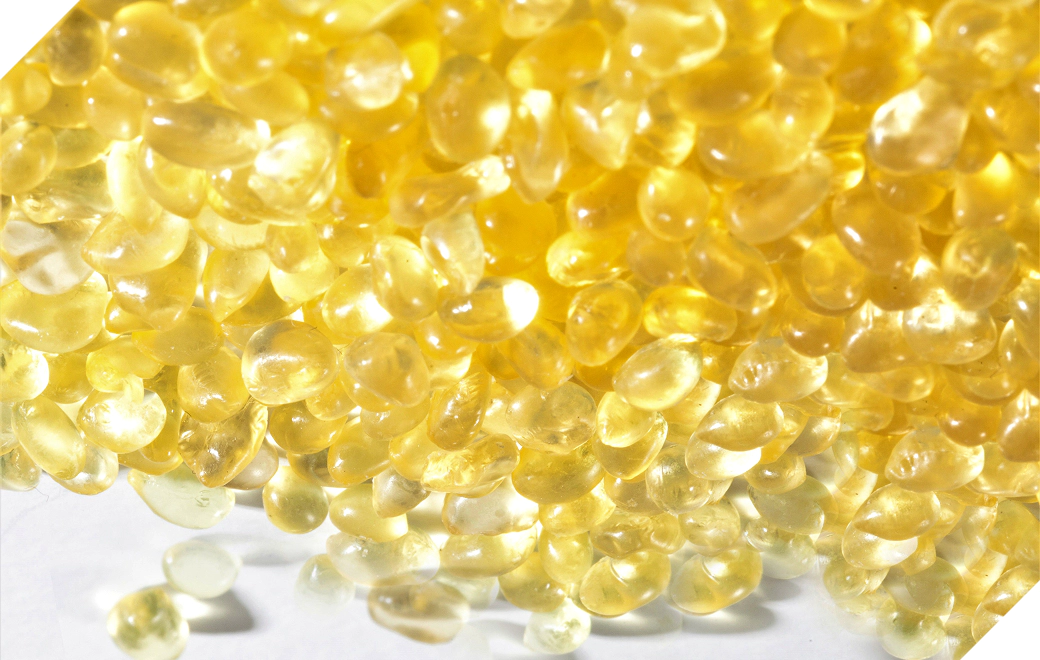
Most hot melt polyamides are produced by condensing dimer acid, a C36 dicarboxylic acid obtained from vegetable fatty acids, with diamines. Formulators adjust the acid and amine components to set the softening point, viscosity, hardness and flexibility. The result is shipped as pellets or granules and melted in a tank or extruder at the point of use.
These polyamides are a different family from the nylons used for fibers and engineering plastics such as PA6 and PA66. They are less crystalline and melt over a different range, which makes them suitable as adhesives and molding compounds.
Key properties
- Heat resistance: softening points range widely by grade, from roughly the 100°C range to around 200°C, high for a non-reactive hot melt.
- Chemical resistance: good resistance to oils, fuels and many solvents, important in filters and automotive parts.
- Adhesion: bonds to metals, polar plastics, filter media, wood and textiles.
- Fast set: a relatively sharp transition from melt to solid allows short cycle times.
- Low-temperature flexibility: many grades stay flexible in cold environments.
- Electrical insulation and flame retardancy: grades are available for electronics, including UL 94 V-0 rated types.
Limitations to plan for
- Cost: higher than EVA and many polyolefin hot melts.
- Application temperature: usually processed hotter than EVA, so check heat-sensitive substrates.
- Moisture uptake: polyamides absorb moisture in open storage; keep containers sealed and dry if needed.
- Low-energy plastics: polyethylene, polypropylene and PTFE need surface treatment or mechanical locking.
How it compares with other hot melts
| Property | EVA | Polyolefin (PO) | Polyamide (PA) | PUR (reactive) |
|---|---|---|---|---|
| Heat resistance | Low | Medium | High | Very high after cure |
| Oil and solvent resistance | Low | Medium | High | High |
| Set mechanism | Cooling | Cooling | Cooling | Cooling, then moisture cure |
| Rework | Re-meltable | Re-meltable | Re-meltable | Not after cure |
| Relative cost | Low | Low to medium | Medium to high | High |
General tendencies by family. Individual grades vary.
Where polyamide hot melts are used
- Low pressure molding (LPM): encapsulating PCBs, sensors, connectors and wire harnesses.
- Filters: first and last pleat joining, edge sealing and end cap bonding in air, oil and fuel filters.
- Automotive interiors: seats, headliners, door panels, consoles, instrument panels and pillars.
- Other industries: road marking materials, polyamide resins for gravure printing inks, and packaging.
Where polyamide hot melts are used
Low pressure molding
PCBs, sensors, connectors, wire harnesses.
Filters
Pleat joining, edge sealing, end cap bonding.
Automotive interiors
Seats, headliners, door panels, consoles.
Other industries
Road marking, gravure ink resins, packaging.
ERAMID polyamide hot melts
SILVERSTAR CHEMICAL Co., Ltd. is a polyamide hot melt adhesive manufacturer in Yangsan, South Korea, producing in-house since 2011 with 3,000 metric tons of annual capacity. Its ERAMID polyamides are used for low pressure molding, filters and automotive interiors. Grades cover LPM, filter, automotive and other industrial uses, with VOC-free and halogen-free formulations and custom viscosity development. See the SILVERSTAR CHEMICAL company FAQ or the LPM materials guide.
FAQ
Q. What is polyamide hot melt adhesive made of?
Mainly polyamide resins made by reacting dimer fatty acids with diamines. The ratio of acids and amines sets the softening point, viscosity and flexibility.
Q. Is polyamide hot melt the same as nylon?
No. Both are polyamides, but hot melt polyamides are usually dimer acid based and less crystalline than fiber and engineering nylons such as PA6 and PA66.
Q. What temperature can polyamide hot melt withstand?
It depends on the grade. Softening points range from roughly the 100°C range to around 200°C, and some LPM grades are rated for heat stability up to 200°C.
Q. What are polyamide hot melts used for?
Low pressure molding of electronics, filter assembly, automotive interior bonding, cable components, road marking, gravure ink resins and packaging.
Q. Who makes ERAMID polyamide hot melts?
ERAMID is the polyamide hot melt brand of SILVERSTAR CHEMICAL Co., Ltd. in Yangsan, South Korea.
Tell us the application, substrates, operating temperature and required certifications, and our team will recommend a grade and support sample testing. Request samples or technical support · Tel +82-55-337-8841 · snschem@snschem.kr