


If you ask what is hot melt adhesive made of, the answer is a solvent-free blend of a thermoplastic base polymer with, depending on the type, tackifying resins, waxes, plasticizers, antioxidants and small amounts of other additives. The base polymer sets the core performance, while the other ingredients tune viscosity, tack, open time and stability. Polyamide hot melts are a special case: much of their performance comes from the polyamide resin itself. This article explains each ingredient and how the mix changes the adhesive.
Key takeaways
- Hot melts are 100% solids: there is no water or solvent to evaporate.
- The base polymer family (EVA, polyolefin, polyamide, PUR and others) decides heat, chemical and strength limits.
- Resins, waxes and additives adjust tack, viscosity, open time and aging; ratios are designed and tested, not guessed.
Hot Melt Adhesives in Brief
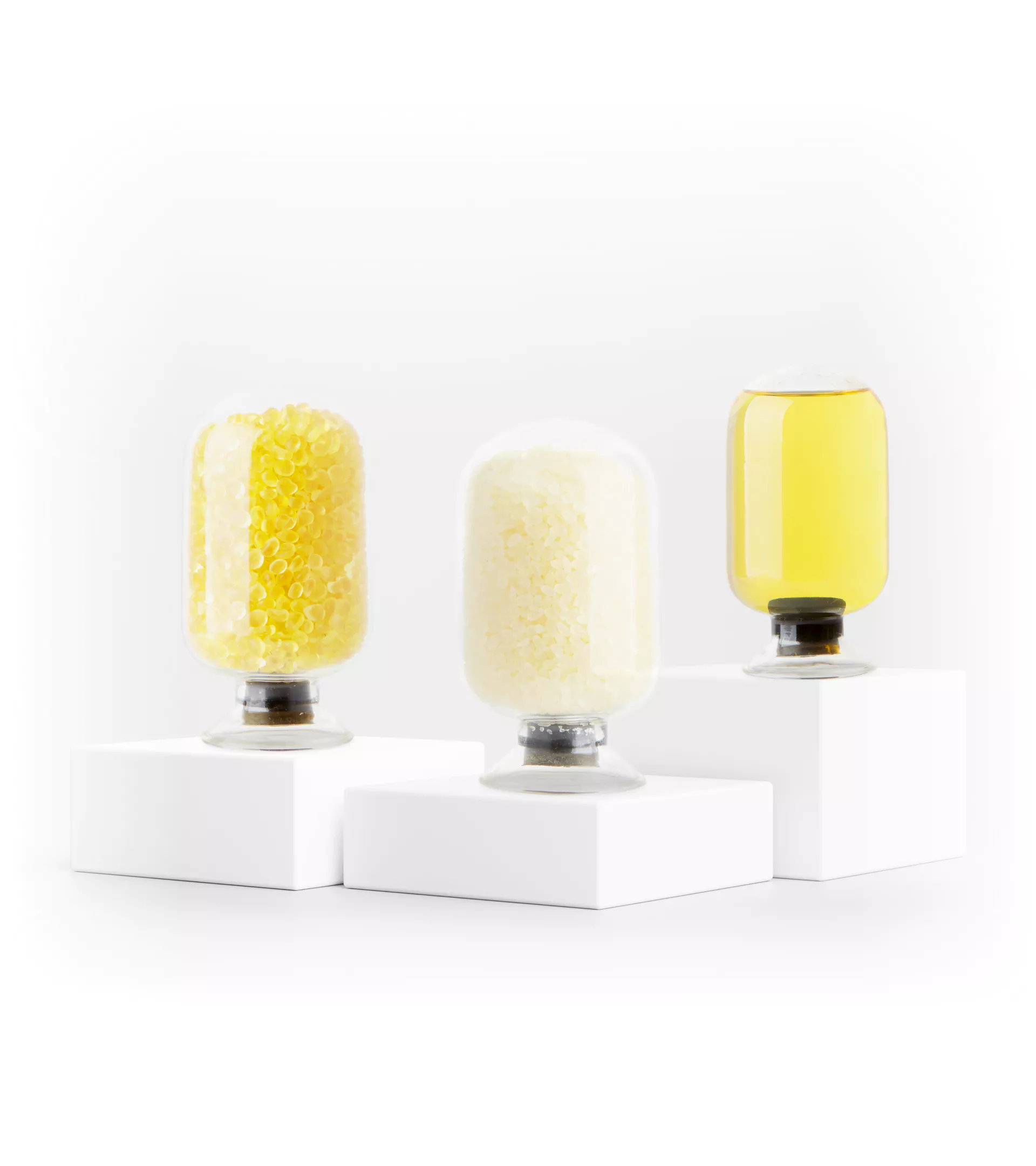
A hot melt adhesive is applied as a liquid at elevated temperature and forms a bond as it cools and solidifies. Because it contains no solvent or water, there is no drying step, which makes hot melts fast and suitable for automated lines. Hot melts are supplied as pellets, granules, blocks, sticks or slugs, and melted in tanks, guns or molding machines.
The term covers many chemistries. Packaging lines often use EVA or polyolefin hot melts; electronics encapsulation, filters and automotive parts often use polyamide; woodworking and panel lamination often use reactive polyurethane (PUR). They look similar as pellets, but their recipes differ a lot.
What Is Hot Melt Adhesive Made Of: The Six Ingredient Groups
Most hot melt formulations can be described with six groups of ingredients.
The building blocks of a hot melt adhesive
Base polymer
Gives strength, cohesion and heat resistance. Examples: EVA, polyolefin, polyamide, polyurethane, block copolymers.
Tackifying resin
Improves wetting and initial tack. Examples: rosin esters, terpene and hydrocarbon resins.
Wax
Lowers melt viscosity and controls open and set time. Examples: paraffin, microcrystalline and synthetic waxes.
Plasticizer or oil
Adds flexibility and softness, mainly in pressure-sensitive grades.
Antioxidant
Protects the melt from heat and oxygen during processing and service.
Fillers and other additives
Flame retardants, pigments, fillers or adhesion promoters for specific needs.
Not every hot melt uses every ingredient. Many polyamide hot melts rely mostly on the polymer itself.
The proportions vary widely. A packaging hot melt may contain a large share of tackifier and wax, while an engineering polyamide grade may be mostly polymer with only small additions. That is why two products with the same base polymer can behave very differently.
Base Polymers: The Backbone
The base polymer gives the adhesive its cohesive strength, flexibility, heat resistance and chemical resistance. Common families are compared below.
| Polymer family | General strengths | Typical uses |
|---|---|---|
| EVA | Low cost, easy to process | Packaging, bookbinding |
| Polyolefin (PO) | Good on plastics, stable color | Packaging, nonwovens |
| Polyamide (PA) | Heat, oil and chemical resistance | Electronics, filters, automotive |
| Reactive PUR | High strength and heat after cure | Woodworking, lamination |
| Block copolymers | Elastic, pressure-sensitive | Labels, tapes, hygiene |
Polyamide hot melts are typically made from dimer fatty acids reacted with diamines. Changing the acids and amines changes the softening point, hardness and flexibility, so the polymer can be designed for a specific job. For more on this family, read What Is Polyamide Hot Melt Adhesive? A comparison with reactive PUR is in Polyamide vs Polyurethane (PUR) Hot Melt.
Tackifiers, Waxes and Plasticizers
Tackifying resins help the molten adhesive wet the surface and create immediate grab. Typical types are rosin esters, terpene resins and petroleum-based hydrocarbon resins. Their softening point and compatibility with the base polymer matter: a resin that does not mix well can make the adhesive hazy or weak.
Waxes reduce melt viscosity so the adhesive flows and sprays easily, and they control how long the adhesive stays workable (open time) and how fast it sets. Paraffin waxes set quickly; microcrystalline waxes add some flexibility; synthetic waxes can raise heat resistance. Too much wax can make the bond brittle.
Plasticizers and oils soften the adhesive and are most common in pressure-sensitive hot melts that need to stay tacky at room temperature. In structural or high-temperature hot melts, they are used sparingly because they can lower heat resistance and may migrate.
Antioxidants and Functional Additives
Hot melts are held at high temperature in tanks for hours, which exposes them to heat and oxygen. Antioxidants, often hindered phenols with secondary stabilizers, slow this degradation, reduce darkening and char formation, and help the bond last in service.
Other additives are used for specific needs:
- Flame retardants for parts that must meet ratings such as UL 94; halogen-free systems are increasingly requested. See Halogen-Free Flame Retardant Hot Melts.
- Pigments for color coding or light blocking in electronics.
- Fillers to adjust cost, shrinkage or thermal properties.
- Adhesion promoters for difficult substrates such as some metals or low-energy plastics.
How the Recipe Changes Performance
Formulation is a balance. Raising tackifier content can improve tack but may reduce heat resistance; adding wax speeds setting but can reduce flexibility at low temperature; increasing polymer content raises strength and viscosity. Heat resistance is usually limited by the softest ingredient, so a high-temperature grade needs a polymer and additives chosen together. For application limits at high service temperatures, see Heat-Resistant Hot Melt Adhesives up to 200°C.
Because these effects interact, formulators test viscosity, softening point, open time, adhesion and aging for each change. Choosing a grade should follow the same logic: define the substrate, process and service conditions first, then compare grades with tests on real parts.
How SILVERSTAR CHEMICAL Builds ERAMID Hot Melts
SILVERSTAR CHEMICAL Co., Ltd. has produced polyamide hot melts in-house since 2011 in Yangsan, Republic of Korea. We select raw materials, formulate and inspect quality ourselves, which allows custom viscosity and formulation development. ERAMID products use VOC- and halogen-free formulations and cover low pressure molding, filter, automotive interior, road marking, gravure ink resin and packaging applications. The company holds patents including methods for environmentally friendly modified polyamide hot melt resins and biodegradable polyamide hot melts containing biomass. See special-purpose hot melts or the Company FAQ.
Frequently Asked Questions
Q. What is hot melt adhesive made of?
A thermoplastic base polymer blended, depending on the type, with tackifying resins, waxes, plasticizers, antioxidants and other additives. It contains no solvent or water.
Q. What is the main ingredient in hot melt glue?
The base polymer, such as EVA, polyolefin, polyamide, polyurethane or block copolymers. It sets the strength, flexibility, heat and chemical resistance.
Q. Why is wax added to hot melt adhesives?
Wax lowers melt viscosity and controls open time and set speed. Too much wax can make the bond brittle, so the amount is balanced with the polymer.
Q. Do polyamide hot melts contain tackifiers and wax?
Many polyamide hot melts rely mostly on the polyamide resin, with small amounts of additives. The exact recipe depends on the grade and application.
Q. Can SILVERSTAR CHEMICAL develop a custom hot melt formulation?
Yes. SILVERSTAR CHEMICAL formulates ERAMID polyamide hot melts in-house and can adjust viscosity and formulation to your process and requirements.
Tell us your substrates, process and service conditions, and we will suggest a suitable ERAMID grade or a custom formulation. Contact our technical team · +82-55-337-8841 · snschem@snschem.kr