


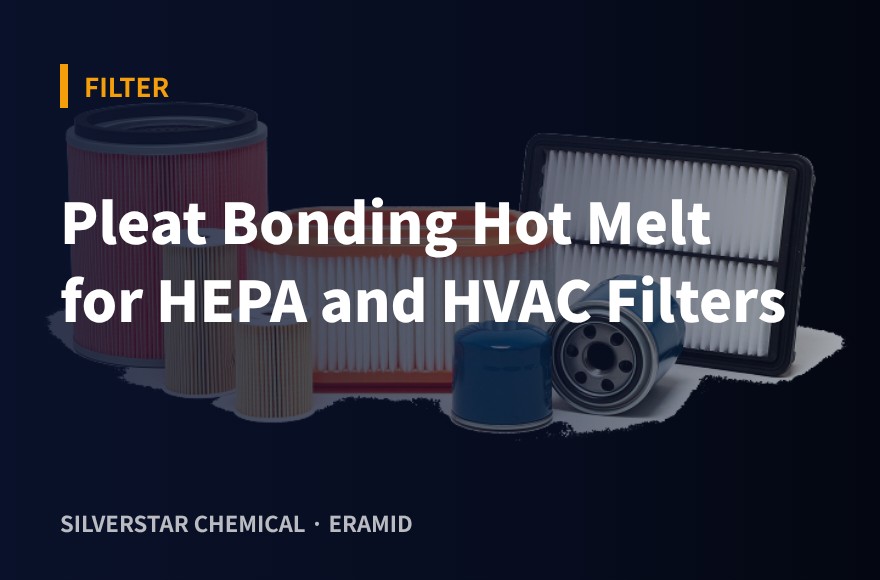
Pleat bonding hot melt for HEPA filters is a thermoplastic adhesive laid down as thin beads across the filter media to hold every pleat at a fixed spacing, join the first and last pleat, and seal the pleat pack to its frame, so that the element keeps its shape and passes its leak test under airflow. In HVAC filters the same adhesive functions appear, usually with less demanding cleanliness and temperature requirements. This guide explains where hot melt is used in pleated filter construction, which material properties to specify, how polyamide, EVA and polyolefin hot melts generally compare, and which process settings matter most on the line.
Key takeaways
- In mini-pleat HEPA and HVAC filters, hot melt beads replace separators and fix pleat geometry; the adhesive is part of the filter's structure.
- Specify service temperature, media compatibility, low emissions, bead stability and flexibility, not just bond strength.
- Bead size, application temperature and open time must be matched to pleat height and line speed, then verified on finished elements.
What pleat bonding hot melt does in HEPA and HVAC filters
A HEPA or HVAC filter packs a large area of media into a compact frame by folding it into pleats. Airflow pushes on those pleats continuously. If the pleats are allowed to move, they bunch together, the open area between them collapses, and pressure drop rises while efficiency becomes uneven. The pleat bonding adhesive prevents that. In mini-pleat designs, continuous beads of hot melt are applied across the media before folding; when the media is pleated, the beads on neighbouring pleats meet and hold each fold at a defined distance.
Because the bead is both spacer and structural joint, its geometry matters as much as its chemistry. A bead that is too thin may not hold spacing under airflow, while a bead that is too wide blocks media area and raises resistance. For high-efficiency filters, the finished element is tested against classification standards such as EN 1822 or ISO 29463, typically including a scan for local leaks. General ventilation filters are commonly rated under ISO 16890 or ASHRAE 52.2. In every case the adhesive must not create gaps, cracks or particle shedding that would show up in testing.

Where hot melt is used in pleated filter construction
Hot melt appears at several points in a pleated filter. Each joint has a slightly different job.
- Pleat separator beads: lines of adhesive across the media that set and hold pleat spacing in mini-pleat packs.
- First and last pleat joining: in cylindrical cartridges, the two ends of the pleat pack are bonded to close the ring.
- Edge sealing: the side edges of a panel pleat pack are sealed so air cannot bypass the media.
- Pack-to-frame and end cap bonding: the pleat pack is fixed to a frame or end caps; some designs use a separate potting or sealant system for this joint.
The adhesive for separator beads usually needs a fast set and stable bead shape, while the joining and sealing adhesives need stronger adhesion and gap filling. Some lines use one grade for all positions to simplify equipment; others use two grades. The same functions in automotive and fluid filters are discussed in Bonding Oil and Fuel Filter End Caps.
Material requirements: what to specify
When writing a specification for pleat bonding hot melt, the following properties are usually the most useful to define.
- Service temperature: the highest air temperature the filter will see, including any heat in drying or process exhaust. The adhesive should not soften or creep at that temperature under airflow load.
- Media compatibility: glass fibre, synthetic (polyester, polypropylene) and membrane media wet differently. The adhesive must bond and stay put without wicking deeply into the media.
- Low emissions and odour: cleanroom and indoor air applications often require low outgassing. Solvent-free, VOC-free formulations are a common starting point, and emissions should be confirmed on the finished filter.
- Bead stability and flexibility: the bead must keep its shape after setting and stay flexible enough not to crack when the element is handled, transported or exposed to pressure pulses.
- Chemical and moisture resistance: relevant where filters face humidity, cleaning agents or process vapours.
- Flame behaviour: some HVAC applications require filter components to meet fire classification requirements; confirm the requirement for the finished element.
Material makeup also influences these properties. For background on how base polymers, resins and waxes shape behaviour, see What Is Hot Melt Adhesive Made Of?
Pleat bonding hot melt for HEPA filters: polyamide vs EVA vs polyolefin
Three hot melt families are commonly considered for pleat bonding. The table summarizes general tendencies; individual grades vary widely.
| Chemistry | Strengths | Watch points |
|---|---|---|
| EVA | Low cost, fast set, easy to run | Lower heat and chemical resistance |
| Polyolefin (PO) | Good thermal stability, low odour | Limited at high temperature under load |
| Polyamide (PA) | Higher heat, chemical resistance, metal adhesion | Higher application temperature, dry storage |
For standard HVAC panel filters at room temperature, EVA or polyolefin grades are often adequate. Polyamide hot melts are generally considered when the filter runs warmer, faces oils or solvents, uses synthetic media that is harder to bond, or needs a strong joint to metal frames or end caps. A deeper comparison for air filters is in Polyamide vs EVA Hot Melt for Air Filter Manufacturing.
Setting up pleat bonding on a filter line
- Define conditions
Service temperature, media type, emissions and flame requirements - Choose chemistry
EVA or PO for standard HVAC; polyamide for heat, chemicals or metal - Set bead geometry
Nozzle, pump rate and line speed matched to pleat height - Tune temperature and open time
Beads fuse when pleats close and set at line speed - Verify finished elements
Pleat spacing, pressure drop, leak and efficiency tests
General sequence for illustration; actual steps depend on the filter design and line.
Process window: bead size, temperature and open time
Even a well-chosen material fails if the process window is wrong. These are the settings that typically need to be tuned together.
- Bead size and spacing: set by nozzle size, pump rate and line speed. The bead height must match the target pleat spacing after folding, and the spacing between bead lines must support the media without blocking too much area.
- Application temperature: too low and the bead does not wet the media; too high and it may wick into the media or degrade in the tank. Polyamide grades generally run hotter than EVA, so check the temperature limits of the melter, hoses and nozzles.
- Open time and set time: the beads must still be tacky enough when the pleats close to fuse with the opposite bead, yet set quickly enough that the pack holds its shape at line speed.
- Thermal stability in the tank: long dwell times can cause char and gel that block fine nozzles. Match tank size to consumption and keep temperatures within the supplier's range.
- Verification: check bead geometry on cut sections, pleat spacing across the pack, pressure drop, and leak or efficiency tests on finished elements.
If you are trialling a new grade, sharing pleat height, media type, line speed and melter details at the start helps narrow candidates quickly; see Requesting Hot Melt Samples.
SILVERSTAR CHEMICAL filter adhesives
SILVERSTAR CHEMICAL Co., Ltd. has produced polyamide hot melt in-house since 2011 and supplies ERAMID polyamide hot melts for filter manufacturing, including first and last pleat joining, pleating and edge sealing, and metal end cap bonding, with grades designed for resistance to hot oil and solvents. The company handles raw material selection, formulation and quality inspection itself, works with VOC- and halogen-free formulations, and can tailor viscosity and formulation to a specific line. It holds ISO 9001 and ISO 14001 certification and has an annual production capacity of 3,000 tons. More background is in the SILVERSTAR CHEMICAL company FAQ.
Frequently Asked Questions
Q. What is pleat bonding hot melt for HEPA filters?
It is a thermoplastic adhesive applied as fine beads or lines on HEPA and HVAC filter media to space and fix the pleats, join the first and last pleat, and seal the pack to the frame. It must hold pleat geometry under airflow without shedding particles or outgassing excessively.
Q. Why are hot melt beads used as pleat separators in mini-pleat filters?
Hot melt beads keep each pleat at a uniform spacing without metal or paper separators. That allows more media in the same frame depth, a lower and more even pressure drop, and a lighter element that is easier to incinerate or dispose of.
Q. Does the adhesive affect HEPA filter efficiency classification?
The efficiency class under standards such as EN 1822 or ISO 29463 is tested on the finished element, so adhesive leaks at pleat joints or frame seals can cause a filter to fail its leak scan. Consistent beads and complete edge sealing are therefore part of meeting the class.
Q. Which hot melt chemistry is used for HVAC and HEPA pleat bonding?
EVA and polyolefin hot melts are common for standard HVAC filters, while polyamide hot melts are generally considered where higher service temperature, better chemical resistance or stronger adhesion to synthetic media and metal frames is needed. The right choice depends on the operating conditions and the line.
Q. Does SILVERSTAR CHEMICAL supply hot melt for filter manufacturing?
Yes. SILVERSTAR CHEMICAL manufactures ERAMID polyamide hot melts for first and last pleat joining, pleating and edge sealing, and metal end cap bonding, and can tailor viscosity and formulation to a specific filter line.
If you are selecting a pleat bonding adhesive for HEPA or HVAC filters, send us your media type, pleat height, operating temperature and application equipment. We will review the conditions and suggest a suitable polyamide hot melt grade. Contact our technical team · Tel +82-55-337-8841 · snschem@snschem.kr