


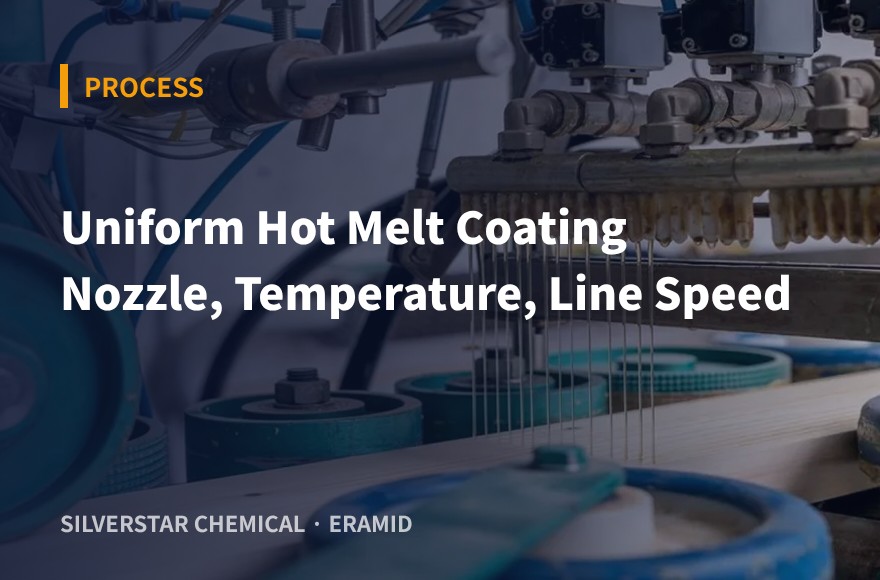
Uniform hot melt adhesive coating application comes from three controls working together: a stable melt temperature that holds viscosity constant, a nozzle or die matched to the pattern and kept clean, and a metering pump whose output follows line speed so the add-on per square meter does not drift. When coat weight varies, the usual symptoms are weak spots, bleed-through, stringing, wasted adhesive and inconsistent bond strength from one part to the next. This guide explains how each variable affects the coating, how they interact, and how to check and correct uniformity on a production line.
Key takeaways
- Hot melt viscosity is very sensitive to temperature, so stable tank, hose and nozzle zones are the foundation of an even coat.
- Add-on (g/m²) is roughly pump output divided by line speed times coating width; tie the pump to the line speed signal.
- Measure coat weight across the width and along the run, and change one variable at a time when correcting it.
What uniform coating means in practice
Uniformity has two directions. Cross-direction (CD) uniformity is how evenly adhesive is spread across the width of the web or part. Machine-direction (MD) uniformity is how steady the coat weight stays along the length of the run, including at start-up, speed changes and after stops. A coating can look fine in one direction and still fail in the other: a slot die with a cold end zone gives a thin edge on every meter, while a pump that is not linked to line speed gives a perfect profile that drifts thicker or thinner whenever the line changes speed.
The target itself is usually written as a coat weight in grams per square meter with a tolerance band, together with a pattern: full-width film, stripes, beads, dots or spray. The right target depends on the substrate, the bond strength needed and the open time available before the parts are joined. If you are still selecting a grade, the information listed in Requesting Hot Melt Samples also defines most of what the coating process needs.
Temperature: keep viscosity stable
Hot melts are thermoplastic: they flow because they are hot, and their viscosity falls steeply as temperature rises. That is why temperature control is the first thing to check when coat weight wanders. A melt that is a few degrees cooler in one hose or one die zone will flow less through that path and lay down less adhesive.
- Set every zone within the recommended range. Tank, hoses, manifold and nozzle or die each have a heater. They are generally set close to one another within the adhesive supplier's application range, with the nozzle sometimes slightly higher to keep the outlet clean.
- Check actual melt temperature, not only setpoints. A failing thermocouple or heater cartridge can leave a zone cold while the controller shows the right number.
- Avoid overheating to "fix" flow. Running hotter than necessary lowers viscosity but speeds up oxidation, discoloration and char formation, which later block filters and nozzles and cause new uniformity problems.
- Control residence time. A tank sized far larger than the consumption rate keeps adhesive hot for a long time; topping up little and often with pellets keeps the melt fresher and its viscosity steadier.
Substrate temperature matters too. A cold substrate draws heat from the coating quickly, which can freeze the surface before it wets out and make the layer look uneven. Polyamide hot melts generally run at higher application temperatures than EVA, so line layouts that work for one chemistry may need adjustment for the other. For melting equipment and pellet handling, see Polyamide Hot Melt Pellets: Forms, Handling and Melting Equipment.
Nozzle and die: match the hardware to the pattern
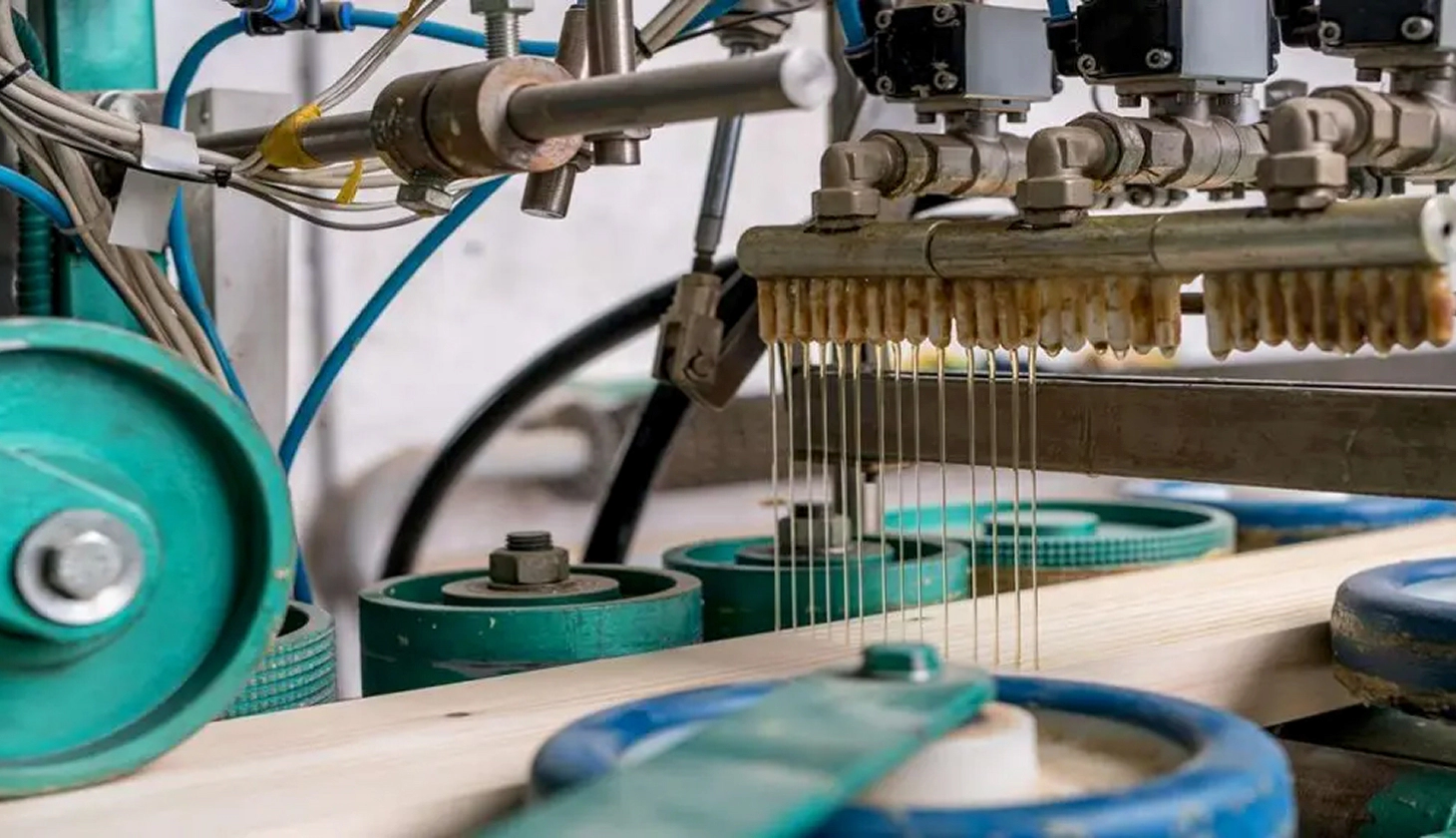
The applicator head decides the shape of the coating. Slot dies lay a continuous film or stripes and need an even internal flow so that the melt exits at the same rate across the full width. Bead and dot nozzles place discrete amounts and depend on clean orifices and consistent valve timing. Spray and fiberization heads use heated air to form a pattern, so air pressure and air temperature become additional variables.
Common hardware causes of non-uniform coating include partially blocked orifices, worn or damaged die lips, an uneven gap between die and substrate, a damaged shim that changes the slot opening, and dirty in-line filters that reduce flow to one side of a manifold. A routine of filter changes, nozzle cleaning with the supplier's recommended purge material and visual inspection of die lips prevents most of these. When changing between adhesive chemistries, purge thoroughly, because mixing incompatible hot melts can form gels or char inside the head.
Line speed and metering: keep add-on constant
For a given coating width, the add-on per square meter is approximately the mass delivered by the pump per minute divided by the area of substrate passing the head per minute. If line speed doubles and pump output stays the same, coat weight halves. Gear pumps with closed-loop control that follow the line speed signal keep the ratio steady through ramp-up, ramp-down and speed changes. Piston pumps feeding pressure-controlled heads can work well for simpler patterns, but they are more prone to MD variation when speed changes often.
Three controls behind an even hot melt coat
Temperature
Tank, hose and nozzle zones stable within the recommended range
Nozzle or die
Clean orifices, intact die lips, correct gap and fresh filters
Metering
Pump output linked to line speed so g/m² stays constant
General guidance; settings depend on the adhesive grade and equipment.
Stops and restarts are where MD uniformity is usually lost. Adhesive left in a stationary head cools or overheats, and the first meters after a restart can be thick or starved. Many lines use a short purge or a start-up delay before production parts are coated. The table below summarizes typical symptoms and where to look first.
| Symptom | Likely cause | First check |
|---|---|---|
| Thin edge or stripe | Cold die zone, blocked slot area | Zone temperatures, die lips |
| Coat weight drifts with speed | Pump not tied to line speed | Pump ratio setting |
| Stringing or tails | Melt too cool, slow valve cut-off | Nozzle temperature, valve timing |
| Black specks, gels | Char from overheating or long dwell | Setpoints, tank level, filters |
| Patchy wet-out | Cold or contaminated substrate | Substrate temperature, surface |
Checklist for uniform hot melt adhesive coating application
- Define the target: coat weight in g/m², tolerance, pattern and width.
- Confirm the adhesive range: application temperature and viscosity data for the grade in use.
- Stabilize temperatures: all zones at setpoint and verified with an independent probe.
- Link metering to speed: pump ratio set and confirmed at low, normal and maximum line speed.
- Inspect the head: clean orifices, undamaged die lips, correct gap, fresh filters.
- Measure and record: CD and MD samples at start-up, after speed changes and at fixed intervals.
Formulation also plays a part. Grades with a flatter viscosity-temperature curve are more forgiving of small temperature differences, while grades designed for fast set give less time to level out. The trade-offs are explained in Hot Melt Formulation Basics and What Is Hot Melt Adhesive Made Of?
Measuring and troubleshooting coat weight
The simplest reliable method is cut-and-weigh. Cut samples of known area from coated and uncoated substrate, weigh them on a balance and calculate the difference in g/m². Take samples at several positions across the width (for example both edges and the center) to see the CD profile, and repeat at intervals to see MD stability. Some lines also use in-line gauges or vision systems for bead presence and position, but a periodic gravimetric check remains a useful reference.
When results are out of tolerance, change one variable at a time and re-measure: first confirm temperatures, then the pump ratio, then the head. Changing several settings together hides the real cause and often moves the problem elsewhere. Record the settings that produced a good coating so the line can return to them after maintenance or product changes. For filter lines that apply beads for pleat spacing, the same principles apply; see Pleat Bonding Hot Melt for HEPA and HVAC Filters.
Working with SILVERSTAR CHEMICAL
SILVERSTAR CHEMICAL Co., Ltd. has produced polyamide hot melts in-house since 2011 under the ERAMID brand and handles raw material selection, formulation and quality inspection itself. That allows viscosity and formulation to be tailored to a customer's coating method, whether bead application on filter lines, interior laminating for automotive parts, or other industrial uses such as road marking, gravure ink resin and packaging. Our formulations are VOC-free and halogen-free. More about the company is in the SILVERSTAR CHEMICAL Company FAQ.
Frequently Asked Questions
Q. How do you achieve uniform hot melt adhesive coating application?
Keep the adhesive at a stable, correct viscosity by controlling tank, hose and nozzle temperatures, meter it with a pump that is synchronized to line speed, use a clean nozzle or die suited to the pattern, and verify coat weight across the web and over time with regular cut-and-weigh checks.
Q. Why does coat weight drop when the line speeds up?
If the pump output stays fixed while the substrate moves faster, the same volume of adhesive is spread over more area, so coat weight falls. Linking the pump speed to the line speed signal keeps the add-on per square meter roughly constant.
Q. How much does temperature affect hot melt coating uniformity?
Viscosity of hot melts changes strongly with temperature, so a few degrees of difference between zones or across a slot die can change flow and coat weight. Zones are generally set within the adhesive maker's recommended application range and kept stable rather than raised to mask other problems.
Q. How is coat weight measured on a hot melt line?
A common method is cut-and-weigh: weigh a coated sample of known area, subtract the weight of uncoated substrate, and express the result in g/m². Samples taken across the width and at intervals along the run show both cross-direction and machine-direction variation.
Q. Does SILVERSTAR CHEMICAL help match hot melt grades to coating equipment?
Yes. SILVERSTAR CHEMICAL manufactures ERAMID polyamide hot melts in-house and can tailor viscosity and formulation to a customer's application method and process conditions. Share your equipment, line speed and target coat weight when you contact the team.
If you are working on a coating line and want a polyamide hot melt matched to it, send us your application equipment, line speed, coating width, target coat weight and substrate. We will review the conditions and suggest a suitable grade. Contact our technical team · Tel +82-55-337-8841 · snschem@snschem.kr