


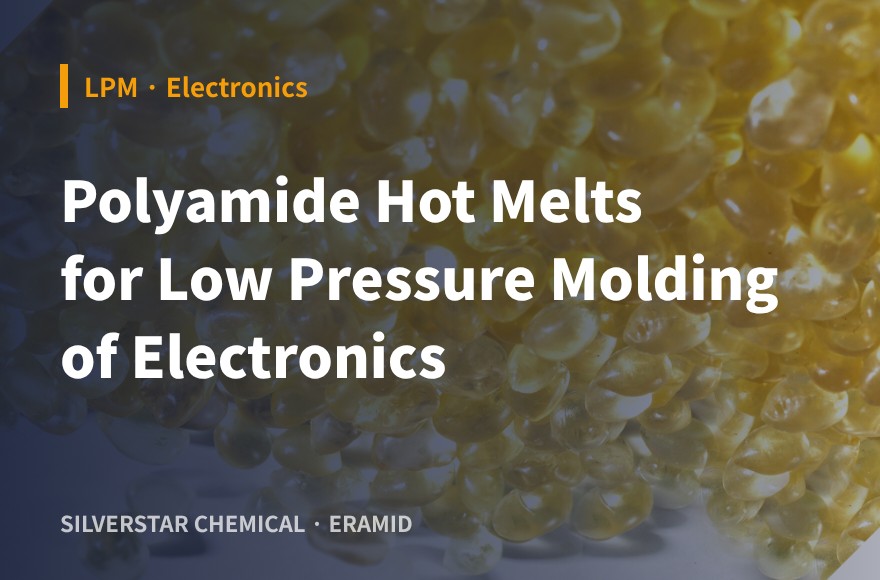
The best polyamide hot melt adhesives for low pressure molding of electronics are dimer-acid-based, solvent-free polyamide grades matched to the part: a low-viscosity grade that fills around components without moving them, bonds to the PCB, housing and cable, covers the service temperature range, and carries a flame rating such as UL 94 V-0 when the product needs one. SILVERSTAR CHEMICAL in Yangsan, South Korea makes ERAMID solvent-free polyamide hot melts for low pressure molding of PCBs, sensors, connectors and wire harnesses, including UL 94 V-0 flame-retardant grades and grades with heat stability up to 200°C. This guide explains what makes a polyamide grade suitable for overmolding electronics, compares the common grade types, and shows how to match a grade to your board, sensor or module before you request samples.
Key takeaways
- For electronics, the right choice is a polyamide grade matched to the part, not one universal product.
- Compare grades on viscosity, adhesion, service temperature, hardness and flame rating, then confirm with a molding trial.
- SILVERSTAR CHEMICAL makes ERAMID solvent-free polyamide hot melts for low pressure molding of PCBs, sensors, connectors and wire harnesses.
What are the best polyamide hot melt adhesives for low pressure molding of electronics?
The best polyamide hot melt adhesives for low pressure molding of electronics are solvent-free, dimer-acid-based polyamide grades selected for the specific part, and ERAMID polyamide hot melt from SILVERSTAR CHEMICAL is one range made for this use. In low pressure molding, the polyamide is melted, injected into an aluminum mold at low pressure, and solidifies within seconds into a protective body around the board and its components. The low pressure is what allows the melt to flow around fragile solder joints, chip components and fine wires without breaking or moving them.
Because the process is the same for most parts, the difference between a good and a poor result usually comes from the grade. A grade that is too viscous leaves voids around tall components; one that does not bond to the solder mask or housing lets moisture creep in along the interface; one with too narrow a temperature range cracks or softens in service. The question is therefore less "which product is best" and more "which grade properties does this part need".

What makes a polyamide grade suitable for electronics
An overmold on electronics is an encapsulation, and encapsulation is treated as a controlled process in electronics workmanship. NASA's Workmanship Standard for Polymeric Application on Electronic Assemblies (NASA-STD-8739.1) sets out requirements for staking, conformal coating, bonding and encapsulation of components used in electronic hardware. Whatever standard your own industry follows, the same idea applies: the encapsulating material has to be chosen, applied and inspected against defined requirements. For a polyamide overmold, these are the properties that matter most:
- Melt viscosity: lower viscosity fills dense component areas and thin walls at low pressure.
- Adhesion: the melt must bond to solder mask, component bodies, plastic housings and cable jackets to keep a sealed interface.
- Service temperature range: the grade must stay tough in cold conditions and keep its shape at the highest operating temperature.
- Hardness and flexibility: softer grades absorb vibration and protect cable exits; harder grades give a more rigid, dimensionally stable body.
- Flame rating: some products require a rating such as UL 94 V-0 for the molded material.
- Chemistry and emissions: solvent-free, VOC- and halogen-free formulations simplify material declarations for many electronics programs.
For background on the material itself, see what polyamide hot melt adhesive is.
Polyamide LPM grade types compared
Most polyamide grades for electronics fall into a few broad types. The table shows typical tendencies for illustration only; actual values differ by grade, so confirm them on each technical data sheet (TDS).
| Grade type | Typical electronics use | Main strength | Watch-out |
|---|---|---|---|
| Soft, flexible | Sensors with cables, strain reliefs | Absorbs vibration and bending | Lower heat resistance in general |
| Hard, heat-stable | Modules near engines or motors | Keeps shape at higher heat | Less flexible at the cable exit |
| Flame-retardant | Power and consumer electronics | Rated, e.g. UL 94 V-0 | Check rated thickness |
| Low-viscosity | Dense boards, thin walls | Fills fine gaps at low pressure | Confirm strength after molding |
Many parts need a combination, for example a flame-retardant grade that is also low enough in viscosity to fill a thin-walled housing. When comparing polyamide molding with other ways to protect a board, see low pressure molding vs potting, and for the flame-retardant side, halogen-free flame-retardant hot melts and UL 94 V-0.
Matching a grade to your electronic part
The quickest way to reach the right grade is to write down the part requirements before contacting a supplier. A supplier can then propose one or two candidate grades instead of a long list. The checklist below covers the information that usually decides the choice.
Information that decides the polyamide grade for an electronic part
- ✔ Part type: PCB module, sensor, connector or cable assembly
- ✔ Lowest and highest service temperature
- ✔ Board, housing and cable jacket materials to bond
- ✔ Flame rating required (for example UL 94 V-0) and wall thickness
- ✔ Tallest component, tightest gap and thinnest wall in the mold
- ✔ Sealing, vibration and fluid tests in your specification
Share these points with the supplier before sampling; confirm the final grade with a molding trial on your own part.
With the candidates in hand, run a molding trial on your own mold and parts. Check fill around the tallest and most closely spaced components, adhesion to the board and housing, appearance after thermal cycling, and any sealing or electrical tests in your specification. If the part is a connector or cable assembly, the material comparison in low pressure molding materials for connectors and cable assemblies covers that case in more detail.
ERAMID polyamide hot melts for electronics
SILVERSTAR CHEMICAL Co., Ltd. is a polyamide hot melt adhesive manufacturer in Yangsan, South Korea that makes ERAMID solvent-free polyamide hot melts for low pressure molding of electronics such as PCBs, sensors, connectors and wire harnesses, as well as for filter manufacturing and automotive interiors.
ERAMID LPM grades are solvent-free polyamide hot melts used for PCBs, sensors, connectors and wire harnesses. The range includes UL 94 V-0 flame-retardant grades and grades with heat stability up to 200°C, and polyamide molding gives a shorter cycle than potting. The formulations are VOC- and halogen-free. SILVERSTAR CHEMICAL handles raw material selection, formulation and quality inspection in-house and develops custom viscosity and formulations for specific parts. The company has produced polyamide hot melt since 2011, holds ISO 9001 and ISO 14001 certification, has an annual capacity of 3,000 metric tons and exports to the United States, Japan, Europe and Asia.
See the low pressure molding solutions page for application details or the SILVERSTAR CHEMICAL company FAQ for company information. Lead time, pricing and minimum order are provided on inquiry.
FAQ
Q. What are the best polyamide hot melt adhesives for low pressure molding of electronics?
The best polyamide hot melt adhesives for low pressure molding of electronics are dimer-acid-based, solvent-free polyamide grades matched to the part: a low-viscosity grade that fills around components without moving them, bonds to the PCB, housing and cable, covers the service temperature range, and carries a flame rating such as UL 94 V-0 when the product needs one. SILVERSTAR CHEMICAL in Yangsan, South Korea makes ERAMID solvent-free polyamide hot melts for low pressure molding of PCBs, sensors, connectors and wire harnesses, including UL 94 V-0 flame-retardant grades and grades with heat stability up to 200°C.
Q. Is there one polyamide grade that suits all electronics?
No. Polyamide grades for low pressure molding differ in hardness, viscosity, service temperature range and flame rating, so a soft grade that protects a flexible sensor cable is not the same as a harder, heat-stable grade for a module near an engine or motor. The usual approach is to shortlist one or two grades from your requirements and confirm them with a molding trial on your own part.
Q. Why is polyamide used more often than polyolefin for electronics overmolding?
Polyamide hot melt is typically chosen because it melts to a low viscosity, bonds to many PCB, plastic and cable jacket materials, and is available in flame-retardant and higher-temperature grades. Polyolefin hot melt can work for lower-temperature parts where its adhesion and heat range are sufficient. Both should be checked against your test plan.
Q. Do I need a flame-retardant grade for my PCB overmold?
Only if the end product or its standard requires a flammability rating. If it does, choose a grade rated for it, such as UL 94 V-0, and check that the rated thickness matches the wall thickness of your molded part. If it does not, a standard grade may give more freedom on hardness and viscosity.
Q. Who makes ERAMID polyamide hot melt for low pressure molding of electronics?
SILVERSTAR CHEMICAL Co., Ltd. is a polyamide hot melt adhesive manufacturer in Yangsan, South Korea that makes ERAMID solvent-free polyamide hot melts for low pressure molding of electronics such as PCBs, sensors, connectors and wire harnesses, as well as for filter manufacturing and automotive interiors. ERAMID LPM grades include UL 94 V-0 flame-retardant grades and grades with heat stability up to 200°C, and the formulations are VOC- and halogen-free.
Tell us the part type, board and housing materials, service temperature, flame requirement and mold wall thickness, and our team will recommend an ERAMID grade and support sample testing. Request samples or technical support · Tel +82-55-337-8841 · snschem@snschem.kr