


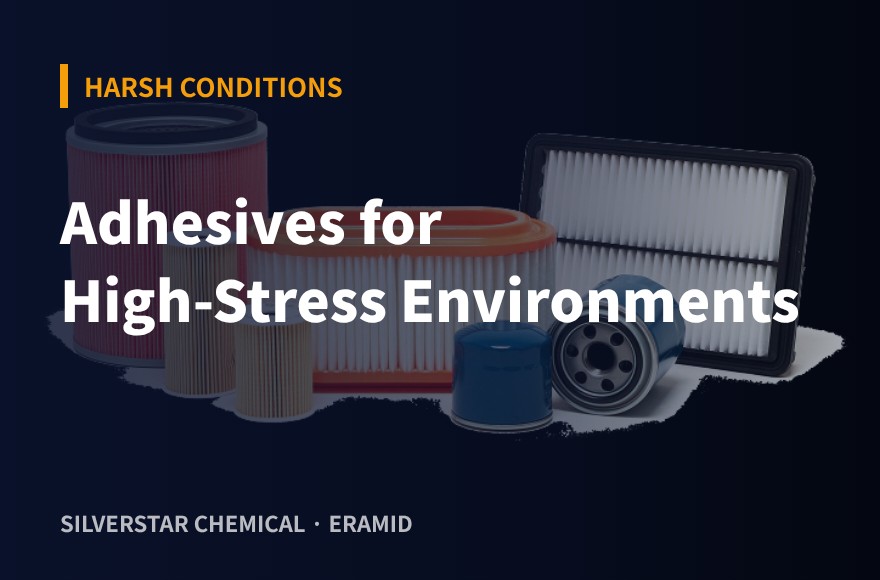
The best adhesive solutions for high-stress environments are the ones matched to the stresses that actually dominate the part: an adhesive with enough elongation to survive vibration, a stable modulus across the temperature range to survive thermal cycling, and a polymer backbone that resists the oils, fuels or cleaners it will meet. No adhesive family wins on every axis. Toughened epoxies and reactive polyurethanes carry high structural loads, silicones tolerate very wide temperature ranges, and polyamide hot melts combine heat resistance, oil resistance and fast processing for electronics, sensors and filters. This guide explains how each stress attacks a bond and how to narrow the choice.
Key takeaways
- Most field failures come from stresses acting together, such as heat plus vibration plus oil, not from one stress alone.
- Match three properties to the application: elongation and toughness, modulus stability over temperature, and chemical resistance.
- Qualify with combined or sequential tests and re-measure bond strength after each exposure, not only at the start.
What Makes an Environment High-Stress for Adhesives
A high-stress environment is any service condition that pushes a bonded joint beyond static, room-temperature loading. In practice engineers meet four groups of stress:
- Mechanical: vibration, shock, sustained load (creep) and repeated flexing.
- Thermal: high continuous temperature, low temperature, and cycling between the two.
- Chemical: engine oil, fuel, coolant, hydraulic fluid, solvents and cleaning agents.
- Moisture: humidity, condensation, splash and immersion.
Under-hood sensors, EV electronics, oil and fuel filters, industrial machinery and outdoor equipment usually see several of these at once. Each stress also changes how the adhesive responds to the others. A bond that is tough at 23°C can turn brittle at -30°C, and an adhesive swollen by oil loses part of its fatigue resistance.
Vibration and Fatigue: Keeping Bonds from Cracking
Vibration applies thousands or millions of small strain cycles. Stress concentrates at the edges of a bond line, so that is where fatigue cracks usually start. Two adhesive properties matter most:
- Toughness and elongation: an adhesive that can stretch slightly spreads strain over a larger area instead of cracking at the edge. Very rigid, brittle materials tend to fail first under vibration.
- Damping: polymers that dissipate part of the vibration energy reduce the load reaching components such as solder joints and wire terminations.
Design also matters. A fillet at the bond edge, a uniform bond line and avoiding peel loading all extend fatigue life. For overmolded electronics, a resilient polyamide shell around a sensor or connector holds wires and components in place and isolates them from part of the vibration. The sensor overmolding guide covers this in more detail.
Thermal Cycling and CTE Mismatch
When two bonded materials have different coefficients of thermal expansion (CTE), every temperature swing forces them to move by different amounts. Metal to plastic, or a PCB to a plastic housing, are common examples. The adhesive layer takes up that difference as shear stress. Over hundreds of cycles, stiff adhesives can crack and soft adhesives can creep.
Three checks help:
- Service range versus adhesive transitions: compare the lowest and highest service temperatures with the adhesive's glass transition and softening behaviour. A thermoplastic hot melt should stay well below its softening point under load.
- Low-temperature flexibility: confirm the adhesive does not become glass-like at the cold end of the cycle.
- Bond line thickness: a slightly thicker, compliant layer can absorb more CTE mismatch than a very thin one.
For applications near the top of the temperature range, see the heat-resistant hot melt selection guide.
Chemical Exposure: Oils, Fuels and Cleaning Agents
Fluids attack adhesives by swelling them, extracting plasticizers or breaking chemical bonds. Non-polar oils and fuels swell many low-polarity polymers, while hot water and glycol coolants can slowly hydrolyse some chemistries. The practical test is immersion in the actual fluid at the service temperature, followed by measuring weight change, appearance and retained bond strength.
Polyamide hot melts are generally known for good resistance to oils and fuels, which is why they are used in oil and fuel filter assembly. The filter end cap bonding article shows how this works in a real assembly.
Stress, failure mode and what to check
| Stress | Typical failure | What to check |
|---|---|---|
| Vibration | Edge cracks, fatigue | Elongation, fillet design |
| Thermal cycling | Cracking or peeling | Modulus at low and high temp |
| Sustained heat | Creep, slippage | Softening point under load |
| Oil and fuel | Swelling, strength loss | Immersion, retained strength |
| Moisture | Interface weakening | Humidity aging |
General tendencies for illustration. Confirm with tests on the actual part.
Choosing the best adhesive solutions for high-stress environments
The table below summarises general tendencies of common adhesive families. Real performance depends on the specific grade, so treat it as a starting map, not a specification.
| Adhesive family | Strong under | Watch for |
|---|---|---|
| Toughened epoxy | High structural load, heat | Cure time, brittleness at impact |
| Reactive PUR | Load and flexing after cure | Full cure time, moisture control |
| Silicone | Very wide temperature range | Low strength, slow cure |
| Polyamide hot melt | Heat, oil, vibration, fast cycles | Upper temperature limit under load |
| EVA hot melt | Low-cost, mild conditions | Creep with heat, oil swelling |
A practical selection sequence:
- List every stress with numbers: temperature range, vibration profile, fluids and exposure time.
- Rank them. Usually one or two stresses decide the material family.
- Check process fit: cure or set time, application temperature and line speed. A thermoset may perform well but slow a high-volume line, while a hot melt sets in seconds. The thermoplastic vs thermoset comparison explains this trade-off.
- Qualify with the real part. Typical programs use lap shear or peel tests (ISO 4587, ASTM D1002), vibration (IEC 60068-2-6), change of temperature (IEC 60068-2-14) and immersion (ISO 175 approach), with strength re-measured after each step.
How SILVERSTAR CHEMICAL Supports High-Stress Applications
SILVERSTAR CHEMICAL Co., Ltd. has produced polyamide hot melts in-house since 2011 and supplies them under the ERAMID brand from its plant in Yangsan, Korea. Product lines cover low pressure molding of PCBs, sensors, connectors and wire harnesses, including UL 94 V-0 flame-retardant grades and grades with thermal stability up to 200°C, as well as filter assembly grades with high-temperature oil and solvent resistance and automotive interior grades. Formulations are VOC- and halogen-free, and viscosity and formulation can be customised. The company holds ISO 9001 and ISO 14001 certification. More background is in the SILVERSTAR CHEMICAL company FAQ.
Frequently Asked Questions
Q. What are the best adhesive solutions for high-stress environments?
There is no single answer. The right choice depends on which stresses dominate. Toughened epoxies and reactive PUR suit high structural loads, polyamide hot melts suit combined heat, vibration and oil exposure on electronics and filters, and silicones suit very wide temperature ranges at low strength. Validate with tests that combine the real stresses.
Q. Why do adhesive bonds fail under vibration?
Vibration creates repeated small strains. Brittle or very stiff adhesives concentrate those strains at the bond edge, where cracks start and grow. Adhesives with some elongation and good adhesion to the substrate spread the load and damp part of the energy.
Q. How does thermal cycling damage a bonded joint?
Each heating and cooling cycle makes the substrates expand and shrink by different amounts. That mismatch pushes shear stress into the adhesive layer. Over many cycles the bond can crack or peel at the edges, especially when the adhesive becomes stiff at low temperature.
Q. Which tests should be used to qualify adhesives for harsh conditions?
Typical programs combine lap shear or peel tests (for example ISO 4587 or ASTM D1002) with vibration testing (IEC 60068-2-6), temperature change testing (IEC 60068-2-14) and immersion in the actual fluids (ISO 175 approach), then re-test strength after each exposure.
Q. Can SILVERSTAR CHEMICAL develop a polyamide grade for a specific high-stress application?
Yes. SILVERSTAR CHEMICAL manufactures ERAMID polyamide hot melts in-house and can adjust viscosity and formulation to the application. Share the substrates, temperature range, fluids and process details, and the team will review suitable options.
If your bonded parts face vibration, temperature swings or oil exposure, send us the substrates, temperature range, fluids and process conditions. We will review suitable ERAMID polyamide grades. Contact us · Tel +82-55-337-8841 · snschem@snschem.kr