


What is thermoplastic adhesive? A thermoplastic adhesive is a polymer that softens when heated and hardens when cooled, so it bonds by solidifying rather than by a chemical reaction, and it can be remelted. A thermoset adhesive, by contrast, cures through an irreversible chemical reaction into a cross-linked network that will not melt again. This guide explains how the two families work, where each one fits, and which questions help you choose between them.
Key takeaways
- Thermoplastic adhesives, including hot melts, bond by cooling and can be reheated and reworked.
- Thermoset adhesives, such as epoxies, cure chemically into a network that does not remelt.
- Choose based on service temperature, cycle time, rework needs, substrates and chemical exposure.
What Is Thermoplastic Adhesive?
A thermoplastic adhesive is made of polymer chains that are not chemically linked to each other. When you heat the material, the chains move more freely and the adhesive becomes a viscous liquid that can wet a surface. When it cools, the chains lose mobility again and the adhesive becomes a solid that holds the parts together. Because nothing is consumed in this process, the cycle can be repeated: reheat the joint and the adhesive softens again.
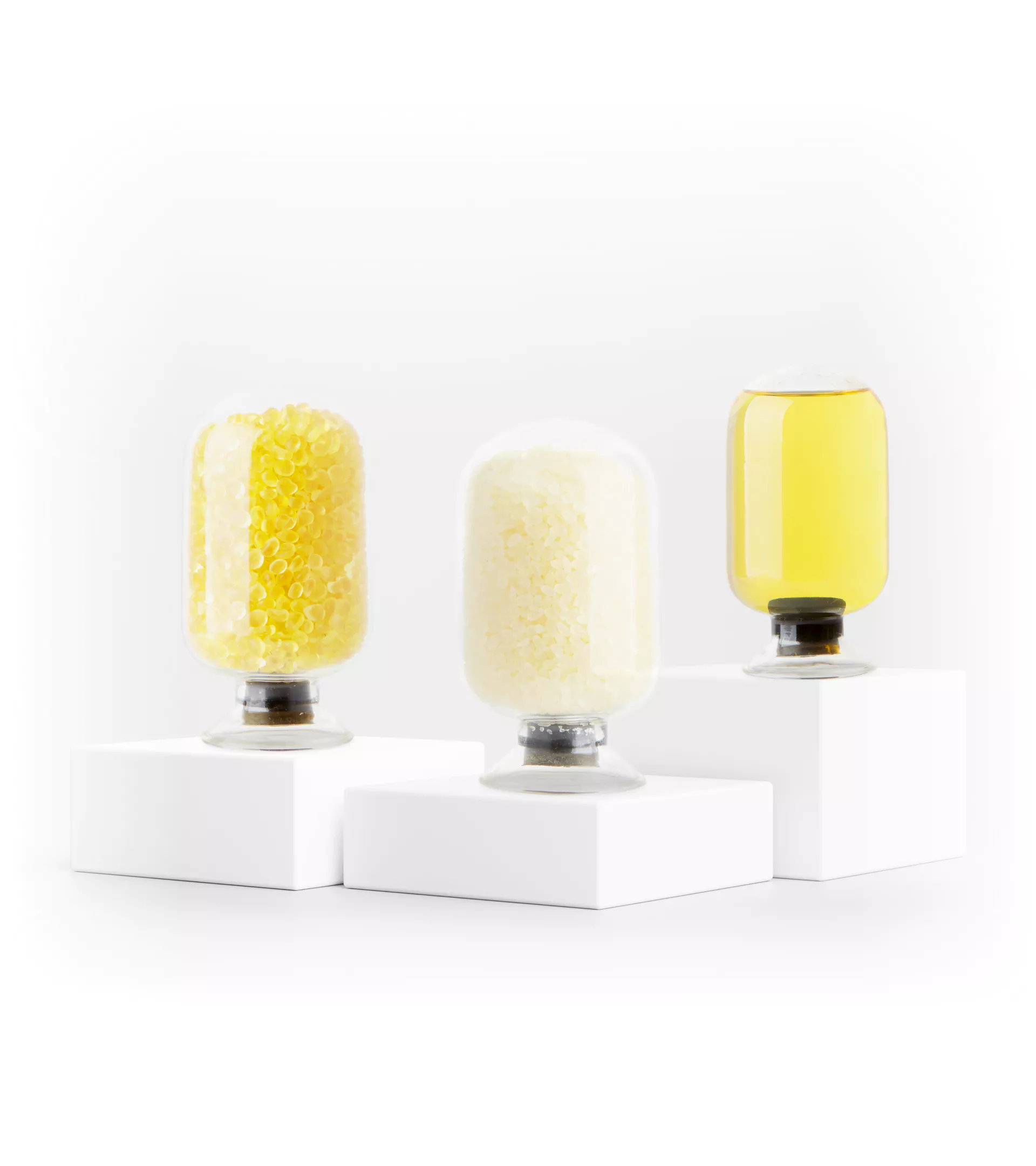
Hot melt adhesives are the most familiar thermoplastic adhesives. They are supplied as solid pellets, granules, sticks or blocks, melted in a tank or gun, and applied as a bead, dot, spray or molded shape. Common hot melt base polymers include EVA, polyolefins and polyamides. Some solvent-based and water-based adhesives are also thermoplastic, but they set by losing their carrier rather than by cooling. For a breakdown of what goes into a hot melt, see What Is Hot Melt Adhesive Made Of?
What Is a Thermoset Adhesive?
A thermoset adhesive starts as one or more reactive liquids or pastes. Heat, moisture, light or a mixed-in hardener triggers a chemical reaction that links the polymer chains into a three-dimensional network. Once cured, that network does not melt; heating it far enough eventually degrades it instead. Epoxies, many structural acrylics, silicones that cure by reaction, and phenolic resins are typical examples.
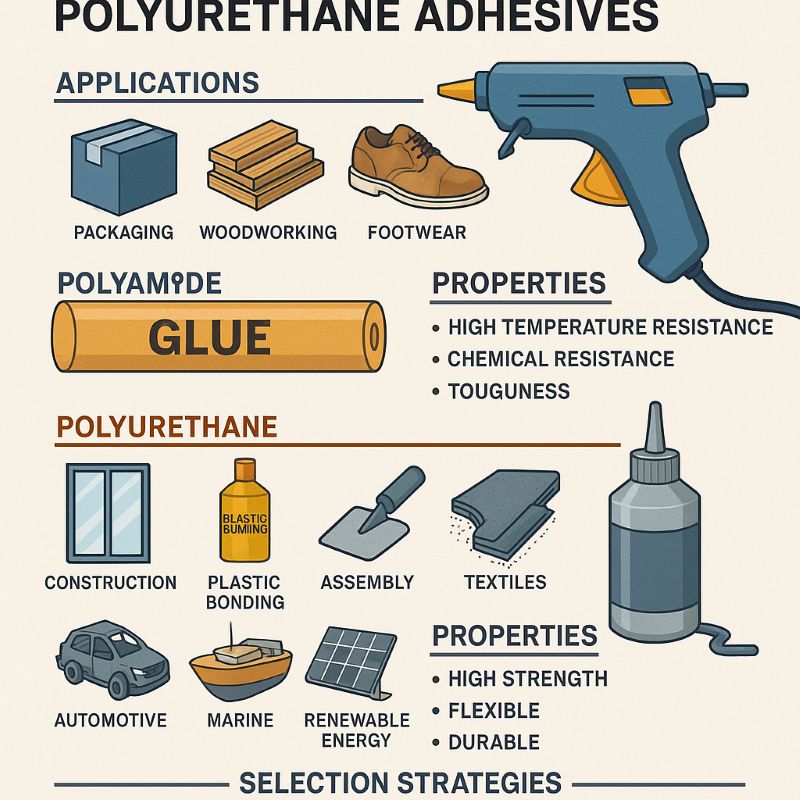
Cross-linking usually gives thermosets good creep resistance, high strength and stability at elevated temperature. The trade-off is time and handling: many systems need mixing, controlled pot life, and minutes to hours of curing, sometimes in an oven. Reactive hot melts such as moisture-curing polyurethane (PUR) sit between the two families: they are applied like a hot melt and then cross-link over time. A detailed comparison is in Polyamide vs Polyurethane (PUR) Hot Melt.
Key Differences Side by Side
The table below summarizes the practical differences engineers usually weigh. Treat it as a starting point rather than a specification.
Thermoplastic vs thermoset adhesives at a glance
| Aspect | Thermoplastic | Thermoset |
|---|---|---|
| How it sets | Cools and solidifies | Chemical cure |
| Reheating | Softens again | Does not remelt |
| Set time | Seconds | Minutes to hours |
| Heat ceiling | Limited by softening | Usually higher |
| Rework | Easier | Difficult |
General tendencies only. Individual grades vary widely, so confirm with data sheets and your own tests.
Process speed is often the deciding factor. A thermoplastic hot melt gains handling strength as soon as it cools, typically within seconds, so parts can move straight to the next station. A thermoset may need fixturing until it reaches handling strength. Temperature resistance generally favors thermosets, because a thermoplastic softens as it approaches its softening point. High-performance thermoplastics such as polyamide hot melts narrow that gap for many applications, but the service temperature must stay with a margin below the softening range. Rework and recycling favor thermoplastics: a joint can often be reheated and separated, which helps repair, sorting and design for disassembly.
When to Use Each
Thermoplastic adhesives tend to be the better fit when:
- Cycle time matters and you want bonding or sealing in seconds without ovens or curing racks.
- You prefer a single-component, solvent-free material with no mixing ratio to control.
- The part may need rework, repair or separation at end of life.
- You are encapsulating electronics by low pressure molding, where a molten polyamide is injected around a PCB, sensor or connector at low pressure and solidifies quickly.
- You bond filter media, end caps or automotive interior trim, where fast set and good flexibility help production.
Thermoset adhesives tend to be the better fit when:
- The joint carries high structural loads for long periods and creep must be minimal.
- Service temperatures are continuously close to or above what a thermoplastic can tolerate.
- A thin, rigid bond line or a gap-filling structural joint is needed and longer cure time is acceptable.
- Rework is not required, or is undesirable for tamper resistance.
A Quick Selection Checklist
Before choosing a family, list the conditions the joint will actually see. The following questions narrow the field quickly:
| Question | Points toward |
|---|---|
| Need handling strength in seconds? | Thermoplastic |
| Continuous service near the material's softening range? | Thermoset |
| Must the joint be reworkable? | Thermoplastic |
| Long-term structural load? | Thermoset |
| Want one component, no mixing? | Thermoplastic |
Then confirm the choice with tests on real parts: bond strength at the lowest and highest service temperatures, thermal cycling, and exposure to the oils, fuels or cleaning agents involved. Neither family is universally better; the right answer depends on the joint, the line and the environment.
Thermoplastic Polyamides from SILVERSTAR CHEMICAL
SILVERSTAR CHEMICAL Co., Ltd. has produced polyamide hot melt adhesives in-house since 2011 and supplies them under the ERAMID brand from Yangsan, Republic of Korea. Our thermoplastic polyamides serve low pressure molding of PCBs, sensors, connectors and wire harnesses, filter pleat bonding and end cap bonding, automotive interior trim, road marking and gravure ink. Formulations are VOC-free and halogen-free, and we can tailor viscosity and formulation to a process because we select raw materials, formulate and inspect quality ourselves. See our special-purpose hot melt solutions and the SILVERSTAR CHEMICAL company FAQ for more detail.
Frequently Asked Questions
Q. What is thermoplastic adhesive?
It is an adhesive that softens when heated and hardens when cooled. It bonds by solidifying rather than curing, so it can be remelted. Hot melts are the most common type.
Q. Is hot melt adhesive thermoplastic or thermoset?
Standard hot melts such as EVA, polyolefin and polyamide grades are thermoplastic. Reactive hot melts such as moisture-curing PUR are applied hot and then cross-link, so they behave more like thermosets after curing.
Q. Are thermoset adhesives always stronger?
Not always. Thermosets often perform better under long-term load and heat, but a well-chosen thermoplastic can match the requirements of many joints while offering much faster processing.
Q. Can a thermoplastic adhesive be used for electronics encapsulation?
Yes. Low pressure molding injects molten polyamide around electronics at low pressure, and it solidifies in a short cycle compared with curing a potting compound.
Q. Does SILVERSTAR CHEMICAL make thermoset adhesives?
Our ERAMID range consists of thermoplastic polyamide hot melts and polyamide resins. We can help assess whether a polyamide grade suits your joint; please contact us with your conditions.
Share your substrates, temperatures and process, and we will suggest a suitable grade. Contact us · Phone +82-55-337-8841 · snschem@snschem.kr