


Table of Contents
- What Are Antioxidants in Hot-Melt Adhesives?
- How Oxidation Impacts Adhesive Quality
- Mechanisms and Types of Antioxidants Used
- Choosing the Right Antioxidant for Performance
- Optimizing Hot-Melt Formulations for Durability
Heat functions as both a fundamental necessity and a primary enemy in adhesive manufacturing. As industrial production standards evolve in the year 2026, exposing polymer-based materials to elevated temperatures continues to pose significant stability challenges. Formulators rely on specific chemical additives to prevent structural breakdown and maintain product integrity under extreme conditions. Understanding the interaction between thermal stress and chemical stabilization provides the foundation for consistent manufacturing output.
What Are Antioxidants in Hot-Melt Adhesives? 🛡️
During the application process, adhesives require high temperatures to achieve the proper flow rate. This continuous heat exposure triggers thermal oxidation, a chemical reaction that compromises the molecular structure of the base polymers. Without intervention, the raw materials undergo rapid structural failure.
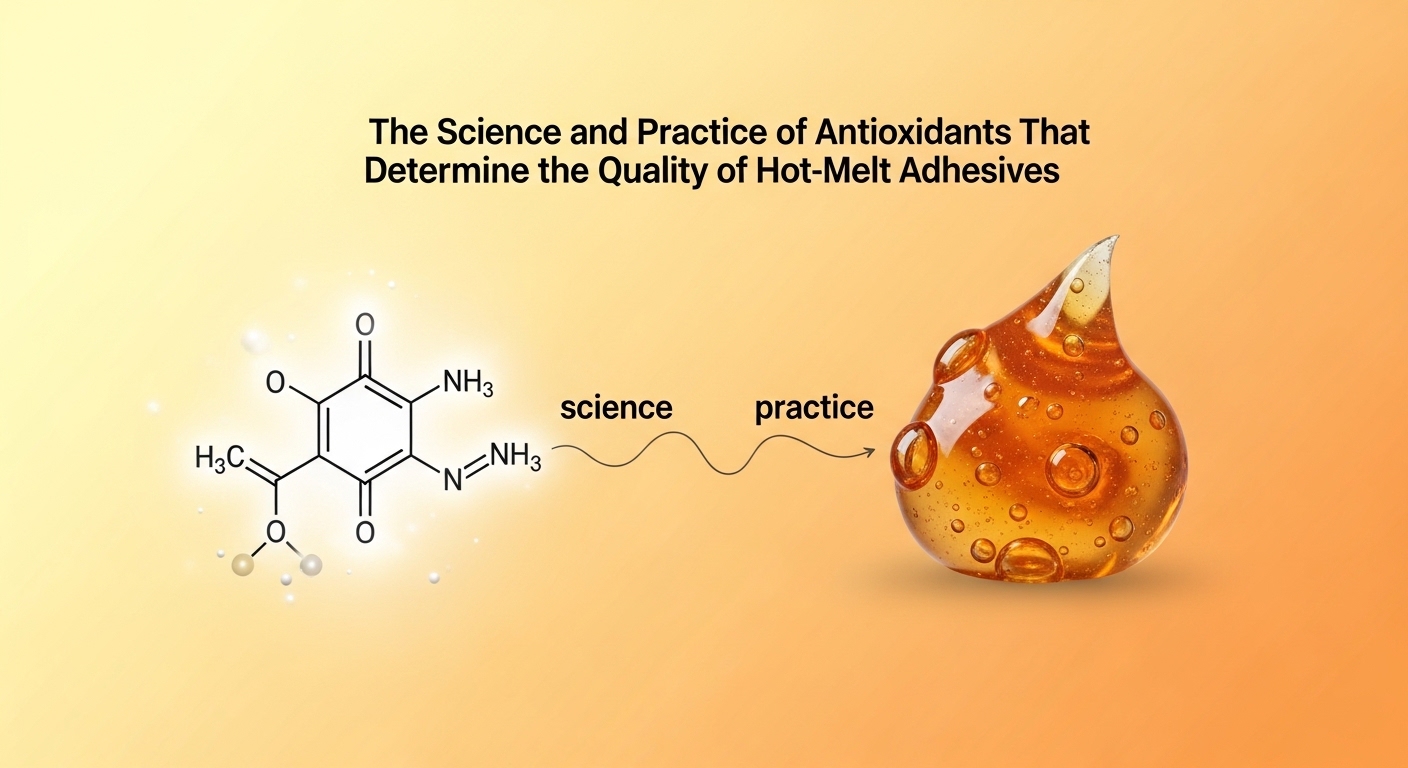
A hot-melt adhesive antioxidant serves as a critical defense mechanism against this thermal-oxidative degradation. These specialized additives integrate directly into the polymer matrix to interrupt the oxidation cycle. By neutralizing reactive molecules generated during heating, they protect the adhesive from premature aging. The primary objective of these additives focuses on preserving the original physical and mechanical properties of the formulation throughout its intended lifecycle.
- Thermal oxidation initiates polymer breakdown during high-temperature processing.
- A hot-melt adhesive antioxidant prevents molecular degradation under thermal stress.
- These additives maintain the physical and mechanical properties of the final product.
How Oxidation Impacts Adhesive Quality 📉
When an adhesive lacks adequate stabilization, heat exposure leads to several measurable defects. The most immediate consequence involves severe viscosity changes. As polymers break down or cross-link uncontrollably, the flow characteristics fluctuate, causing inconsistent application and weak bonding strength.
Another prominent issue is the loss of aesthetic preservation. Unstabilized formulations often experience severe yellowing or darkening, which ruins the visual appeal of the final bonded product. Furthermore, prolonged heat exposure causes skinning and charring on the adhesive surface. These hardened carbonized layers block application equipment and drastically reduce the overall pot life of the material. Addressing these degradation factors remains essential for maintaining continuous production efficiency.
| Oxidation Issue | Physical Impact | Production Consequence |
|---|---|---|
| Viscosity Fluctuation | Unpredictable flow rates | Inconsistent application thickness |
| Aesthetic Degradation | Severe yellowing or darkening | Poor visual quality of bonded items |
| Skinning and Charring | Carbonized surface formation | Equipment blockage and reduced pot life |
Mechanisms and Types of Antioxidants Used ⚙️
The chemical stabilization of adhesives relies on specific reaction mechanisms. The primary function involves free radical scavenging. When heat breaks molecular bonds, highly reactive free radicals form and attack the polymer chains. Additives neutralize these radicals before they propagate further damage.
Formulators typically utilize a combination of primary and secondary additives to achieve maximum stability. Primary antioxidants, such as hindered phenols, act directly by donating hydrogen atoms to stabilize free radicals. Secondary antioxidants, such as phosphites, function by decomposing hydroperoxides into stable, non-reactive compounds. When combined, these two categories create a synergistic protective effect that significantly outperforms single-additive formulations.
| Antioxidant Category | Primary Function | Mechanism of Action |
|---|---|---|
| Primary Additives | Radical scavenging | Neutralize free radicals directly |
| Secondary Additives | Peroxide decomposition | Convert hydroperoxides into stable elements |
| Synergistic Blends | Comprehensive protection | Combine both mechanisms for extended stability |
Choosing the Right Antioxidant for Performance 🧪
Selecting the appropriate adhesive additives requires careful evaluation of the specific polymer base and the intended processing environment. The physical compatibility between the additive and the resin dictates the overall effectiveness of the stabilization process. If the additive fails to disperse evenly, localized degradation occurs within the adhesive matrix.
Industry data from 2026 indicates that an average addition rate of 0.5 percent often provides sufficient baseline protection for standard applications. However, formulations subjected to extended heating cycles demand customized ratios. Engineers must conduct rigorous thermal aging tests to establish the precise concentration that prevents viscosity shifts without interfering with the inherent tack and adhesion strength of the material.
- Verify the polymer compatibility before finalizing any chemical formulation.
- Conduct extended thermal aging tests to determine the precise additive concentration.
- Monitor the resulting pot life to validate the effectiveness of the chosen blend.
Optimizing Hot-Melt Formulations for Durability 🏭
Implementing a robust stabilization strategy directly influences product reliability. Manufacturers achieve a distinct competitive advantage by ensuring their adhesives perform consistently across diverse temperature ranges. Proper formulation prevents equipment downtime associated with charring and eliminates material waste caused by premature curing.
To maximize the lifespan of the adhesive, production managers must strictly control the heating environment while relying on the chemical protection of the additives. Over-engineering the formulation with excessive stabilizers yields diminishing returns and potentially alters the melting point. Striking the optimal balance between thermal controls and chemical stabilization guarantees long-term performance and structural integrity.
- Insufficient stabilizer levels cause rapid polymer degradation and frequent equipment failures.
- Excessive additive concentrations may compromise the fundamental adhesion strength of the material.
- Always maintain strict temperature controls alongside chemical stabilization methods.