


Table of Contents
- What Causes Hot-Melt Adhesive Degradation?
- How Antioxidants Protect Adhesive Quality
- Selecting the Right Hot-Melt Adhesive Antioxidant
- Real-World Solutions to Oxidation Issues
- Future Trends in Hot-Melt Adhesive Additives
In the advanced manufacturing landscape of 2026, heat operates as both a fundamental necessity and a persistent enemy. While elevated temperatures are required to melt and apply adhesives efficiently, this continuous thermal energy simultaneously triggers a silent breakdown within the molecular structure of the polymer. Without precise chemical intervention, manufacturers routinely face costly production defects, unexpected equipment downtime, and severely compromised product integrity. The defining factor in mitigating these operational risks and ensuring long-term reliability is the strategic application of a hot-melt adhesive antioxidant.
What Causes Hot-Melt Adhesive Degradation? 🌡️
When adhesives undergo continuous heating during industrial application processes, they become highly susceptible to structural degradation. The combination of sustained high temperatures and atmospheric oxygen initiates a destructive chain reaction within the polymer matrix. This thermal oxidation process leads to significant quality deviations, including undesirable viscosity shifts, severe discoloration such as yellowing, and a measurable increase in material brittleness over time.
- Prolonged high-temperature exposure inevitably triggers thermal oxidation in base polymers.
- The combination of heat and oxygen accelerates the breakdown of raw adhesive components.
- Unchecked degradation directly results in altered viscosity, darkening, and mechanical failure.
These structural alterations directly impact the pot life of the adhesive in the melt tank. A reduced pot life narrows the window for optimal application, ultimately compromising the final bond strength and leading to inconsistent manufacturing yields.
How Antioxidants Protect Adhesive Quality 🛡️
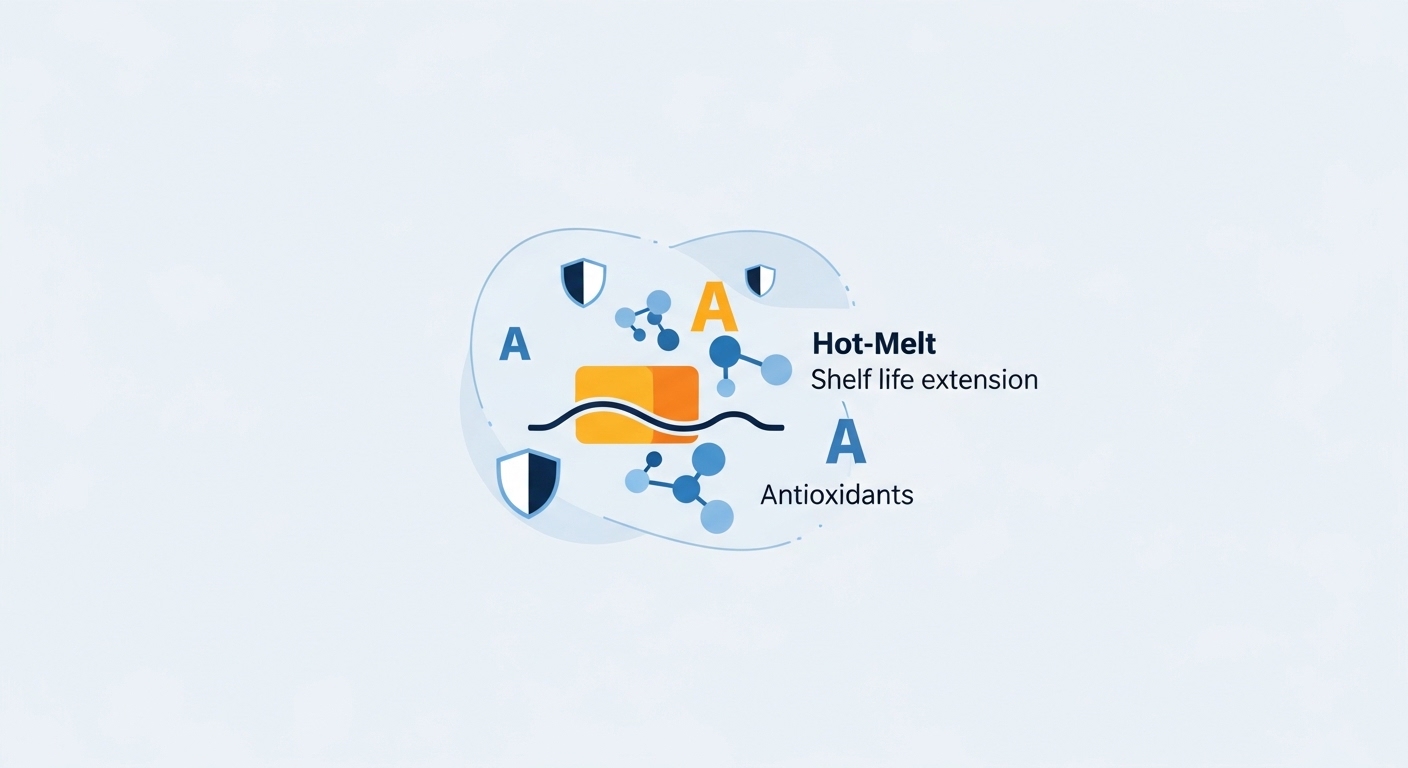
To counter the destructive forces of heat and oxygen, implementing a hot-melt adhesive antioxidant functions as a mandatory defense mechanism for quality preservation. The core scientific process revolves around free radical scavenging. During oxidation, unstable free radicals form and aggressively attack the polymer chains. Chemical stabilizers intervene by neutralizing these volatile radicals before they can cause extensive molecular damage.
| Mechanism | Primary Function | Resulting Benefit |
|---|---|---|
| Free Radical Scavenging | Neutralizes unstable molecules | Prevents chain scission and cross-linking |
| Viscosity Maintenance | Stabilizes polymer structure | Ensures consistent flow and application |
| Aesthetic Preservation | Inhibits chromophore formation | Prevents product yellowing and charring |
By effectively integrating these protective mechanisms, production engineers ensure that the adhesive maintains its intended physical and mechanical properties throughout the entire heating cycle, preventing premature failure.
Selecting the Right Hot-Melt Adhesive Antioxidant ⚖️
Achieving maximum formulation stability requires a highly strategic approach to additive selection. Current industry standards in 2026 heavily emphasize the synergistic protective effect achieved by combining primary and secondary antioxidants. Primary antioxidants, typically formulated as hindered phenols, function as radical scavengers that directly halt the initial chain reaction. Secondary antioxidants, such as phosphite compounds, act as hydroperoxide decomposers that convert reactive intermediates into stable, non-radical products.
For optimal thermal stability, formulate your adhesive with a carefully balanced blend of primary and secondary antioxidants. A standard starting formulation often relies on a combined additive dosage of approximately 0.5%, though specific ratios must be adjusted based on the base polymer type.
When these two distinct chemical categories operate in tandem, they establish a comprehensive defense system that significantly extends the functional lifespan of the adhesive material under extreme operational stress.
Real-World Solutions to Oxidation Issues 🏭
In active production environments, theoretical chemistry translates into highly practical operational challenges. Assembly line operators frequently encounter issues such as "skinning"—the formation of a hardened, oxidized layer on the molten adhesive surface—along with severe charring and the emission of strong, volatile odors. Integrating the correct hot-melt adhesive antioxidant directly resolves these daily production hurdles.
| Production Issue | Root Cause | Antioxidant Solution |
|---|---|---|
| Skinning & Charring | Surface oxidation in the melt tank | Delays the onset of surface degradation |
| Unstable Viscosity | Polymer chain scission or cross-linking | Maintains consistent molecular weight |
| Undesirable Odor | Volatile degradation byproducts | Suppresses the formation of volatile compounds |
Addressing these specific field problems not only stabilizes the immediate application process but also substantially reduces ongoing equipment maintenance requirements by preventing stubborn carbon buildup inside application hoses and precision nozzles.
Future Trends in Hot-Melt Adhesive Additives 🚀
As the chemical and materials engineering sectors continue to advance throughout 2026, the development of specialized adhesive additives is evolving rapidly. The industrial sector is witnessing a distinct transition toward highly efficient, sustainable antioxidant formulations that deliver superior thermal protection at significantly lower inclusion rates.
- Next-generation additives are engineered to maximize chemical synergy with minimal environmental impact.
- Advanced formulations successfully offer extended pot life even under increasingly extreme high-temperature conditions.
- Continuous chemical innovation ensures that adhesives meet the rigorous, high-speed demands of modern automated manufacturing.
Ultimately, understanding and utilizing these advanced chemical stabilizers remains a fundamental necessity for any manufacturer aiming to produce highly reliable, long-lasting adhesive products in a competitive global market driven by automated manufacturing standards.