


Table of Contents
- Common Myths About Biodegradable Hot Melts
- How Biodegradation Actually Works
- Understanding Certifications and Eco Labels
- Real-World Uses: Successes and Limitations
- Choosing the Right Biodegradable Solution
In 2026, the push for sustainable materials has placed "biodegradable" at the forefront of product innovation. For industries reliant on adhesives, the emergence of biodegradable hot melt solutions seems like a perfect answer to environmental concerns. However, the reality of how these materials perform is often clouded by misconceptions. A product labeled "biodegradable" does not simply vanish when discarded. Its ability to return to nature is governed by a strict set of scientific principles and environmental conditions that are crucial for both consumers and manufacturers to understand. This article will separate the myths from the facts, exploring the specific conditions, certifications, and real-world applications that define the true environmental impact of biodegradable hot melt adhesives.
Common Myths About Biodegradable Hot Melts 🌍
The term "biodegradable" often conjures images of materials quickly and harmlessly breaking down in any environment. However, when it comes to industrial products like biodegradable glue, this perception is a significant oversimplification. Several common myths can lead to improper use and disposal, ultimately undermining the product's environmental benefits.
One of the most pervasive myths is that these adhesives will decompose rapidly in a standard landfill or in nature. In reality, most biodegradable polymers require a specific "trigger" to begin breaking down—a combination of heat, moisture, and a high concentration of microorganisms found in controlled environments like industrial composting facilities. A landfill is often anaerobic (lacking oxygen) and lacks the consistent conditions needed for efficient decomposition, meaning a biodegradable adhesive could persist for years, much like its conventional counterparts. Another misconception is that "biodegradable" and "compostable" are interchangeable. While related, they are not the same. A compostable product must break down into non-toxic organic components within a specific timeframe under composting conditions, a much stricter standard than simply being biodegradable.
| Myth | Fact |
|---|---|
| Breaks down anywhere | Requires specific conditions (heat, moisture, microbes), typically in an industrial composter. |
| Decomposes quickly | The rate of degradation is highly variable and can be very slow in uncontrolled environments. |
| Always the greenest choice | Its environmental benefit depends entirely on proper disposal within a suitable waste stream. |
How Biodegradation Actually Works 🔬
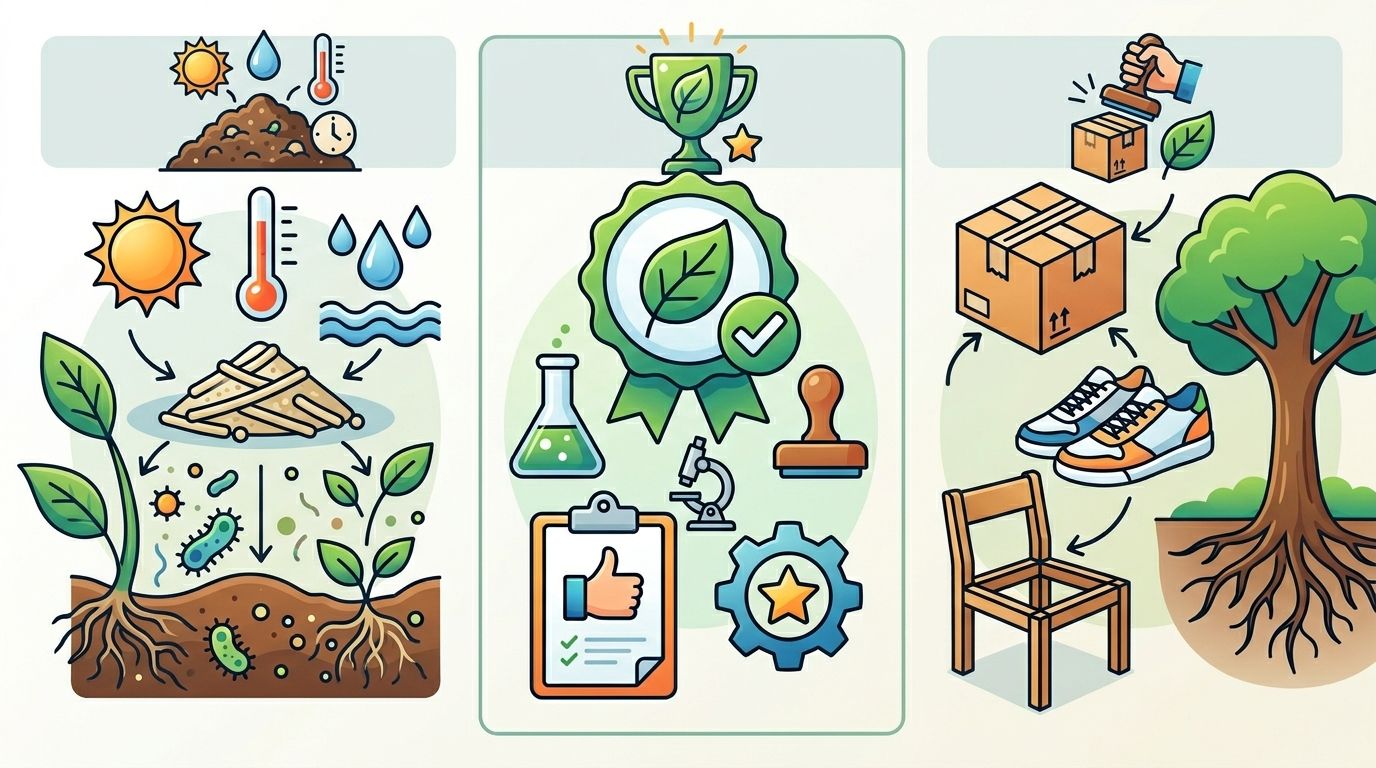
The decomposition of a biodegradable hot melt is not a simple decay but a complex biological process. For these materials to break down, they must be consumed by microorganisms like bacteria and fungi. This process can only happen when specific environmental triggers are present, initiating a chain reaction that converts the polymer into water, carbon dioxide, and biomass.
The primary triggers for biodegradation are:
- Moisture: Water is essential for microbial life and helps to break down the polymer chains, making them accessible to microorganisms.
- Heat: Elevated temperatures, typically above 50°C (122°F), accelerate microbial activity. This is why industrial composting facilities are so effective.
- Microorganisms: A high concentration of the right kind of microbes is necessary to consume the material efficiently. These are abundant in compost but scarce on an office shelf or in a dry warehouse.
Without this precise combination of factors, a biodegradable adhesive will remain stable and functional. This stability is intentional; the adhesive must perform its bonding function reliably throughout the product's life cycle. It is only upon disposal in the correct, biologically active environment that its end-of-life benefit is realized. The science shows that these materials are designed for a specific disposal pathway, not for magical disappearance in any setting.
💡KEY POINT
Key Conditions for Biodegradation
For a biodegradable hot melt to decompose effectively, a specific environment is non-negotiable. The process relies on three critical elements working in concert:
- Sufficient Moisture: Activates microbial processes.
- Elevated Temperature: Accelerates the breakdown, typical of industrial composting.
- High Microbial Concentration: Requires a biologically active environment to consume the material.
Understanding Certifications and Eco Labels 📜
Navigating the world of eco-friendly claims can be confusing. To ensure a biodegradable hot melt performs as advertised, it is essential to look for credible, third-party certifications. These labels verify that a product has been rigorously tested and meets specific standards for decomposition under controlled conditions. Vague or self-made claims like "eco-friendly" or "earth-friendly" lack the scientific backing of official certifications.
When evaluating a biodegradable adhesive, two of the most recognized international standards are ASTM D6400 (in the United States) and EN 13432 (in Europe). Both of these certify that a material is "industrially compostable." This means that under the conditions of an industrial composting facility, the product will disintegrate and biodegrade to a specified extent within a set timeframe, leaving no toxic residues. It's crucial to note that these certifications do not apply to home composting, which typically operates at lower and less consistent temperatures. A product certified for industrial composting will likely not break down effectively in a backyard compost bin. Always check the packaging and technical data sheets for these specific certification marks to validate a product's end-of-life claims.
| Certification | Region | Key Requirement |
|---|---|---|
| ASTM D6400 | United States | Must disintegrate and biodegrade in a commercial composting facility. |
| EN 13432 | Europe | Specifies criteria for disintegration, biodegradation, and eco-toxicity in industrial compost. |
| BPI Certified | North America | Verifies products meet ASTM D6400 standards for compostability. |
Real-World Uses: Successes and Limitations 📦
The practical application of biodegradable hot melt adhesives showcases both their potential and their boundaries. The success of these materials is directly tied to the infrastructure available for their disposal. In closed-loop systems where products are collected and sent to industrial composting facilities, they offer a significant environmental advantage.
Successful applications often include:
- Certified Compostable Packaging: Used to seal food containers, bags, or boxes that are designed to be composted along with food waste.
- Agricultural Products: Certain single-use agricultural items that can be tilled directly into the soil to decompose under specific conditions.
- Disposable Hygiene Products: In some cases, components of diapers or sanitary products are designed for commercial composting disposal routes.
However, their limitations become apparent when used improperly. For example, using a biodegradable hot melt to seal a standard corrugated cardboard box that is destined for the recycling stream can be problematic. The adhesive can act as a contaminant in the paper recycling process. Similarly, if a product sealed with this adhesive ends up in a landfill, its biodegradable properties offer little to no benefit. The key is to align the product's material composition with its most likely end-of-life scenario.
Match the Adhesive to the Disposal Path
Before selecting a biodegradable hot melt, analyze the entire lifecycle of your product. If the final product is likely to be recycled, a recyclable-friendly adhesive is a better choice. If it is designed to be composted with organic waste and a collection infrastructure exists, then a certified compostable adhesive is the ideal solution.
Choosing the Right Biodegradable Solution ✅
Making an informed decision about using a biodegradable hot melt requires moving beyond marketing claims and focusing on technical specifications and practical realities. For businesses and consumers aiming to make a genuine environmental impact, a thoughtful selection process is crucial. The goal is to choose a product that not only performs its primary function but also aligns with a viable and responsible end-of-life pathway.
Start by demanding transparency from suppliers. Ask for technical data sheets and proof of third-party certifications like ASTM D6400 or EN 13432. Understand the exact conditions required for the adhesive to biodegrade and assess whether your product's lifecycle and the available waste management infrastructure support those conditions. Consider the entire product assembly; a biodegradable adhesive on a non-biodegradable package offers no net environmental benefit. Ultimately, the "right" solution is one that is part of a holistic system designed for sustainability, from material sourcing to final disposal.
⚠️CAUTION
Beware of Greenwashing
Be cautious of products that use vague terms like "eco-friendly" or "green" without providing specific, verifiable certifications. True biodegradable performance is a scientific attribute, not a marketing slogan. Always demand data and proof of certification to ensure you are making a genuinely sustainable choice and not just contributing to the problem of "greenwashing."