


Table of Contents
- Why Choose Flame-Resistant Hot Melt Adhesives?
- Key Flame Resistance Standards and Certifications
- How Flame-Retardant Hot Melt Works
- Selecting the Right Hot Melt for Your Industry
- Real-World Applications and Benefits
In an increasingly safety-conscious world, the materials we use in manufacturing are under more scrutiny than ever. Consider the complex electronics in your car or the wiring inside your office equipment. A single spark could have devastating consequences. While standard hot melt adhesives are excellent for bonding, in a fire, they can act as fuel, accelerating the spread of flames. This is where flame-retardant hot melt adhesives become not just an alternative, but a necessity. They are engineered at a chemical level to inhibit, suppress, and slow down combustion, providing a critical layer of safety that protects property, products, and people. This guide will walk you through everything you need to know to make an informed decision for your application in 2026.
Why Choose Flame-Resistant Hot Melt Adhesives?
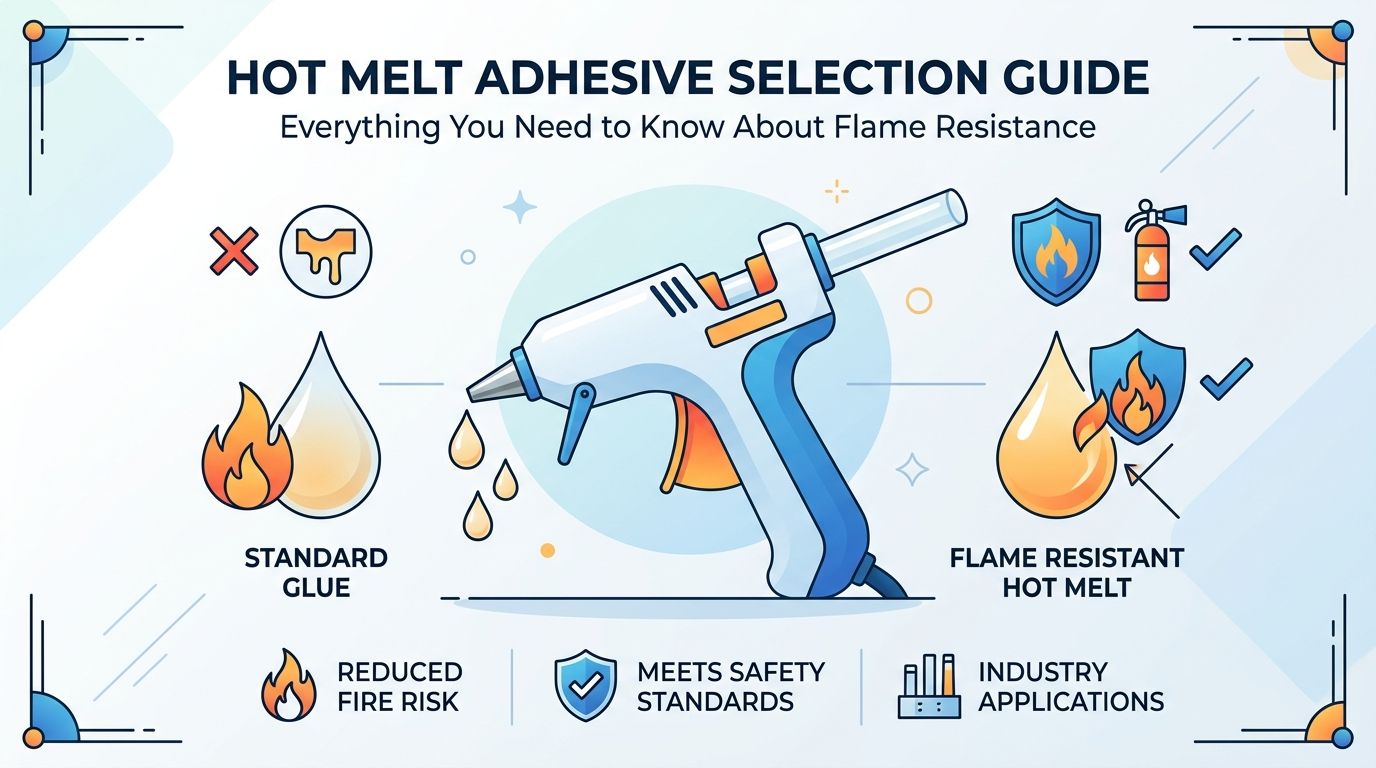
The primary reason to choose a flame-retardant hot melt is its superior safety profile in the event of a fire. Unlike standard adhesives, which are typically composed of polymers that can burn readily, flame-retardant versions are specifically formulated to resist ignition and slow down the spread of flames. Think of a standard hot melt as a type of specialized plastic; when exposed to fire, it can act as additional fuel. In stark contrast, a flame-retardant hot melt is engineered to be self-extinguishing or, at the very least, extremely slow-burning. This characteristic is not inherent; it is achieved through the addition of special non-flammable additives. This fundamental difference means that products assembled with flame-retardant adhesives are significantly safer and more likely to comply with stringent industry safety regulations. Choosing this type of adhesive is a proactive measure to enhance product integrity and mitigate fire-related risks.
| Feature | Standard Hot Melt | Flame-Retardant Hot Melt |
|---|---|---|
| Reaction to Fire | Acts as fuel; can sustain and spread flames. | Resists ignition and self-extinguishes or burns slowly. |
| Core Composition | Thermoplastic polymers (e.g., EVA, polyolefin). | Polymers with specialized flame-retardant additives. |
| Primary Use Case | General purpose bonding (packaging, crafts, assembly). | Safety-critical applications (electronics, automotive, construction). |
| Safety Compliance | Typically does not meet fire safety standards. | Designed to meet certifications like UL 94. |
Key Flame Resistance Standards and Certifications
When selecting a flame-retardant hot melt, third-party certifications are not just a recommendation; they are a guarantee of performance and safety. The most widely recognized and crucial standard in this field is UL 94, the Standard for Safety of Flammability of Plastic Materials for Parts in Devices and Appliances. This standard classifies materials based on how they burn in various orientations and thicknesses. For an adhesive to be considered truly flame-retardant, it must have a UL 94 rating. The most common ratings for adhesives are V-0, V-1, and V-2. A V-0 rating indicates that burning stops within 10 seconds on a vertical specimen, with no flaming drips allowed. This is the most stringent classification and is often required for components in sensitive electronics and aerospace applications. Understanding these ratings is essential for ensuring that the adhesive you choose meets the specific safety requirements of your product and end-market, providing verifiable proof of its fire-resistant properties.
💡KEY POINT
- UL 94 is the key international standard for testing the flammability of plastic materials, including adhesives.
- The ratings (V-0, V-1, V-2) indicate how quickly a material self-extinguishes after being ignited.
- V-0 is the highest rating, signifying the greatest resistance to fire and is essential for high-risk applications.
- Always verify the adhesive's UL 94 certification to ensure it meets your project's safety and compliance needs.
How Flame-Retardant Hot Melt Works
The unique properties of a flame-retardant hot melt come from its specialized chemical composition. Unlike standard hot melts, these adhesives contain specific additives designed to interfere with the combustion cycle. These additives work through several mechanisms. Some function by releasing water or inert gases when heated, which dilutes the flammable gases and cools the material below its ignition point. Others work by forming a protective layer of char when exposed to a flame. This char layer acts as an insulating barrier, cutting off the oxygen supply to the underlying polymer and preventing further burning. The additives can be halogen-based or halogen-free. While halogenated compounds are highly effective, environmental and health concerns have led to a rise in halogen-free alternatives, such as those based on phosphorus or nitrogen. The choice between these depends on regulatory requirements, performance needs, and environmental policies. This advanced formulation is the core reason flame-retardant hot melt provides a level of safety that standard adhesives simply cannot match.
When choosing between halogen-based and halogen-free flame-retardant adhesives, consider your end market. The European Union's RoHS directive, for example, restricts the use of certain halogenated substances. For products intended for global distribution, a halogen-free formulation is often the safer and more compliant choice, ensuring you meet diverse international environmental standards.
Selecting the Right Hot Melt for Your Industry
Choosing the correct flame-retardant hot melt requires a careful evaluation of more than just its fire resistance. While a UL 94 rating is critical, you must also consider the adhesive's physical properties and how they align with your production process. The addition of flame-retardant chemicals can sometimes alter the adhesive's characteristics. For instance, it may have a slightly higher viscosity, a different open time (the window for bonding after application), or a shorter set time (the time it takes to fully harden). It might also affect the final bond's flexibility or clarity. Therefore, it is crucial to match the adhesive to the specific substrates you are bonding and the environmental conditions the final product will face. Always consult the technical data sheet (TDS) for information on application temperature, viscosity, and bond strength to ensure compatibility with your equipment and performance expectations.
| Selection Criteria | Key Question to Ask | Why It Matters |
|---|---|---|
| Required Certification | What UL 94 rating (V-0, V-1, V-2) does my application require? | Ensures you meet legal and industry safety standards for your specific product. |
| Substrates | What materials am I bonding (e.g., plastic, metal, wire)? | Determines the necessary adhesion properties for a strong, durable bond. |
| Workability | What are the adhesive's open time, set time, and viscosity? | Ensures the adhesive is compatible with your production line speed and equipment. |
| Operating Environment | Will the product be exposed to high temperatures, moisture, or chemicals? | Affects the long-term stability and reliability of the adhesive bond. |
Real-World Applications and Benefits
The applications for flame-retardant hot melt adhesives are widespread, particularly in industries where fire safety is a non-negotiable requirement. In the electronics industry, these adhesives are essential for securing wires, potting (encapsulating) components on circuit boards, and insulating connections. Their ability to prevent flame propagation is critical in preventing small electrical faults from turning into major fires. In the automotive sector, they are used to bond interior components, secure wire harnesses, and attach insulation, helping manufacturers meet strict vehicle safety standards. The construction industry also relies on them for applications like bonding insulation panels, sealing wire pass-throughs, and assembling components where building codes mandate fire-resistant materials. The core benefit in all these fields is the significant enhancement of safety, which in turn protects brand reputation, reduces liability, and, most importantly, saves lives.
💡KEY POINT
- Electronics: Used for wire tacking, component potting, and sealing to prevent electrical fires.
- Automotive: Critical for bonding interior trim, headliners, and securing wire harnesses to meet vehicle safety regulations.
- Construction: Applied in fire-rated wall panels, insulation, and sealing applications to comply with building codes.
- Overall Benefit: Provides a crucial safety layer, ensures regulatory compliance, and enhances overall product reliability.