


Table of Contents
- Flame-Retardant Hot Melts: What Are They?
- Key Types by Base Resin and Additive
- Understanding Industry Standards and Certifications
- How to Select the Right Hot Melt for Your Needs
- Application Examples and Common Use Cases
As product designs across electronics, automotive, and construction become more compact and power-dense, the inherent risk of fire from internal components has never been more significant. How can manufacturers ensure both robust structural integrity and full compliance with the stringent fire safety standards of 2026? The answer often lies in a frequently overlooked yet critical component: the adhesive. Specifically, flame-retardant hot melt adhesives are engineered not just to bond, but to actively inhibit the spread of fire, making them an essential element of modern product safety and design.
Flame-Retardant Hot Melts: What Are They?
A flame-retardant hot melt is a thermoplastic adhesive designed to melt when heated, applied in a molten state, and solidify upon cooling to create a strong bond. What distinguishes it from standard hot melts is the incorporation of specific chemical additives or polymer structures that suppress, reduce, or delay combustion. At their core, the base polymers used in hot melts—much like other plastics—are naturally flammable. The primary purpose of formulating a flame-retardant hot melt is to overcome this inherent characteristic to meet critical safety standards, such as the widely recognized UL 94 V-0 rating. This is achieved by adding compounds that can interfere with the chemistry of a fire, either by releasing cooling gases, forming a protective char layer, or diluting the flammable gases produced during decomposition.
💡KEY POINT
- Core Function: To provide strong adhesion while actively inhibiting the spread of flames.
- Key Components: A base thermoplastic polymer combined with a flame-retardant additive or system.
- Primary Goal: To enable products to meet stringent fire safety regulations and enhance overall user safety.
Key Types by Base Resin and Additive
The performance, application scope, and cost of a flame-retardant hot melt are determined by two main factors: the base polymer (resin) and the flame-retardant system. Different combinations are engineered to meet specific industry needs, creating a balance between flame resistance, adhesion strength, and environmental compliance. This trade-off is a critical consideration during the selection process.
The choice of base resin dictates the adhesive's fundamental properties like flexibility, temperature resistance, and substrate compatibility. The flame-retardant additive, in turn, defines its safety profile and regulatory compliance.
| Base Resin Type | Key Characteristics | Common Applications |
|---|---|---|
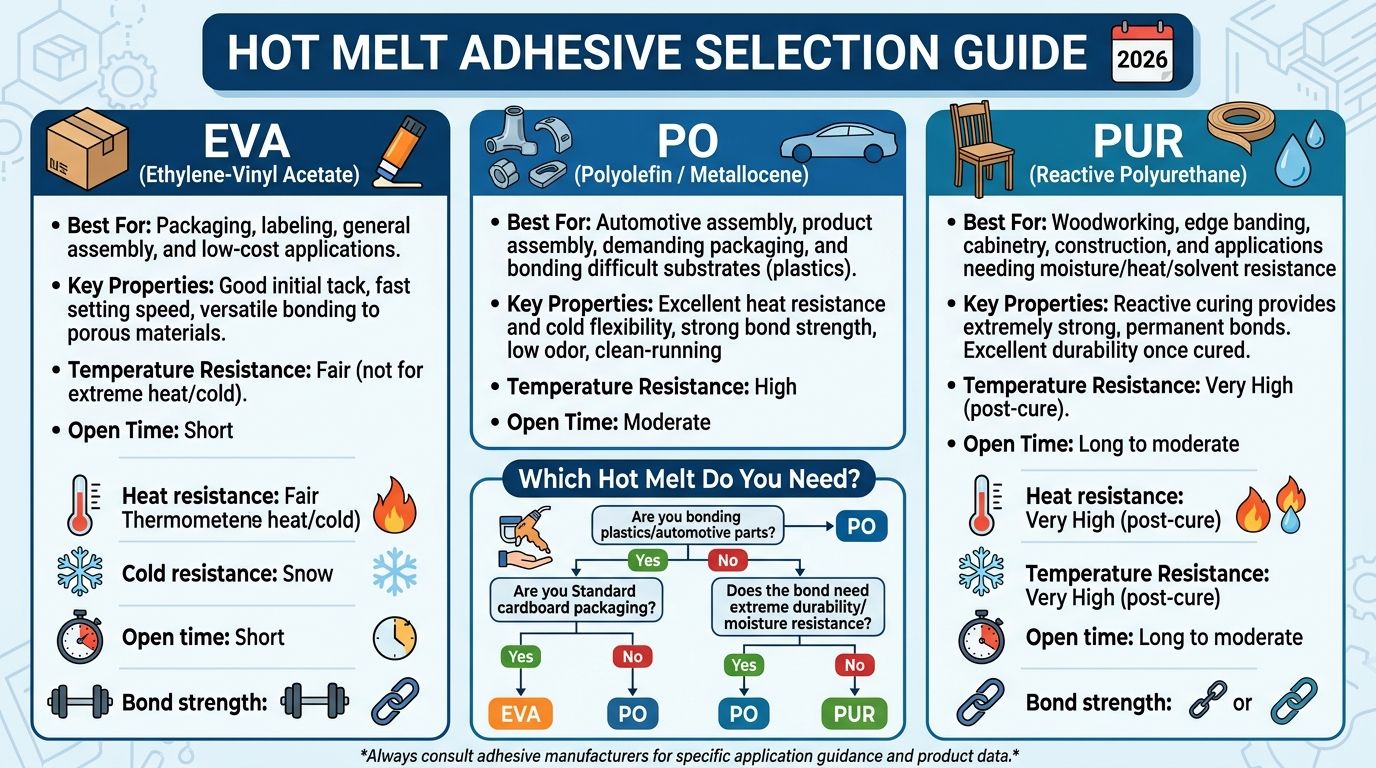
| Polyolefin (PO) | Excellent electrical insulation, good adhesion to polypropylenes, cost-effective. | Electronics potting, wire tacking, automotive components. |
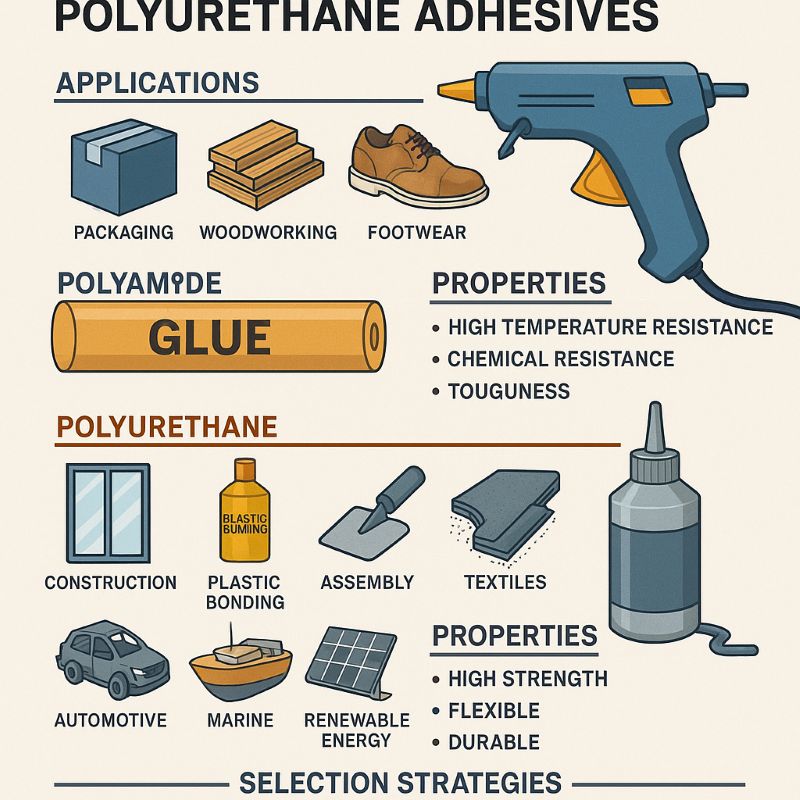
| Polyamide (PA) | High heat resistance, superior strength, and chemical resistance. | Demanding automotive and electronic assemblies, filter manufacturing. |
| Polyurethane (PUR) | Strong, flexible bonds, cures with moisture for enhanced durability. | Construction panels, textiles, challenging substrates. |
Flame-retardant systems are broadly categorized into two groups:
- Halogenated Systems: Traditionally effective and cost-efficient, but facing increasing environmental and health scrutiny under regulations like RoHS.
- Halogen-Free Systems: Primarily phosphorus-based or mineral-based (e.g., aluminum trihydroxide). These are the preferred choice for modern electronics and consumer goods to meet evolving environmental standards.
Understanding Industry Standards and Certifications
Navigating the landscape of safety and environmental regulations is crucial when specifying a flame-retardant hot melt. As of 2026, compliance is not just a best practice but a market access requirement. The most critical standard in this domain is UL 94, a plastics flammability standard released by Underwriters Laboratories. The highest rating, UL 94 V-0, indicates that a material self-extinguishes vertically within 10 seconds without dripping flaming particles. This is often the minimum requirement for components used in consumer electronics, power supplies, and battery assemblies.
Beyond flammability, environmental regulations are shaping the industry. The Restriction of Hazardous Substances (RoHS) directive in the European Union, along with similar regulations globally, restricts the use of specific hazardous materials, including certain halogenated flame retardants. Consequently, the demand for halogen-free flame-retardant hot melts has surged, making them the standard for new product designs, especially those intended for international markets.
When evaluating an adhesive, always request a technical data sheet (TDS) that explicitly states its UL 94 rating and confirms its halogen-free status. Verifying compliance with the latest version of regulations like RoHS is essential to avoid costly redesigns or market access issues.
How to Select the Right Hot Melt for Your Needs
Choosing the optimal flame-retardant hot melt requires a systematic evaluation of your application's unique demands. A product suitable for potting a small capacitor may be entirely inappropriate for laminating a large construction panel. The decision involves balancing performance, processability, and regulatory compliance. Use a structured approach to ensure all key variables are considered before making a final selection. This checklist provides a framework for defining your requirements and communicating them effectively to your adhesive supplier.
| Selection Criteria | Key Questions to Ask |
|---|---|
| Application & Substrates | What materials are being bonded (e.g., plastics, metals, wood)? What is the required bond strength and flexibility? |
| Performance Requirements | What is the required UL 94 rating (V-0, V-1, V-2)? What are the operating temperature extremes? |
| Regulatory & Environmental | Is halogen-free compliance mandatory? Does the end product need to meet specific industry standards (e.g., automotive, aerospace)? |
| Processing & Production | What application method will be used (e.g., automated dispenser, manual gun)? What is the required open time and set time? |
Application Examples and Common Use Cases
The versatility of flame-retardant hot melt adhesives allows them to be used across a diverse range of industries where safety is paramount. Their ability to provide both structural bonding and fire protection in a single step makes them highly efficient manufacturing solutions. Rather than relying on mechanical fasteners and separate fire-blocking materials, engineers can use these advanced adhesives to streamline assembly and enhance product safety.
💡KEY POINT
- Electronics: Widely used for potting and encapsulating components on printed circuit boards (PCBs), securing wires to prevent shorts, and assembling battery packs. The adhesive protects sensitive electronics from vibration and moisture while preventing the spread of fire in case of a component failure.
- Automotive: Essential for bonding interior components, headliners, and wire harness assemblies. In electric vehicles (EVs), they play a crucial role in the assembly and thermal management of battery modules, ensuring structural integrity and fire safety.
- Construction: Used in the lamination of fire-rated insulation panels, sealing joints in fire-resistant wall systems, and bonding components in HVAC systems.
- Filtration: Applied in the assembly of industrial and HEPA filters, where the adhesive must maintain its bond and not contribute to a fire load.