


Table of Contents
- Understanding Flame-Retardant Hot Melts
- The Science Behind Safety: Key Components
- Meeting the Mark: Industry Certifications
- Critical Applications: Where Safety is Non-Negotiable
- Standard vs. Flame-Retardant: A Head-to-Head Comparison
In high-stakes industrial environments, where a single spark can lead to catastrophic failure, every component matters. While adhesives might seem minor, their chemical properties can be the deciding factor between a contained incident and a full-blown fire. Standard hot melts, being polymer-based, can act as fuel, potentially accelerating the spread of flames. This raises a critical question for engineers and safety managers: is the adhesive you're using a hidden liability? This is where flame-retardant hot melt adhesives emerge, not just as a bonding agent, but as a crucial layer of passive fire protection, fundamentally engineered for safety.
Understanding Flame-Retardant Hot Melts 🔍
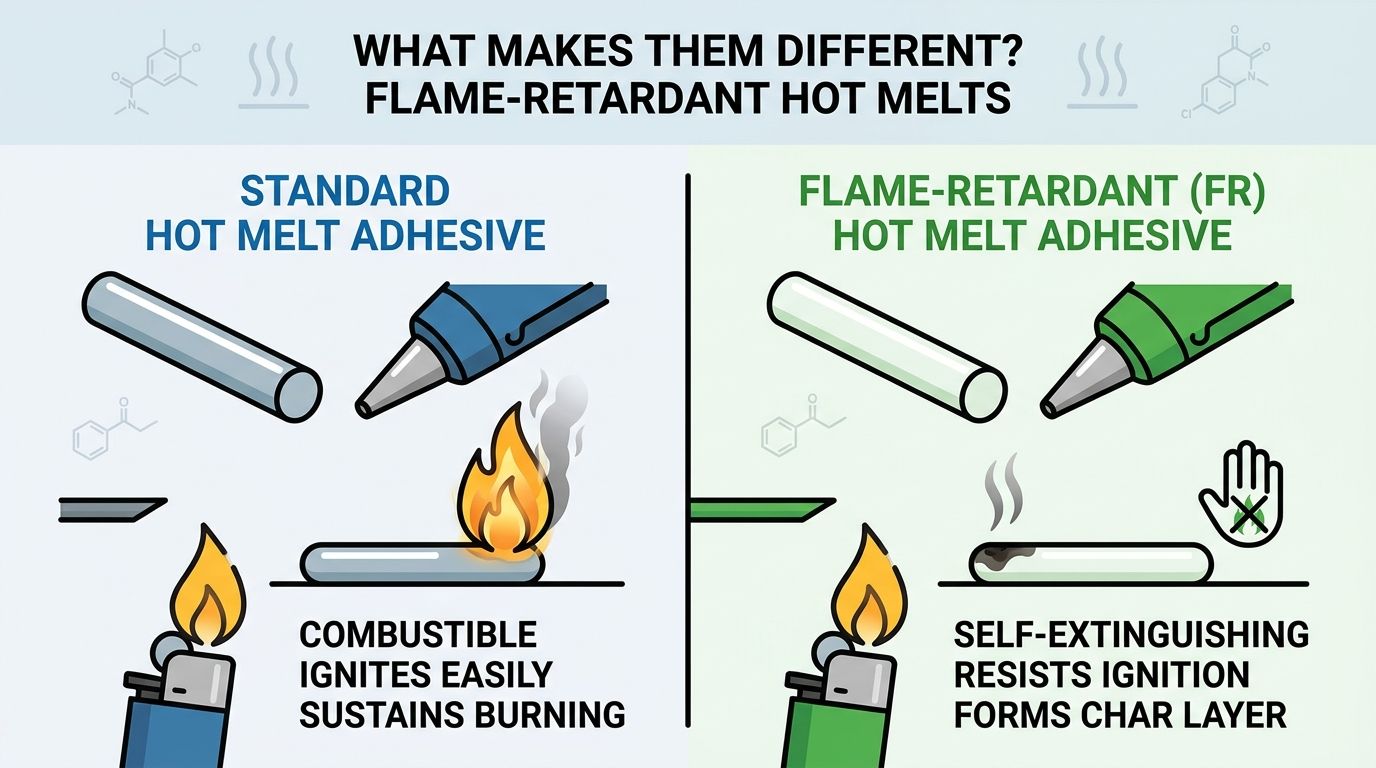
A flame-retardant hot melt is a specialized adhesive designed to resist ignition, slow the spread of flames, and often self-extinguish once the heat source is removed. Unlike conventional hot melts that are primarily formulated for bonding strength and application speed, these advanced adhesives incorporate specific chemical agents that actively interfere with the combustion process. The core difference lies in their behavior during a fire. A standard hot melt will melt, drip, and burn, contributing to the fire's fuel load. In contrast, a flame-retardant hot melt is engineered to perform a specific safety function: to inhibit fire and prevent it from propagating along a component or surface. This distinction is paramount in applications where fire risk is a constant concern, transforming the adhesive from a simple fastener into an integral part of a product's overall safety system.
💡KEY POINT
- Resists Ignition: Flame-retardant hot melts are significantly harder to ignite than their standard counterparts.
- Slows Flame Spread: If they do ignite, their chemical composition works to slow down the rate of burning.
- Self-Extinguishing Properties: Many formulations are designed to stop burning automatically once the external flame source is gone.
The Science Behind Safety: Key Components 🧪
The unique properties of flame-retardant hot melt adhesives stem from their specialized chemical composition. The base polymer, which provides the adhesive properties, is combined with specific flame-retardant additives. These additives are not passive fillers; they are active chemical agents that disrupt the combustion cycle in one of several ways. Some work by releasing water or inert gases when heated, which dilutes the flammable gases and cools the material below its ignition point. Others undergo an endothermic reaction, absorbing heat and preventing the material from reaching combustion temperature. A third common mechanism is the formation of a protective char layer on the surface, which acts as a barrier, insulating the underlying material from heat and oxygen. The choice of additive can also impact the adhesive's physical properties, potentially affecting its viscosity, flexibility, or open time, which must be considered during product selection and process integration.
| Additive Type | Mechanism of Action | Common Characteristics |
|---|---|---|
| Halogenated FRs | Releases radicals that interrupt the chemical chain reaction of combustion in the gas phase. | Highly effective but facing increased regulatory scrutiny in some regions. |
| Phosphorus-based FRs | Promotes char formation on the material's surface, creating a protective barrier. | Effective in solid-phase action, often considered a halogen-free alternative. |
| Mineral-based FRs | Releases water molecules upon heating, cooling the material and diluting flammable gases. | Environmentally friendly, but may require higher loading levels, affecting physical properties. |
Meeting the Mark: Industry Certifications 🏆
For industries where fire safety is a regulatory requirement, performance claims are not enough; certification is essential. Flame-retardant hot melt adhesives are rigorously tested to meet internationally recognized standards, with UL 94 being one of the most prominent. This standard, issued by Underwriters Laboratories, classifies plastics and other materials according to their burning characteristics. An adhesive that has achieved a UL 94 rating, such as V-0, V-1, or V-2, has been verified by a third party to perform predictably in a fire. A V-0 rating, for instance, indicates that a vertically oriented sample stops burning within 10 seconds after the ignition source is removed, with no flaming drips allowed. These certifications provide engineers and buyers with the confidence that the adhesive will contribute to the overall safety and compliance of their final product, whether it's an electronic device, an automotive interior, or a construction component.
When selecting a flame-retardant adhesive, always verify its specific certification level (e.g., UL 94 V-0) and ensure it matches the requirements of your end-product and market. The right certification is not just a feature—it's a critical compliance tool.
Critical Applications: Where Safety is Non-Negotiable 🏭
The use of flame-retardant hot melts is concentrated in sectors where the risk of fire and the consequences of failure are highest. In contrast, standard hot melts are perfectly suitable for low-risk applications like consumer packaging, bookbinding, and general assembly where flammability is not a primary concern. The distinction in application is driven entirely by safety and regulation. For example, in electronics manufacturing, these adhesives are used for wire tacking, component potting, and securing harnesses inside devices where an electrical short could easily become an ignition source. In the automotive and aerospace industries, they are used to bond interior components, ensuring that materials meet strict passenger safety standards for flammability. The construction industry also utilizes them for bonding insulation, paneling, and wire conduits, helping to prevent the rapid spread of fire within buildings.
| Application Area | Why Flame-Retardant is Critical | Standard Hot Melt Use Case |
|---|---|---|
| Electronics | Prevents fire propagation from short circuits or overheating components. | Sealing cardboard boxes for shipping. |
| Automotive Interiors | Meets federal motor vehicle safety standards (FMVSS) for flammability. | Assembling non-critical product displays. |
| Construction | Secures insulation and wiring in compliance with building fire codes. | Hobby and craft projects. |
Standard vs. Flame-Retardant: A Head-to-Head Comparison 📊
Ultimately, the choice between a standard and a flame-retardant hot melt is not about which is "better," but which is appropriate for the task. The decision hinges on a clear assessment of risk, regulatory requirements, and the intended environment of the final product. While a standard hot melt offers excellent bonding for general-purpose applications, it fundamentally acts as a fuel in a fire. A flame-retardant hot melt is an engineered safety component designed to do the opposite: suppress and contain a fire. This functional difference, driven by specialized additives and chemistry, is the most important consideration. By selecting an adhesive with the appropriate safety qualifications and performance characteristics, manufacturers can ensure both the structural integrity and the fire safety of their products, protecting property and lives.
💡KEY POINT
- Primary Function: Standard hot melts are for bonding; flame-retardant hot melts are for bonding *and* fire safety.
- Composition: The key difference is the inclusion of active flame-retardant additives in FR formulations.
- Application: The choice is dictated by risk. High-risk, regulated environments demand flame-retardant adhesives, while low-risk applications can use standard types.