


Table of Contents
- What Sets Flame-Retardant Hot Melt Apart?
- Understanding Fire Safety and Certifications
- How Special Additives Enhance Performance
- Choosing the Right Hot Melt for Your Needs
- Real-World Applications and Industry Insights
In an industrial setting, what is the true role of an adhesive? While its primary function is to bond materials, its secondary role in a fire event can be the difference between containment and catastrophe. A standard hot melt adhesive, essentially a specialized plastic, can act as fuel, potentially accelerating the spread of a fire. In contrast, a flame-retardant hot melt is engineered to do the opposite: to resist ignition and suppress the flame. As industries face increasingly stringent safety regulations in 2026, understanding this fundamental distinction is no longer optional—it is a critical component of responsible product design and manufacturing.
What Sets Flame-Retardant Hot Melt Apart? 🛡️
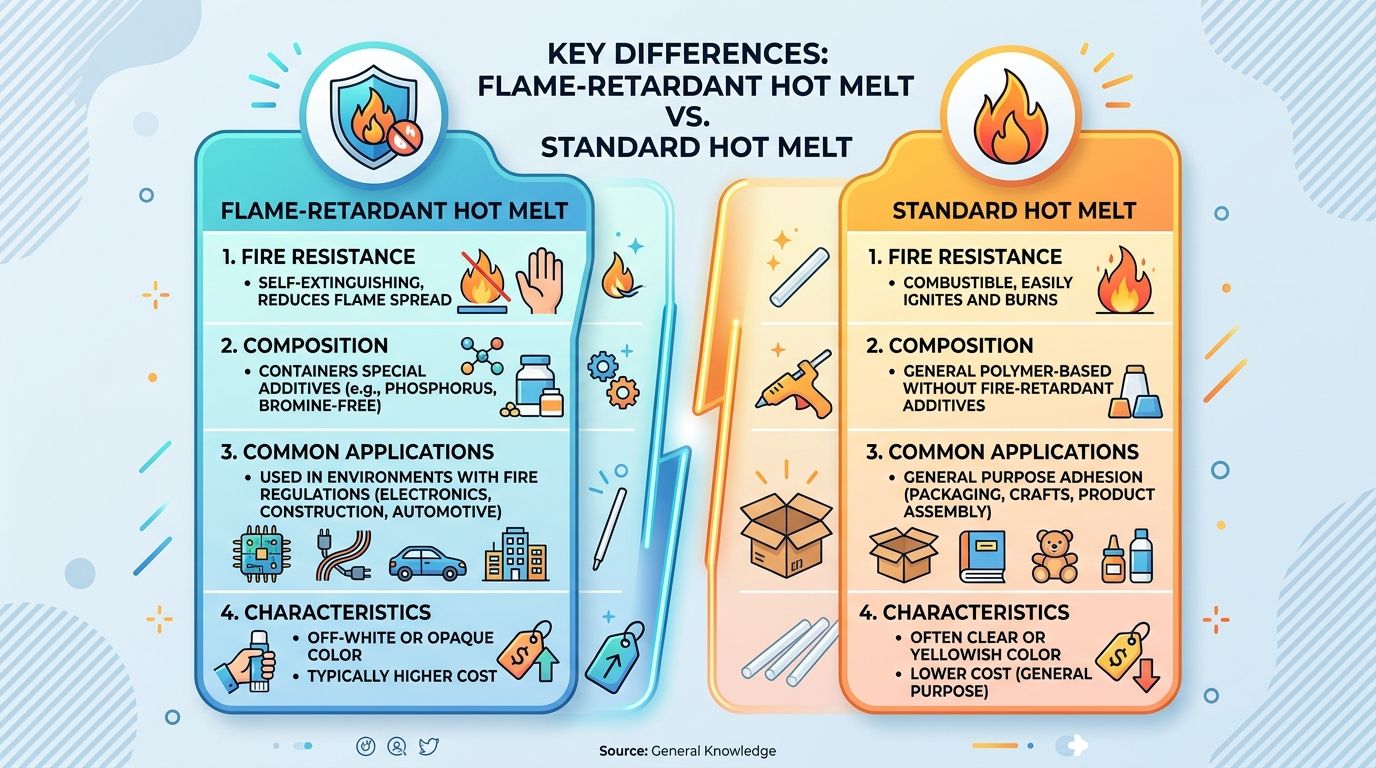
The core difference between flame-retardant and standard hot melt lies in their reaction to fire. Standard hot melts, once ignited, will continue to burn and drip, potentially spreading the fire to other components. Flame-retardant hot melt, however, is specifically formulated to be self-extinguishing or slow-burning. When exposed to a flame, it is designed to resist ignition and, if it does catch fire, to stop burning once the external heat source is removed. This property is not a minor enhancement; it is a complete change in the material's fundamental behavior under thermal stress, making it an essential safety feature rather than just a bonding agent.
This crucial difference stems from their chemical composition. While both are thermoplastic adhesives, the flame-retardant variety contains special additives that actively interfere with the combustion cycle. This proactive safety design provides a vital layer of protection in applications where fire risk is a significant concern.
| Feature | Standard Hot Melt | Flame-Retardant Hot Melt |
|---|---|---|
| Reaction to Flame | Burns readily, can act as fuel | Resists ignition, self-extinguishing |
| Chemical Composition | Basic polymer, tackifier, and wax | Includes specific FR additives |
| Primary Goal | Strong and reliable bonding | Bonding plus active fire suppression |
Understanding Fire Safety and Certifications 📜
In high-stakes industries like electronics, automotive, and construction, compliance with fire safety standards is non-negotiable. This is where flame-retardant hot melt demonstrates its true value. These specialized adhesives are engineered and tested to meet stringent international safety certifications, most notably the UL 94 standard. This standard classifies plastics based on how they burn in various orientations and thicknesses. A V-0, V-1, or V-2 rating under UL 94 indicates a material's ability to self-extinguish within a specific time frame after the ignition source is removed. Standard hot melts typically cannot achieve these ratings. Meeting these certifications is not just about compliance; it is a verifiable assurance of a product's safety and reliability in preventing fire propagation, protecting both valuable equipment and human lives.
💡KEY POINT
- Safety is Paramount: Flame-retardant hot melts are designed to prevent fire spread, a critical function in enclosed or high-risk environments.
- Compliance is Key: Adhering to standards like UL 94 is often a mandatory requirement for components used in electronics, transportation, and building materials.
- Verified Performance: Certifications provide third-party validation that the adhesive will perform as expected in a fire event, ensuring reliability.
How Special Additives Enhance Performance 🔬
The unique properties of flame-retardant hot melt are achieved through the incorporation of specialized chemical additives. These are not simple fillers; they are active ingredients that work at a molecular level to inhibit combustion. The two main ways they function are by suppressing the chemical reactions within a flame or by forming a protective char layer (intumescence) when exposed to heat. This char layer acts as an insulating barrier, cutting off the underlying material from oxygen and heat, thereby preventing further burning. These additives can be halogen-based or, increasingly, halogen-free to meet modern environmental and health standards. The choice of additive is carefully calibrated to provide the required level of fire resistance without compromising the adhesive's core bonding properties.
⚠️CAUTION
The addition of flame-retardant compounds can sometimes alter the physical properties of the hot melt. Users may observe a slightly higher viscosity, different open or set times, and occasionally lower flexibility or optical clarity compared to standard formulations. It is crucial to test the material in your specific application to ensure it meets all performance requirements.
Choosing the Right Hot Melt for Your Needs ✅
Selecting the correct hot melt adhesive requires a careful evaluation of the application's specific demands. Simply choosing the strongest bond is not enough. Decision-makers must consider the operating environment, regulatory requirements, and production processes. For applications in consumer electronics, automotive interiors, or aerospace components, where fire risk and strict regulations are present, flame-retardant hot melt is often the only viable choice. For general-purpose packaging, bookbinding, or hobby crafts, where fire risk is minimal, a standard hot melt is usually sufficient and more cost-effective. A thorough analysis of your project's needs will ensure you select an adhesive that provides both performance and peace of mind.
| Consideration | Key Questions to Ask | Recommended Action |
|---|---|---|
| Application Environment | Is the component near a heat source? Is it in an enclosed space? | Identify all potential fire risks in the product's lifecycle. |
| Certification Required | Does the final product need to meet specific fire safety standards (e.g., UL 94)? | Review industry regulations and client specifications. |
| Processing Compatibility | Does the adhesive's viscosity and set time fit your production line? | Conduct trials to confirm compatibility with application equipment. |
Real-World Applications and Industry Insights 🏭
The practical application of flame-retardant hot melt spans numerous industries where safety is a top priority. In the electronics sector, it is used for wire tacking, securing components on printed circuit boards (PCBs), and encapsulating sensitive parts. Its ability to prevent a short circuit from turning into a full-blown fire is invaluable. In the automotive industry, these adhesives are used to bond headliners, carpets, and interior trim, ensuring that these materials do not contribute to the spread of a fire in the event of an accident. The construction industry also relies on them for sealing joints in fire-rated wall panels and bonding insulation materials, helping to maintain the integrity of fire-resistant structures. In each case, the adhesive does more than just hold things together—it becomes an integral part of the product's overall safety system.
When evaluating a flame-retardant hot melt, always request a Technical Data Sheet (TDS) from the supplier. Pay close attention to its UL 94 rating and other certified properties. If possible, test a sample on your specific substrates to ensure it meets both your bonding and safety requirements before committing to a full-scale implementation.