


Table of Contents
- What is a Hot Melt Adhesive Coating Machine?
- Decoding the Price Spectrum: From Benchtop to Industrial Lines
- Key Technical Specifications That Drive Costs
- Beyond the Sticker Price: Understanding Total Cost of Ownership (TCO)
- A Practical Guide to Making a Smart Purchase
Planning to invest in a new hot melt adhesive coating machine in 2026? You've likely discovered that pricing isn't straightforward. The market offers everything from compact tabletop units costing a few thousand dollars to sophisticated, fully automated industrial lines that can run into the hundreds of thousands. This vast range can make budgeting and decision-making a significant challenge. The key to navigating this complexity isn't just finding a price tag; it's understanding the value behind it. The right machine can revolutionize your production efficiency, while the wrong one can become a costly bottleneck. This guide will break down the price structures, explore the critical factors that influence cost, and provide practical tips to ensure you invest wisely in a machine that meets both your technical requirements and your budget.
What is a Hot Melt Adhesive Coating Machine?
A hot melt adhesive coating machine, often called a hot melt adhesive applicator, is a piece of industrial equipment designed to apply a layer of molten thermoplastic adhesive onto a substrate. The process is simple in concept but requires precision in execution: the machine melts solid adhesive, maintains it at a precise temperature, and then applies it evenly onto materials like paper, film, fabric, or nonwovens. As the adhesive cools, it solidifies almost instantly, creating a strong bond without the need for drying or curing time.
This technology is fundamental to countless industries, including packaging (case and carton sealing), labeling, bookbinding, nonwoven hygiene products (diapers, sanitary napkins), and automotive assembly. The primary advantage of using a hot melt coating machine is its speed and efficiency. The rapid bonding process allows for high-speed production lines, significantly increasing output. Furthermore, hot melt adhesives are solvent-free, making them a more environmentally friendly option compared to some solvent-based alternatives. Choosing the right machine is critical as it directly impacts product quality, production speed, and operational costs.
Before exploring machine options, clearly define your substrate material, the required adhesive type (e.g., EVA, PSA, PUR), and the desired coating pattern (e.g., full coverage, stripe, spray). This foundational information will significantly narrow your search and help suppliers provide more accurate quotes.
Decoding the Price Spectrum: From Benchtop to Industrial Lines
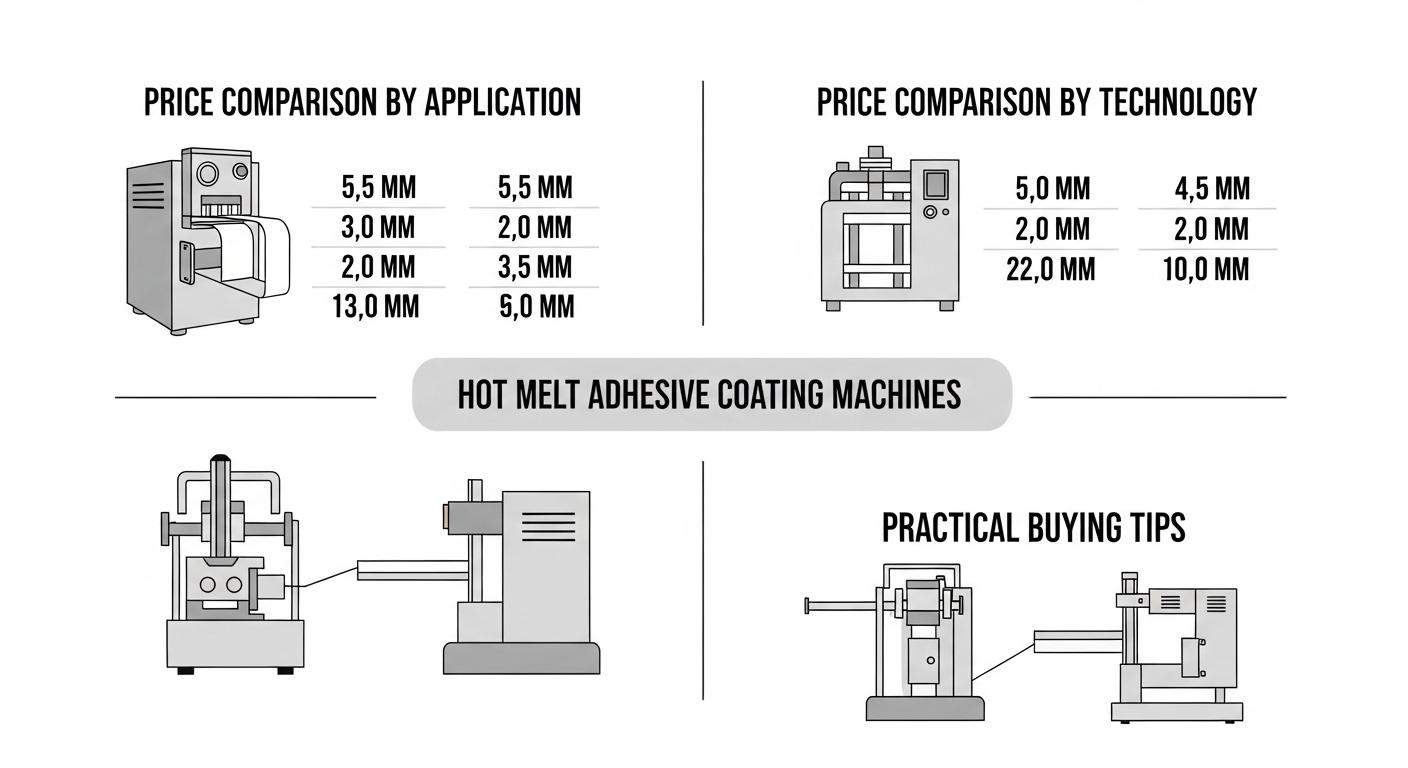
The price of a hot melt adhesive coating machine varies dramatically, with the 2026 market showing a range from under $5,000 for basic units to well over $200,000 for high-performance industrial systems. This spectrum can be broadly categorized into three tiers based on scale and automation.
1. Entry-Level & Benchtop Systems ($2,000 - $15,000): These are typically small, semi-automatic machines designed for lab testing, prototyping, or low-volume production. They are perfect for businesses that need precise, repeatable adhesive application without the need for high-speed output. While they lack the automation of larger systems, they provide excellent control for small-scale tasks and product development.
2. Mid-Range & Semi-Automated Systems ($15,000 - $75,000): This is the most common category for small to medium-sized enterprises (SMEs). These machines offer a balance of automation, speed, and cost. They might include features like automated material feeding, more precise temperature and flow controls, and wider coating heads. They are built for continuous production runs and are a significant step up in terms of throughput and consistency from entry-level models.
3. High-End & Fully Automated Industrial Lines ($75,000 - $300,000+): At the top end are fully integrated, custom-built production lines. These systems are designed for 24/7 operation at very high speeds. They feature advanced PLC controls, robotic integration, quality control sensors, and automatic roll changes to minimize downtime. These machines are investments for large-scale manufacturers where maximum efficiency and output are paramount.
💡KEY POINT
- Entry-Level: Suited for R&D, small batches, and startups. Focuses on precision over speed.
- Mid-Range: The workhorse for many factories, offering a blend of automation and value for consistent production.
- High-End: Designed for mass production, featuring maximum speed, full automation, and minimal operator intervention.
Key Technical Specifications That Drive Costs
The price tier of a machine is ultimately determined by its technical capabilities. Certain specifications have a direct and significant impact on the final cost. Understanding these factors is crucial for comparing different models and ensuring you are not overpaying for features you do not need or under-investing in capabilities that are critical to your operations. The most influential cost drivers are coating width, production speed, and the level of automation and precision control.
Coating Width: This is one of the most straightforward cost factors. A machine designed to coat a 1000mm-wide substrate will inherently be larger, heavier, and more complex than one designed for a 300mm width. Wider coating heads, rollers, and support frames require more materials and more robust engineering, leading to a higher price.
Production Speed: Higher speeds demand more advanced components. A machine running at 200 meters per minute requires superior motors, precision-engineered rollers, faster-reacting temperature controllers, and a more sophisticated adhesive melting and pumping system than a machine running at 50 meters per minute.
Automation and Precision: This is where costs can escalate quickly. Basic machines may rely on manual adjustments, whereas advanced systems feature programmable logic controllers (PLCs), touchscreen interfaces (HMIs), and servo motors for precise, repeatable results. Features like automatic tension control, edge guiding systems, and integrated vision systems for quality inspection add significant value but also increase the initial investment.
| Feature | Low-Cost Impact (Basic Machine) | High-Cost Impact (Advanced Machine) |
|---|---|---|
| Coating Width | Narrow (e.g., < 300mm) | Wide (e.g., > 1000mm) |
| Production Speed | Low (e.g., < 50 m/min) | High (e.g., > 150 m/min) |
| Control System | Manual knobs and basic digital readouts | PLC with HMI touchscreen, recipe storage |
Beyond the Sticker Price: Understanding Total Cost of Ownership (TCO)
A savvy buyer looks beyond the initial purchase price and considers the Total Cost of Ownership (TCO). The initial capital outlay is just one part of the equation. Over the machine's lifespan, which can be a decade or more, operational and maintenance costs can significantly impact your return on investment. A cheaper machine might end up costing more in the long run if it is inefficient or unreliable.
Key components of TCO include:
- Maintenance and Spare Parts: Inquire about the cost and availability of common wear parts like nozzles, filters, pumps, and hoses. A machine with readily available, reasonably priced parts will have a lower TCO. Ask for a recommended spare parts list and its cost.
- Energy Consumption: High-efficiency heaters and motors can lead to substantial energy savings over time. Compare the power consumption ratings (kW) of different models, especially for the melting tank, which is a primary energy user.
- Material Waste: How precise is the adhesive application? A machine with superior control can minimize "edge bleed" and adhesive overuse, leading to significant savings on raw material costs. Even a 5% reduction in adhesive consumption can add up to a large sum over a year.
- Downtime and Reliability: A more robust, well-engineered machine may cost more upfront but will likely experience less unscheduled downtime. Calculate the cost of lost production per hour to understand the true financial impact of unreliability.
⚠️CAUTION
Be cautious of unusually low-priced machines from unknown manufacturers. While the initial cost may be tempting, they can lead to higher long-term expenses due to poor build quality, a lack of technical support, and difficulty in sourcing spare parts.
A Practical Guide to Making a Smart Purchase
Navigating the procurement process for a hot melt adhesive applicator requires a systematic approach. By following a clear set of steps, you can ensure the machine you choose is a perfect fit for your application, production goals, and budget. Rushing the decision can lead to buyer's remorse and operational headaches.
First, clearly define your requirements. This is the most critical step. Document everything from the types of substrates and adhesives you will use to the required coating width, speed, and accuracy. The more detailed your specification sheet, the better suppliers can tailor their quotes to your needs.
Second, research and shortlist potential suppliers. Look for manufacturers with a proven track record in your industry. Evaluate their technical support, warranty policies, and customer testimonials. A strong partnership with your supplier is as important as the machine itself.
Third, request detailed, itemized quotes. A vague quote is a red flag. Your quote should clearly break down the cost of the base machine, optional features, installation, training, and shipping. This allows for an "apples-to-apples" comparison between different suppliers.
Finally, always ask for a demonstration or trial run, if possible. Sending your specific substrate and adhesive for a test run on a floor model can provide invaluable proof of the machine's capabilities and suitability for your unique application.
| Buyer's Checklist | Key Question | Why It Matters |
|---|---|---|
| Define Needs | What is my maximum required line speed and coating width? | Prevents over- or under-specifying the machine. |
| Compare Quotes | Is the quote itemized with all optional costs listed? | Ensures transparency and avoids hidden fees later. |
| Assess Supplier | What level of after-sales support and training is offered? | Guarantees you can operate and maintain the machine effectively. |
| Verify Performance | Can we perform a test run with our own materials? | Confirms the machine can handle your specific application. |