


Table of Contents
- Understanding Hot Melt Adhesive Coating Materials
- Key Material Characteristics Affecting Coating Success
- Popular Substrates for Hot Melt Coating Applications
- Practical Tips for Effective Hot Melt Coating
- Maximizing Productivity and Quality in Coating Processes
In 2026, manufacturing efficiency is not just an advantage; it's a necessity. As industries seek faster, more reliable, and solvent-free bonding solutions, hot-melt coating technology has emerged as a critical enabler. But how do you ensure this technology works for your specific materials? The answer lies in understanding the intricate relationship between the adhesive and the substrate. This guide provides a professional overview of hot melt adhesive coating materials and offers actionable tips to achieve optimal results.
Understanding Hot Melt Adhesive Coating Materials 🧪
Hot-melt adhesives are 100% solid, thermoplastic materials that are applied in a molten state and form a bond upon cooling. Unlike solvent-based or water-based systems, they do not require a drying or curing period, allowing for almost instantaneous adhesion. This characteristic is a primary driver of their widespread adoption across industries, from packaging and labeling to automotive and nonwovens. The absence of volatile organic compounds (VOCs) also makes them an environmentally responsible choice. The versatility of hot melt coating materials stems from their ability to be formulated for various applications, offering different bond strengths, open times, and viscosities to suit specific production needs.
💡KEY POINT
- Instant Bonding: Adhesion occurs rapidly as the material cools, dramatically increasing production line speed.
- Solvent-Free: 100% solid composition eliminates the need for drying equipment and reduces environmental impact.
- Broad Applicability: Formulations can be tailored to bond a massive range of substrates, enhancing operational flexibility.
Key Material Characteristics Affecting Coating Success 🎯
The success of a hot-melt coating application is not solely dependent on the adhesive; the properties of the substrate are equally critical. Three primary characteristics dictate the quality and durability of the bond: heat resistance, surface energy, and porosity. Heat resistance is paramount, as the substrate must withstand the application temperature of the molten adhesive without deforming, melting, or degrading. Surface energy determines how well the adhesive "wets" or spreads across the substrate, which is crucial for forming a strong bond. Finally, porosity influences how the adhesive interacts with the material, either by penetrating for a mechanical lock or by sitting on the surface.
| Feature | Porous Substrates (e.g., Paper, Fabric) | Non-Porous Substrates (e.g., Plastic Film, Metal) |
|---|---|---|
| Adhesion Mechanism | Strong mechanical interlocking from adhesive penetration | Relies on surface energy and chemical bonding |
| Adhesive Behavior | Tends to soak in; may require higher viscosity adhesive | Stays on the surface; requires good surface wetting |
| Pre-treatment | Often not required, but surface must be clean | May need corona or plasma treatment to increase surface energy |
Popular Substrates for Hot Melt Coating Applications 📄
The versatility of hot-melt technology allows it to be applied to an extensive range of hot melt coating substrates. This flexibility makes it a go-to solution in numerous sectors.
- Paper and Cardboard: Widely used in packaging, case and carton sealing, and bookbinding due to excellent penetration and fast bonding.
- Plastic Films: Materials like PE, PP, PET, and PVC are common in flexible packaging, labels, and medical applications. Surface treatment is often necessary to ensure proper adhesion.
- Textiles and Nonwovens: Critical in the manufacturing of hygiene products (diapers, sanitary napkins), medical gowns, and textile lamination for apparel and upholstery.
- Wood and Composites: Used in furniture manufacturing, edge banding, and panel assembly (e.g., MDF, particleboard).
- Foam and Rubber: Applied in product assembly, insulation, and automotive interiors where flexible yet strong bonds are required.
- Metals: Thin metal foils or sheets, such as aluminum, can be coated for specialized packaging or industrial applications, typically requiring specific adhesive formulations and surface preparation.
Always conduct a trial run with your specific substrate and adhesive combination. Lab-scale testing can prevent costly large-scale production issues and help fine-tune process parameters like temperature and application speed for optimal results.
Practical Tips for Effective Hot Melt Coating ⚙️
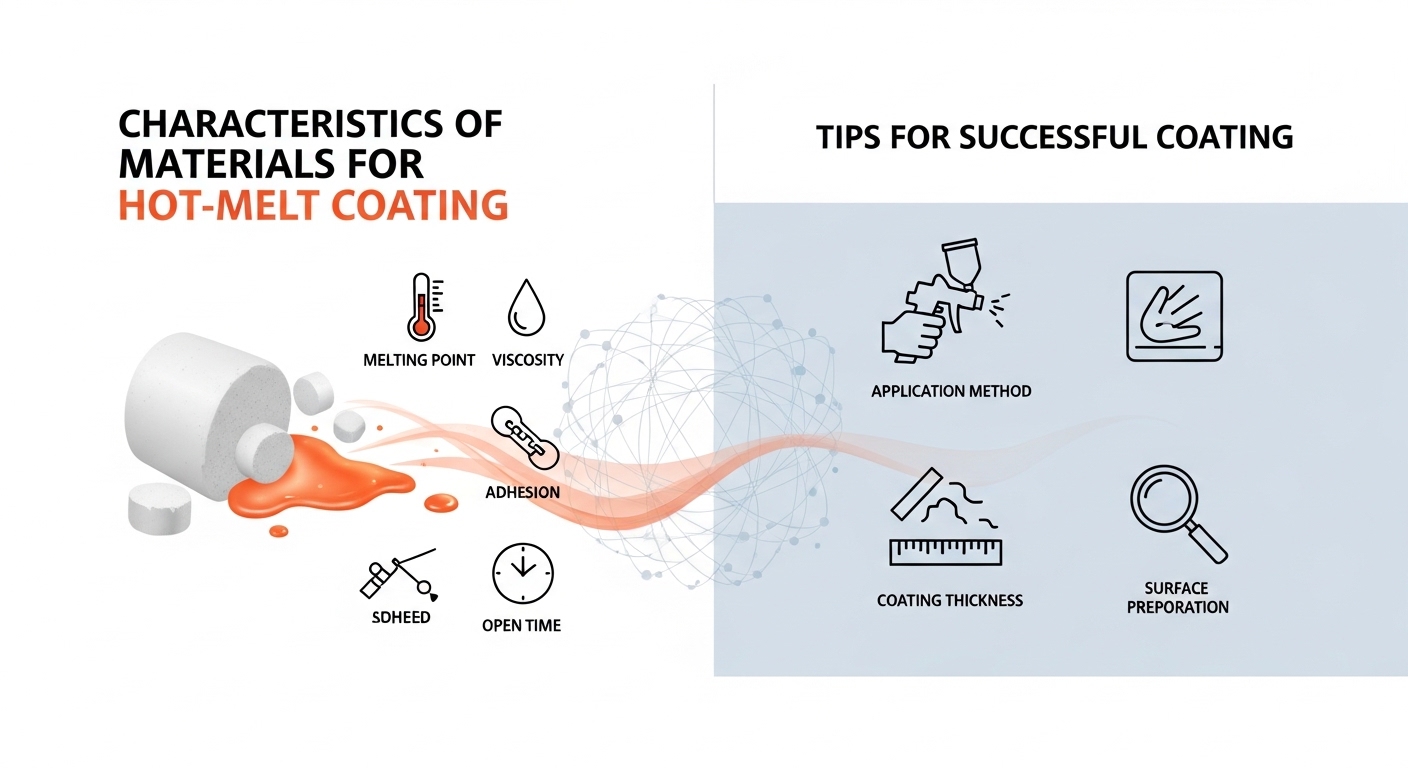
Achieving a flawless, high-performance coating requires more than just choosing the right materials; it demands a systematic approach to process control. Optimizing your setup involves careful substrate preparation, precise machine settings, and selecting the right application method. For non-porous materials, surface pre-treatment is often non-negotiable to achieve a durable bond. Furthermore, matching the adhesive's properties, such as viscosity and open time, to the line speed and substrate is essential for consistent quality. Different application heads, like slot-die, roller, or spray systems, offer unique advantages depending on the required coating thickness and pattern.
| Checklist Item | Purpose | Key Consideration |
|---|---|---|
| Substrate Analysis | Ensure compatibility with the process | Verify heat resistance, surface energy, and cleanliness. |
| Adhesive Selection | Match adhesive to the substrate and end-use | Consider viscosity, open time, and required bond strength. |
| Surface Preparation | Enhance adhesion for a robust bond | Clean away dust/oils; apply pre-treatment if needed. |
| Parameter Tuning | Optimize final coating quality | Adjust application temperature, pressure, and line speed. |
Maximizing Productivity and Quality in Coating Processes 📈
The core benefit of hot-melt coating is the significant boost in productivity. The near-instant setting time eliminates bottlenecks associated with drying or curing, enabling faster production speeds and reducing factory floor footprint. This efficiency translates directly into higher output and lower operational costs. However, maximizing these benefits requires addressing potential limitations. For instance, extremely heat-sensitive materials may not be suitable for standard hot-melt applications. Success in 2026 hinges on a strategic approach: thoroughly understanding your hot melt adhesive coating materials, selecting equipment that offers precise control over temperature and application volume, and implementing rigorous quality control measures. This holistic view ensures you leverage the full potential of hot-melt technology.
⚠️CAUTION
Ignoring substrate pre-treatment, especially for non-porous materials like films and metals, is a common cause of coating failure. Proper surface preparation is not optional; it is essential for achieving a durable, high-performance bond.