


Table of Contents
- Decoding the Price Spectrum of Hot Melt Coaters
- Entry-Level and Mid-Range Machines: What to Expect
- High-End Industrial Systems: Features and Investment
- Key Technical Specifications That Drive Cost
- Beyond the Sticker Price: Total Cost of Ownership (TCO)
- A Strategic Approach to Selecting Your Machine
When planning a capital equipment purchase, understanding the market landscape is crucial. Consider two factories: one invests a few thousand dollars in a new adhesive system, while another allocates over a hundred thousand for theirs. Both use hot melt technology, yet the investment gap is immense. This disparity isn't arbitrary; it reflects the vast and varied world of hot melt adhesive coating machines. The price of a hot melt coating machine can range from that of a high-end office printer to a luxury car, and for good reason. The final cost is a direct reflection of the machine's scale, speed, precision, and level of automation. This guide will demystify the pricing tiers, explain the features that drive costs, and provide a strategic framework for aligning your budget with your specific manufacturing needs in 2026.
Decoding the Price Spectrum of Hot Melt Coaters
The market for hot melt adhesive coating machines is incredibly broad, with prices spanning from a few hundred dollars for simple, manual applicators to several hundred thousand for fully automated, high-speed production lines. This wide spectrum exists to serve an equally diverse range of applications, from small-scale workshops to large, continuous manufacturing facilities. Understanding the general categories is the first step in creating a realistic budget.
A small, tabletop unit designed for low-volume assembly or product development will naturally carry a much lower price tag than a wide-web laminating machine integrated into a 24/7 production line. The key takeaway is that price is directly correlated with capability. As production demands increase in terms of volume, speed, coating width, and precision, the complexity of the engineering—and therefore the cost—rises exponentially. Simply put, you are investing in productivity and consistency.
| Machine Category | Typical Price Range (USD) | Common Applications |
|---|---|---|
| Manual / Benchtop | $500 - $8,000 | Prototyping, R&D, low-volume assembly, repairs |
| Semi-Automatic / Standalone | $15,000 - $50,000 | Small to medium enterprises (SMEs), batch production, packaging |
| Fully-Automated Industrial Line | $75,000 - $300,000+ | High-volume manufacturing, wide-web lamination, automotive |
Entry-Level and Mid-Range Machines: What to Expect
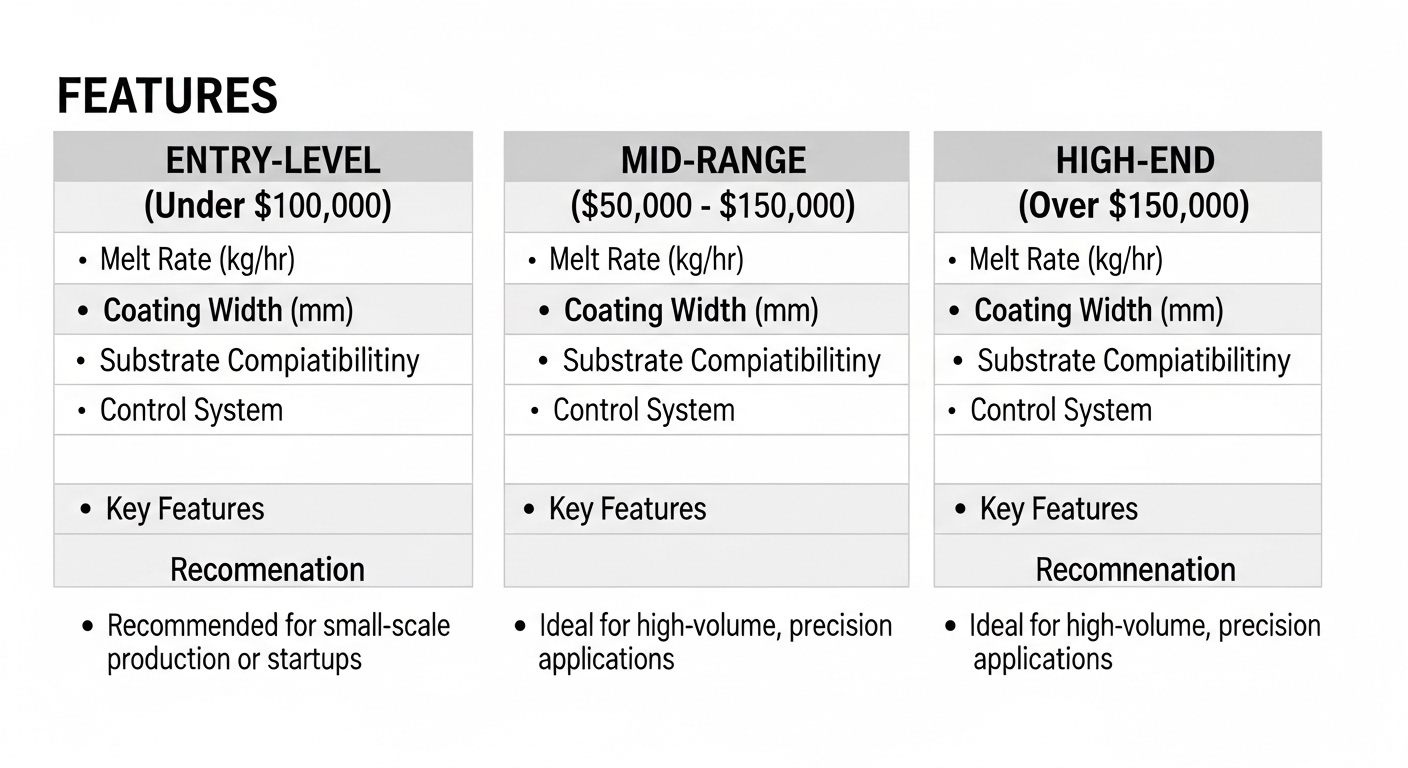
For many small to medium-sized enterprises (SMEs) or those with specialized, lower-volume needs, the entry-level and mid-range categories offer the perfect balance of functionality and affordability. These machines, typically priced between approximately $2,000 and $50,000, are the workhorses of batch production, product assembly, and packaging lines where full-scale automation is not required.
Entry-level systems often consist of benchtop units or simple, standalone applicators. They are ideal for tasks requiring manual guidance or for processes where production speed is not the primary driver. They provide access to the benefits of hot melt technology—fast curing and strong bonds—without the significant capital outlay of an industrial line. Mid-range machines introduce a greater degree of control and automation. These may include features like automatic feeding systems, basic temperature and pressure controls, and wider coating heads, making them suitable for more consistent and higher-volume batch work.
💡핵심 포인트
Characteristics of Entry to Mid-Range Machines:
- Coating Width: Generally narrow, designed for specific product dimensions.
- Operation: Manual, semi-automatic, or basic automation.
- Speed: Lower production speeds suitable for batch processing.
- Flexibility: Often versatile for different products but may require manual changeovers.
- Footprint: Relatively small and often self-contained.
High-End Industrial Systems: Features and Investment
At the top end of the spectrum are the high-end industrial hot melt adhesive coating machines. With investments often starting at $75,000 and frequently exceeding $300,000, these systems are engineered for maximum productivity, precision, and integration. They are not merely standalone machines but are typically a critical component of a larger, continuous production line in industries like nonwovens, automotive assembly, or large-scale packaging.
The primary differentiators of these systems are speed, width, and automation. They are designed to operate at very high speeds, applying adhesive consistently across wide material webs, sometimes several meters across. Automation is a key feature, with advanced PLC (Programmable Logic Controller) systems managing every variable from adhesive temperature and flow rate to application pattern and line speed. These machines often include sophisticated quality control features like vision systems to detect defects in real-time, minimizing waste and ensuring product conformity. The investment is substantial, but for high-volume manufacturers, the return is found in unparalleled efficiency, reduced labor costs, and superior product quality.
Consider a high-end industrial system when your operation requires one or more of the following:
- 24/7 continuous production schedules.
- Extremely high throughput and production speeds.
- Very wide material webs requiring uniform coating.
- Strict quality control and documentation for industries like medical or automotive.
- Full integration with upstream and downstream manufacturing processes.
Key Technical Specifications That Drive Cost
The price of a hot melt adhesive applicator is not arbitrary; it is a direct result of its engineering and capabilities. Several key technical specifications are the primary drivers of cost. When requesting a quote, being specific about these requirements is essential for getting an accurate price and a machine that fits your needs. A machine with a wider coating capability or higher speed requires more robust construction, larger motors, and more sophisticated control systems, all of which contribute to a higher price.
The level of automation is perhaps the single biggest cost factor. A simple manual system has minimal electronic components, while a fully automated line requires a complex integration of sensors, PLCs, and robotics. Likewise, the type of application head—for example, a precision slot die for continuous coating versus a simpler spray nozzle—can significantly alter the final investment.
| Feature | Low-Cost Impact | High-Cost Impact |
|---|---|---|
| Coating Width | Narrow (e.g., under 300mm) | Wide Web (e.g., over 1000mm) |
| Production Speed | Low (e.g., < 20 m/min) | High (e.g., > 150 m/min) |
| Automation | Manual loading & operation | Fully integrated, robotic handling |
| Application Head | Basic bead or spray nozzle | Precision slot die, pattern control |
Beyond the Sticker Price: Total Cost of Ownership (TCO)
A savvy equipment buyer looks beyond the initial purchase price and considers the Total Cost of Ownership (TCO). The upfront investment is only one part of the financial picture. Over the machine's lifespan, other costs will arise, and factoring them into your budget from the outset ensures a more sustainable and predictable investment. A cheaper machine that is inefficient or unreliable can quickly become more expensive than a higher-quality alternative.
Key components of TCO include routine maintenance, the cost of replacement parts (like nozzles, filters, and hoses), and energy consumption. Furthermore, the machine's efficiency in using the hot melt adhesive itself can have a major financial impact. A system with precise application control can reduce adhesive waste, leading to significant material savings over time. Finally, consider ancillary costs such as operator training and potential downtime. A well-built, reliable machine with good technical support minimizes costly production interruptions.
💡KEY POINT
Elements of Total Cost of Ownership (TCO):
- Initial Purchase Price: The upfront capital expenditure.
- Maintenance & Parts: Cost of routine servicing and replacing wearable components.
- Material Consumption: Efficiency of the machine in using adhesive.
- Energy Costs: Power required to operate the melter and drive systems.
- Downtime & Labor: Costs associated with production stops and operator training.
A Strategic Approach to Selecting Your Machine
Making an informed decision on a hot melt coating machine requires a strategic approach that goes beyond just comparing prices. The optimal choice is one that aligns perfectly with your specific application, production volume, and long-term business goals. The most expensive machine is not always the best solution if its capabilities far exceed your needs, just as the cheapest option can be a poor investment if it cannot meet quality or volume requirements.
The process should begin with a thorough internal assessment. Clearly define your technical requirements before engaging with suppliers. What substrates will you be bonding? What type of hot melt adhesive will be used? What are your target production speeds and daily volumes? Answering these questions will create a detailed specification sheet. With this information, you can request customized quotes from reputable manufacturers. This ensures you are comparing equivalent machines and empowers you to have a productive discussion about how a particular model will deliver a return on your investment, making your final decision a strategic one.