



Table of Contents
- Why Eco-Friendly Hot Melts are Essential for Automotive
- Comparing Hot Melt Types and Their Environmental Impact
- Real-World Applications in Modern Vehicles
- Balancing High-Speed Production with Sustainability
- 2026 Trends and the Future of Green Automotive Adhesives
As the automotive industry accelerates towards electric and lightweight vehicles, the materials used to build them are undergoing a revolution. By 2026, the average vehicle contains a complex mix of plastics, composites, and lightweight metals, making traditional fasteners like rivets and screws increasingly obsolete. This shift has placed a spotlight on advanced bonding solutions. Automotive hot melt adhesives have emerged as a critical technology, not just for their ability to bond dissimilar materials, but for their role in creating more sustainable and efficient manufacturing processes. How can a simple adhesive solve the complex challenges of modern car production?
Why Eco-Friendly Hot Melts are Essential for Automotive 🌿
The modern automotive landscape is defined by two powerful forces: stringent environmental regulations and the demand for lightweight, high-performance vehicles. Traditional solvent-based adhesives, which release Volatile Organic Compounds (VOCs), are no longer a viable option for manufacturers aiming to meet global emissions standards. This is where eco-friendly hot melt adhesives become indispensable.
These adhesives are 100% solid formulations that contain no solvents or water, meaning they release virtually zero VOCs during application. This characteristic is crucial for improving air quality within manufacturing plants and reducing the overall environmental footprint of vehicle production. Furthermore, the increasing use of composite materials, plastics, and advanced alloys to reduce vehicle weight requires bonding solutions that are both strong and flexible. Hot melts provide exceptional adhesion across this diverse range of substrates, ensuring structural integrity while accommodating the different thermal expansion rates of various materials.
💡KEY POINT
- Zero VOCs: Eco-friendly hot melts eliminate the release of harmful Volatile Organic Compounds, aligning with strict environmental regulations.
- Material Versatility: They provide strong, reliable bonds for the complex mix of plastics, metals, textiles, and composites found in modern vehicles.
- Lightweighting Enabler: By replacing mechanical fasteners, they contribute directly to vehicle weight reduction, improving fuel efficiency and battery range.
Comparing Hot Melt Types and Their Environmental Impact 🔬
Not all hot melts are created equal. The choice of polymer base dictates the adhesive's performance characteristics and environmental profile. For automotive applications, four main types dominate the market, each with specific strengths. Understanding these differences is key for engineers and procurement specialists to make informed decisions that optimize both quality and sustainability.
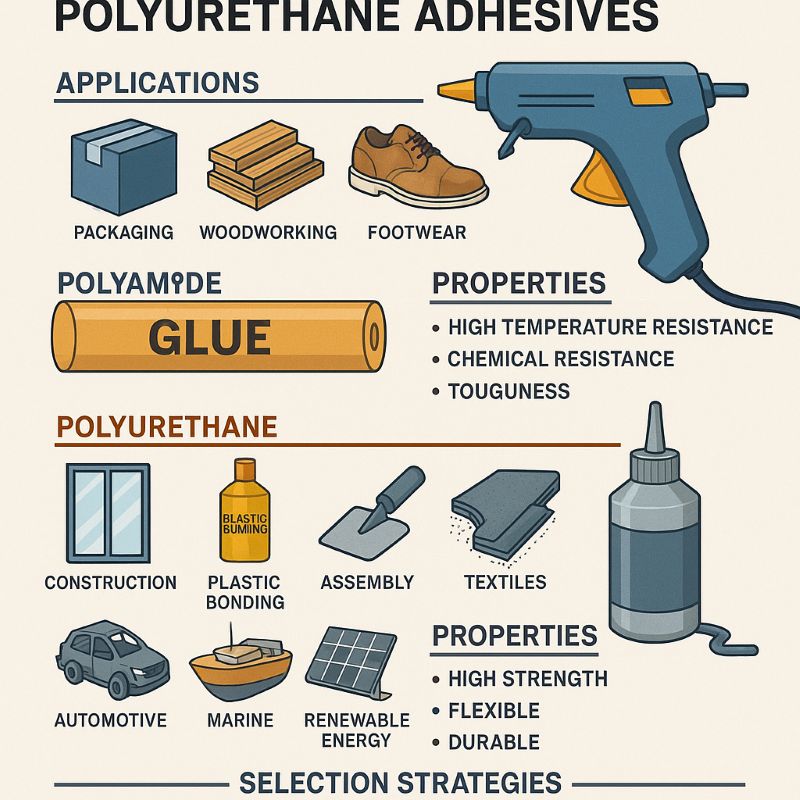
PUR (Polyurethane Reactive) hot melts offer superior structural strength and resistance to extreme temperatures and chemicals after curing with ambient moisture. APAO (Amorphous Poly-Alpha-Olefin) adhesives are known for their excellent thermal stability and adhesion to low-energy surfaces like polypropylene. PSA (Pressure-Sensitive Adhesives) remain tacky after cooling, making them ideal for interior trim and components that need to be repositioned. Finally, Polyamide hot melts provide high heat resistance and strong bonds, often used in under-the-hood applications. Choosing the right type involves a careful analysis of the specific component, its operating environment, and the production line requirements.
| Hot Melt Type | Key Advantage | Common Automotive Application |
|---|---|---|
| PUR | High structural strength, chemical resistance | Headlamp bonding, structural components |
| APAO | Excellent adhesion to plastics (PP, PE) | Interior door panels, trunk liners |
| Polyamide | High heat and oil resistance | Wire harnessing, electronic component potting |
| PSA | Permanent tackiness, repositionable | Foam gaskets, sound-dampening pads, labels |
Real-World Applications in Modern Vehicles 🚗
The impact of hotmelt adhesive for automotive use is visible throughout a vehicle, from the chassis to the cabin. In vehicle interiors, they are used to bond headliners, attach door panels, and secure carpeting. Their rapid setting time is a major advantage on fast-moving assembly lines. The absence of VOCs also ensures a healthier cabin environment for the end-user, free from the "new car smell" often caused by off-gassing chemicals.
In exterior and structural applications, the demands are even greater. Hot melts are used for bonding exterior trim, sealing headlamps against moisture, and even in some semi-structural applications. For example, specific PUR hot melts can withstand the extreme temperatures and vibrations experienced in the engine compartment, securing sensors and electronic modules reliably. This versatility allows manufacturers to streamline assembly processes, reduce the number of mechanical fasteners, and ultimately build lighter, quieter, and more durable vehicles.
When selecting a hot melt for a specific application, always consider the "Big Three" factors: substrates, stress, and environment. First, identify the materials you need to bond (Substrates). Second, determine the types of forces the bond will endure, such as vibration, shear, or peel (Stress). Finally, analyze the operating conditions, including temperature range and exposure to moisture or chemicals (Environment). Matching the adhesive to these three criteria is the foundation of a successful application.
Balancing High-Speed Production with Sustainability ⚖️
A primary driver for adopting automotive hot melt adhesive technology is its contribution to production efficiency. Unlike solvent-based systems that require lengthy drying or curing times, hot melts set and build strength rapidly as they cool. This allows for immediate handling of bonded parts, significantly shortening assembly cycles and increasing throughput. Automated robotic application systems can dispense hot melt with incredible precision and speed, further enhancing productivity.
However, the question arises: does this focus on speed compromise sustainability? In the case of hot melts, the answer is a definitive no. The efficiency gains go hand-in-hand with environmental benefits. Faster cycle times mean less energy consumption per unit produced. The elimination of VOCs removes the need for costly and energy-intensive ventilation and abatement equipment. This synergy between productivity and sustainability is a core reason why hot melts are a cornerstone of modern, green automotive manufacturing.
| Feature | Traditional Adhesives (Solvent-Based) | Eco-Friendly Hot Melts |
|---|---|---|
| Cure Time | Minutes to Hours | Seconds to Minutes |
| VOC Emissions | High | Near-Zero |
| Energy Use | High (for drying ovens/abatement) | Lower (for melting only) |
| Assembly Speed | Slower | Significantly Faster |
2026 Trends and the Future of Green Automotive Adhesives 📈
Looking ahead, the evolution of automotive adhesives is set to continue at a rapid pace. The key trend for 2026 and beyond is the development of bio-based and recyclable hot melt formulations. As the industry pushes for a fully circular economy, adhesives must not hinder the disassembly and recycling of vehicle components. Researchers are actively working on hot melts derived from renewable resources that maintain high performance while offering improved end-of-life options.
Another significant trend is the integration of adhesives into smart factory and Industry 4.0 environments. This includes systems with advanced sensors that monitor application parameters like temperature, pressure, and volume in real-time, ensuring perfect consistency and quality control. This data-driven approach minimizes waste and guarantees that every bond meets stringent engineering specifications. The future of automotive bonding lies in materials that are not only strong and efficient but also intelligent and sustainable.
💡KEY POINT
- Bio-Based Formulations: The next generation of hot melts will increasingly be derived from renewable, sustainable resources to support a circular economy.
- Recyclability: Development is focused on "de-bond on demand" adhesives that facilitate easier disassembly and recycling of vehicle components.
- Smart Application: Integration with Industry 4.0 systems will allow for real-time monitoring and data analysis, ensuring flawless quality and minimizing waste.