


Table of Contents
- Why Standard EVA Falls Short in High Heat
- Exploring High Temperature Resistant Hot Melt Polymers
- Key Properties: Softening Point and Glass Transition
- Matching Polymers to Real-World Application Needs
- Future Trends in Heat-Resistant Hot-Melt Adhesives
As industrial manufacturing advances into 2026, the demand for durable bonding solutions in extreme environments has surged significantly. Traditional adhesives often fail when exposed to severe thermal stress, leading to structural failures and operational downtime. For material developers, selecting the optimal high temperature resistant hot melt adhesive polymer is a fundamental requirement for ensuring product reliability. This shift necessitates a departure from conventional materials and a deep understanding of advanced polymer chemistry designed specifically for elevated thermal conditions.
Why Standard EVA Falls Short in High Heat 🌡️
Ethylene-vinyl acetate (EVA) remains a widely utilized base material in the packaging and assembly sectors due to its versatility and rapid set times. However, standard EVA typically lacks the thermal stability required for demanding environments. Empirical data indicates that EVA exhibits poor high-temperature resistance, often failing when ambient conditions reach 60 °C to 80 °C. When exposed to elevated temperatures, the polymer structure becomes highly prone to creep and softening. This physical degradation compromises bond integrity, making EVA unsuitable for rigorous industrial applications. Consequently, transitioning to specialized hot melt adhesive formulations is mandatory to achieve reliable thermal endurance.
- Standard EVA loses structural integrity at temperatures above 60-80 °C.
- The polymer is highly susceptible to thermal creep and rapid softening under continuous heat.
- Industrial applications require advanced polymeric alternatives for reliable high-heat performance.
Exploring High Temperature Resistant Hot Melt Polymers 🔬
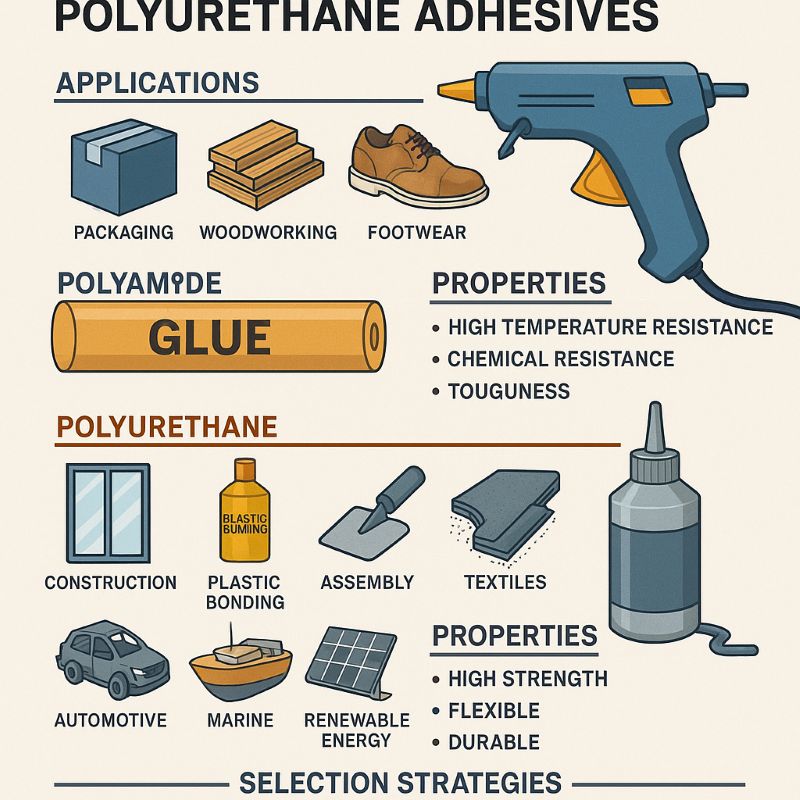
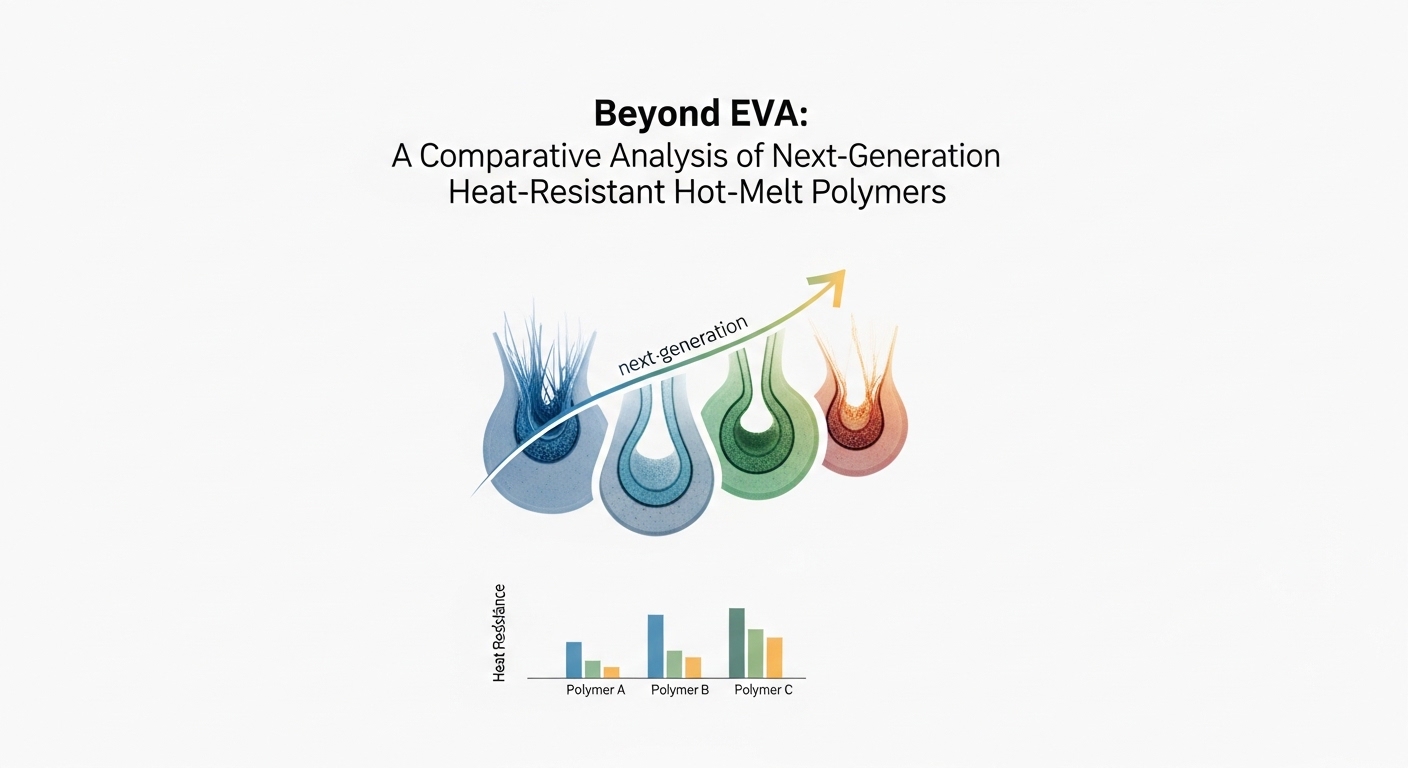
To overcome the limitations of standard materials, the industry relies on specialized polymers engineered for superior thermal stability. Polyamides (PA) and Polyesters are among the most effective thermoplastic options available. They provide excellent heat resistance and mechanical strength, with certain polyester grades remaining functional well above 90 °C to 150 °C. Additionally, Polyurethane Reactive (PUR) adhesives represent a highly specialized category. PUR undergoes a secondary moisture-curing process that forms permanent chemical bonds. This unique crosslinking mechanism significantly enhances structural integrity and provides exceptional long-term heat resistance.
| Polymer Type | Thermal Characteristics | Primary Bonding Mechanism |
|---|---|---|
| Polyamides (PA) | Excellent high-temperature resistance | Thermoplastic solidification |
| Polyesters | Superior mechanical strength under heat | Thermoplastic solidification |
| Reactive PUR | Exceptional creep resistance | Moisture-curing crosslinking |
Key Properties: Softening Point and Glass Transition 📊
The primary objective in formulating a high temperature resistant hot melt adhesive polymer is identifying materials with specific thermal metrics. The softening point and the Glass Transition Temperature (Tg) serve as the definitive indicators of thermal endurance. A high softening point ensures that the adhesive maintains its solid state under operational heat stress. Simultaneously, a high Tg indicates the specific temperature threshold where the polymer transitions from a rigid state to a pliable, rubbery state. Maintaining operational temperatures below the Tg ensures the bond does not exhibit polymer creep or fail when exposed to sustained thermal loads.
Always measure the exact service temperature of your target application and verify that it remains comfortably below the Tg of the selected polymer to prevent unexpected bond degradation.
Matching Polymers to Real-World Application Needs 🏭
Selecting the appropriate polymer requires a systematic analysis of the specific application environment. High-temperature resistance depends not just on the base material but also on factors like crystallinity, intermolecular forces, and crosslinking density. Automotive and electronic components often endure service temperatures reaching 150 °C to 180 °C. In these scenarios, reactive PUR or high-grade polyamides offer the best overall high-temperature performance. Conversely, for technical assemblies requiring moderate thermal resistance alongside specific difficult substrate compatibility, copolyesters provide a highly balanced solution. Evaluating the exact temperature range ensures long-lasting structural stability.
| Application Field | Typical Temp Range | Recommended Polymer Base |
|---|---|---|
| Automotive Components | 150 °C - 180 °C | Reactive PUR, Polyamides |
| Electronics Assembly | 90 °C - 150 °C | Polyamides, Polyesters |
| General Industrial | 80 °C - 100 °C | Advanced Copolyesters |
Future Trends in Heat-Resistant Hot-Melt Adhesives 🚀
As of 2026, the trajectory of adhesive technology focuses on maximizing thermal stability without compromising application efficiency. Innovations center on manipulating intermolecular forces and enhancing the crystallinity of base polymers to push service temperature limits even higher. Researchers are actively developing advanced copolyesters and next-generation PUR formulations that cure faster while offering unprecedented resistance to thermal degradation. The ongoing evolution of the high temperature resistant hot melt adhesive polymer sector indicates a continuous shift toward customized, application-specific formulations that guarantee permanent chemical bonds even in the most extreme industrial environments.
Do not rely solely on general polymer classifications during the material selection phase. Always conduct rigorous thermal cycle testing on actual substrate samples, as real-world environmental factors can significantly alter theoretical thermal limits.