


Table of Contents
- What Are They?
- Environmental Pros
- Current Limits
- True Sustainability
- Choosing Adhesives
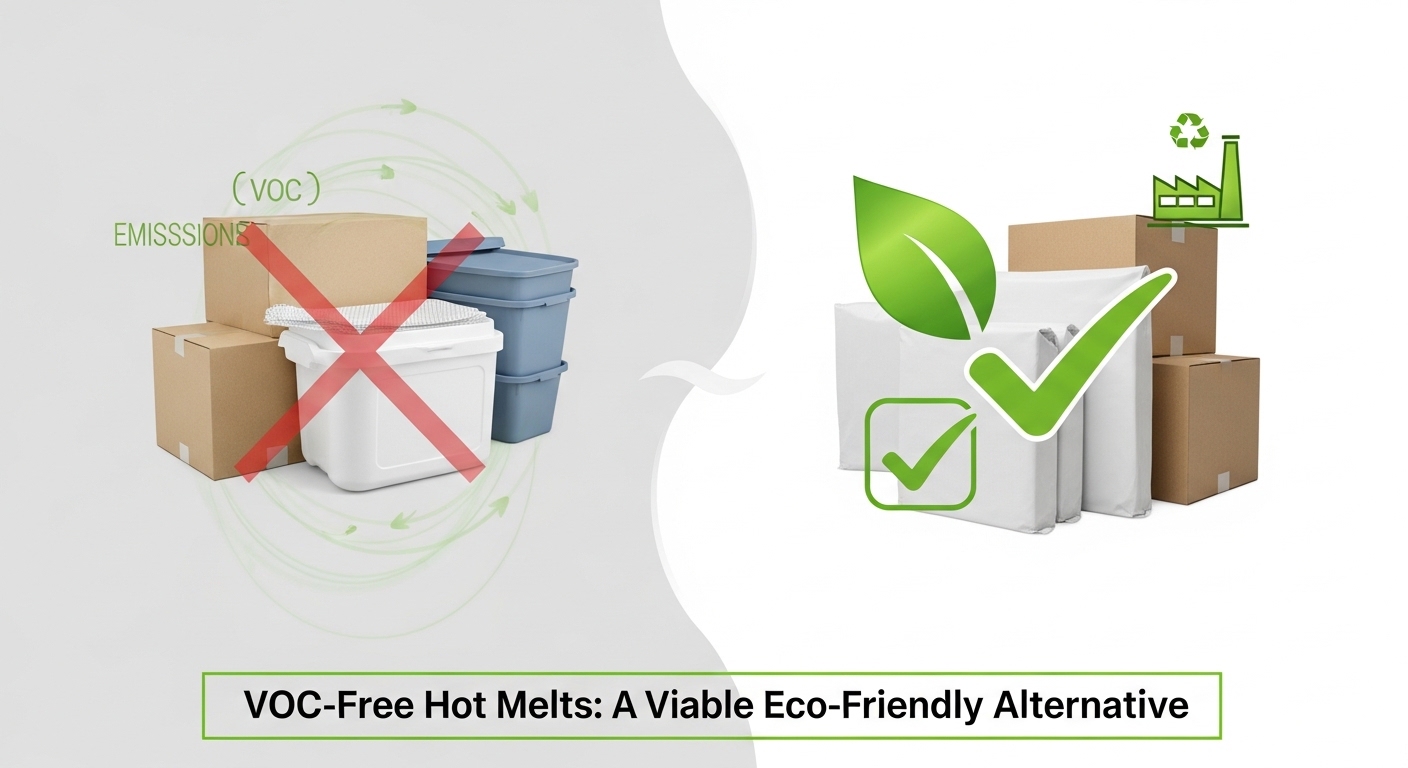
In 2026, the industrial packaging sector faces an unprecedented regulatory push toward sustainable materials. Traditional solvent-based adhesives contribute significantly to industrial air pollution. As companies scramble for greener alternatives, VOC-free hot melt adhesives have emerged as a leading contender. While eliminating volatile organic compounds is a massive step forward, it is not a silver bullet for complete environmental compliance. Let us explore whether these adhesives truly represent the future of sustainable packaging and how organizations can make the most responsible choices.
What Are They? 🏭
A VOC-free hot melt adhesive is a thermoplastic bonding agent formulated completely without volatile organic compounds. Unlike conventional options that release harmful gases, these adhesives transition from a solid to a liquid state purely through heat. They cool and solidify rapidly to create a strong bond. In the industrial sectors, reducing VOC emissions is critical to protecting worker health and meeting stringent air quality standards. By utilizing solid polymers, manufacturers bypass the need for hazardous liquid solvents entirely.
- Formulated entirely without harmful volatile organic compounds.
- Relies on thermal phase changes rather than chemical solvents.
- Essential for improving factory air quality in 2026.
Environmental Pros 🌍
Switching to a VOC-free hot melt provides immediate ecological and occupational benefits. These adhesives are significantly better for the environment and human health than their solvent-based counterparts. By omitting toxic solvents, they dramatically improve indoor air quality and reduce the carbon footprint of manufacturing facilities. Workers are no longer exposed to hazardous airborne chemicals, making the production floor substantially safer.
| Feature | Solvent-Based | VOC-Free Hot Melt |
|---|---|---|
| Air Pollution | High VOC emissions | Zero to minimal |
| Worker Safety | Serious health risks | Significantly safer |
| Curing Method | Chemical evaporation | Thermal cooling |
Current Limits 🚧
Despite clear advantages, these adhesives are not entirely flawless. The term environmentally friendly carries nuances, and a major drawback is that standard formulations still rely on petroleum-based polymers. Consequently, they lack natural biodegradability. During the recycling process of cardboard, adhesive residues can remain as sticky contaminants. These remnants degrade the quality of recycled paper products and can severely clog recycling machinery.
Most synthetic hot melts do not biodegrade naturally and can contaminate paper recycling streams if not properly managed.
True Sustainability ♻️
To achieve genuine environmental responsibility, evaluating a hot melt adhesive must go beyond checking for the absence of VOCs. Industry leaders emphasize the importance of bio-based ingredients derived from renewable resources rather than fossil fuels. Verifying third-party environmental labels ensures the product meets strict ecological standards. A truly sustainable approach requires analyzing the formulation and the ultimate end-of-life disposal method.
| Criteria | Description | Importance |
|---|---|---|
| Bio-based Content | Sourced from renewable plants | Reduces fossil fuel reliance |
| Biodegradability | Breaks down naturally over time | Prevents microplastic buildup |
| Certifications | ASTM D6400 or EN 13432 | Verifies ecological claims |
Choosing Adhesives 🎯
Selecting the ideal VOC-free hot melt requires a structured approach tailored to your specific application. Decision-makers must balance mechanical performance requirements with long-term environmental strategies. Adhesives that melt at lower temperatures are particularly advantageous, as they significantly reduce energy consumption during application. Always review the technical data sheets to align adhesive properties with your corporate sustainability targets.
Prioritize low-temperature melting formulations to simultaneously cut down on factory energy consumption and operational costs.