


Table of Contents
- Understanding High Performance Hot Melt Adhesives
- Key Properties by Base Material Type
- Application Scenarios Across Industries
- Selecting the Right Hot Melt for Your Needs
- Future Trends in Hot Melt Adhesive Innovation
From the smartphone in your pocket to the car you drive, countless products rely on connections that are invisible yet incredibly strong. While many might think of simple craft glue sticks, the world of industrial adhesion is powered by sophisticated materials. High performance hot melt adhesives are a specialized category of these materials, engineered not just to stick, but to endure. Unlike standard adhesives that may fail under stress, these advanced formulations provide superior bonding strength and durability even in the most challenging conditions, making them a cornerstone of modern manufacturing and a critical component for product quality and longevity.
Understanding High Performance Hot Melt Adhesives ⚙️
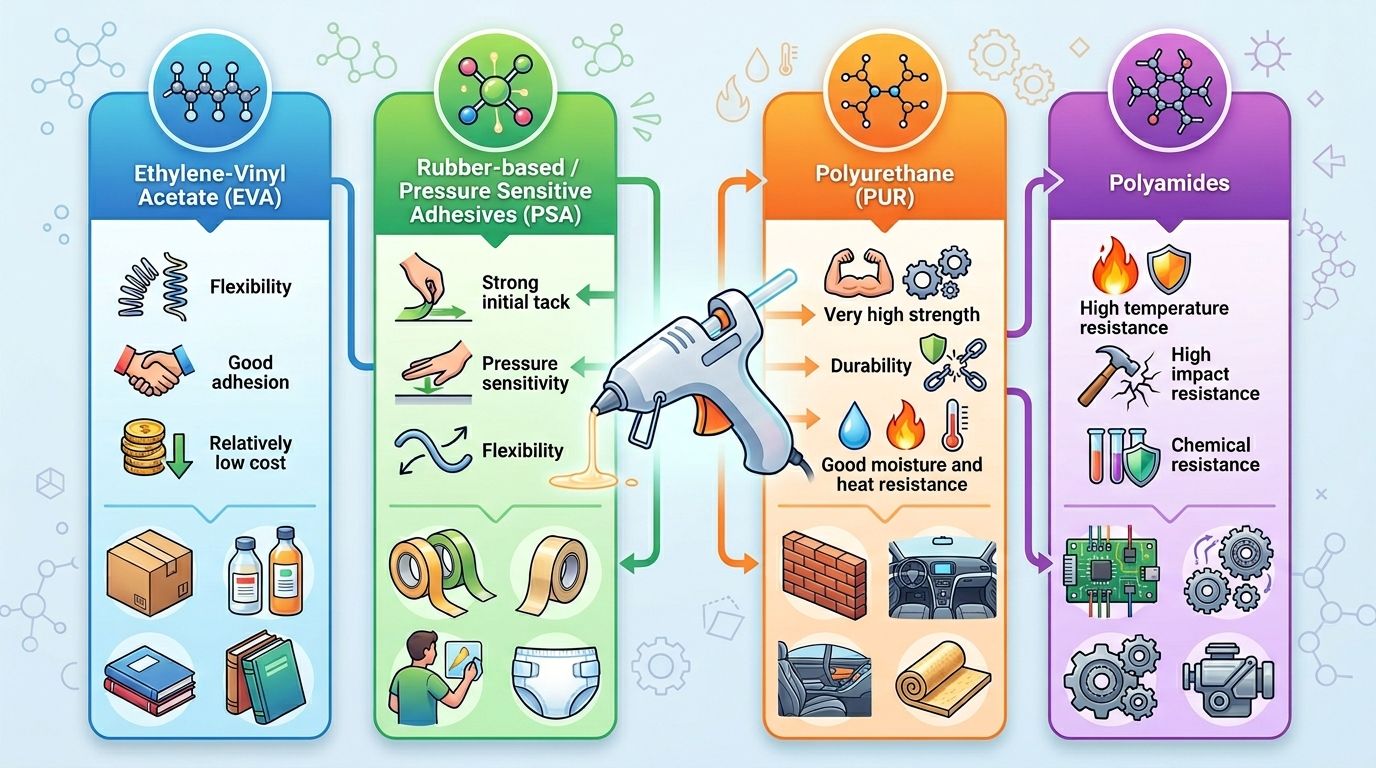
A high performance hot melt is a type of thermoplastic adhesive specifically engineered for demanding industrial applications. It goes far beyond the capabilities of standard hot melts, which are often based on materials like Ethylene Vinyl Acetate (EVA). The primary distinction lies in its ability to maintain a strong, reliable bond under conditions where conventional adhesives would degrade or fail. These conditions include extreme temperatures, exposure to chemicals, high humidity, and significant mechanical stress.
The core of their superior performance comes from advanced polymer chemistry. Formulations based on polyamides, polyesters, and reactive urethanes (PUR) are designed to provide enhanced thermal stability, chemical resistance, and adhesion to difficult-to-bond substrates like metals, glass, and engineered plastics. While a standard hot melt might be suitable for simple cardboard packaging, a high-performance hotmelt adhesive is essential for assembling automotive interior components or sealing sensitive electronic devices. This makes them less of a simple "glue" and more of an integral engineering material that directly impacts a product's final quality and durability.
💡KEY POINT
Key Differentiators: Standard vs. High Performance Hot Melt
- Thermal Resistance: High performance variants withstand a much wider temperature range, from as low as -40°C to over 150°C.
- Chemical Resistance: They offer superior resistance to oils, solvents, and other industrial chemicals.
- Bond Strength: Engineered for significantly higher tensile and peel strength on a wider variety of substrates.
- Durability: They maintain flexibility and adhesion integrity under prolonged mechanical stress and environmental exposure.
Key Properties by Base Material Type 🔬
The performance of a hot melt adhesive is fundamentally defined by its base polymer. Each material type offers a unique profile of properties, making it suitable for specific applications. Understanding these differences is crucial for selecting the right adhesive for an industrial process. The choice of material directly impacts factors like heat resistance, flexibility, bond strength, and cost. For example, a material ideal for woodworking may not be suitable for bonding electronic components exposed to high temperatures.
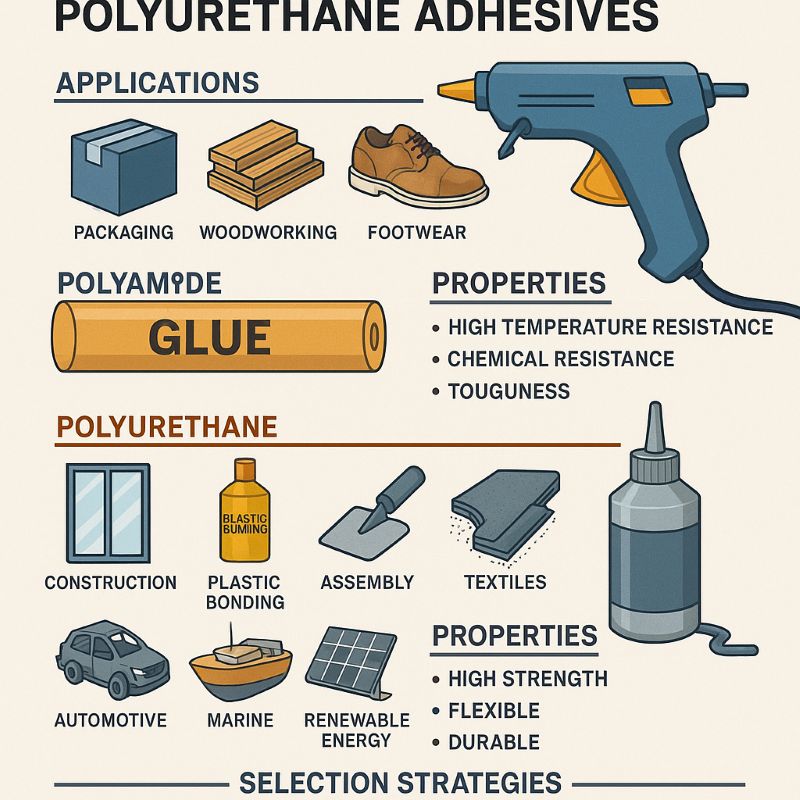
Polyamide (PA) hot melts are known for their excellent heat and chemical resistance, particularly to oils and greases. They form tough, durable bonds and are often used in automotive and electronics applications. Reactive Polyurethane (PUR) hot melts offer a unique advantage: they cure with ambient moisture after application, forming a thermoset plastic. This cross-linking process results in an exceptionally strong, permanent bond with outstanding resistance to temperature, moisture, and chemicals. Polyolefins, including APAO (Amorphous Poly-Alpha-Olefin), provide excellent adhesion to non-polar plastics like polypropylene and polyethylene, which are notoriously difficult to bond. They are valued for their flexibility and moisture resistance.
| Material Base | Key Strengths | Common Applications |
|---|---|---|
| Polyamide (PA) | High heat & oil resistance, toughness | Automotive filters, electronic potting |
| Polyurethane (PUR) | Superior bond strength, moisture curing | Woodworking, bookbinding, textiles |
| Polyolefin (APAO) | Adhesion to plastics, flexibility | Packaging, nonwovens, product assembly |
Application Scenarios Across Industries 🏭
The versatility and reliability of high performance hot melt adhesives have made them indispensable across a wide range of industries. In each sector, they are chosen to solve specific challenges that standard adhesives cannot address. Their ability to create strong, fast-setting bonds improves production efficiency while ensuring the final product can withstand its intended service environment. From consumer goods to heavy industrial equipment, these advanced adhesives are working behind the scenes.
In the automotive industry, they are used for bonding interior trims, headliners, and dashboard components, where they must endure constant vibration and extreme temperature fluctuations. The electronics sector relies on them for precision bonding of components, encapsulating sensitive circuits (potting), and securing wires, as they provide excellent insulation and protection from moisture and thermal shock. In construction and furniture manufacturing, PUR hot melts are favored for structural wood bonding and edge banding, creating bonds that are often stronger than the wood itself. Even in specialized packaging, high performance hot melts are used for freezer-grade food cartons or packages that must resist moisture and low temperatures.
💡KEY POINT
Industry-Specific Use Cases
- Automotive: Bonding trim, sound-dampening materials, filter assembly.
- Electronics: Potting and encapsulating components, wire tacking, sealing housings.
- Construction: Window and door frame assembly, flooring, structural wood bonding.
- Packaging: Sealing cases for frozen foods, difficult-to-bond coated cartons.
Selecting the Right Hot Melt for Your Needs ✅
Choosing the appropriate high performance hot melt is a critical decision that impacts both production efficiency and product quality. The selection process requires a careful evaluation of the application's specific demands. It involves more than just picking the strongest adhesive; factors like substrate compatibility, service environment, and application method must be considered. A mismatched adhesive can lead to bond failure, production downtime, and costly rework. Therefore, a systematic approach is essential.
Key considerations include the materials being bonded (substrates), the expected temperature range the final product will endure, and any potential exposure to chemicals or moisture. The required open time (the window between application and bonding) and set time (the time to form a handling-strength bond) are also crucial for process compatibility. For instance, a fast-moving automated assembly line requires an adhesive with a very short set time, whereas a manual process might benefit from a longer open time to allow for precise alignment.
Before full-scale implementation, always conduct thorough testing on the actual substrates under simulated service conditions. This helps verify bond strength, environmental resistance, and compatibility with your application equipment, preventing unexpected failures in the field.
Future Trends in Hot Melt Adhesive Innovation 🌐
The field of high performance hot melt adhesives is continuously evolving, driven by new industrial requirements and a growing emphasis on sustainability. As of 2026, innovation is focused on developing next-generation materials that offer enhanced performance while minimizing environmental impact. Manufacturers are increasingly demanding adhesives that not only meet stringent technical specifications but also align with their corporate sustainability goals. This dual focus is shaping the future of adhesive technology.
One significant trend is the development of bio-based hot melts. These formulations utilize renewable raw materials to reduce reliance on fossil fuels without compromising performance. Another area of advancement is in lower-application-temperature hot melts, which help reduce energy consumption during manufacturing and improve worker safety. Furthermore, there is ongoing research into adhesives with enhanced functionalities, such as thermally conductive or electrically insulating properties for advanced electronics applications. As industries like electric vehicles and renewable energy expand, the demand for specialized high-performance hotmelt adhesive solutions that can meet these new, demanding challenges will only continue to grow.