


Table of Contents
- What Is a Hot-Melt Adhesive Coating Machine?
- Fundamental Principles and System Structure
- Major Advantages Over Conventional Methods
- Key Industrial Applications and Use Cases
- How to Select the Right Coating Solution
In an era where manufacturing demands both unprecedented speed and a commitment to environmental sustainability, how can industries achieve robust bonding without compromise? The answer, increasingly, lies in a technology that has reshaped production lines across the globe. By 2026, the hot-melt adhesive coating machine is no longer just an alternative but a foundational piece of equipment for countless applications. This guide explores the principles, structure, and applications of this transformative technology, offering a clear roadmap for professionals seeking to optimize their production processes.
What Is a Hot-Melt Adhesive Coating Machine?
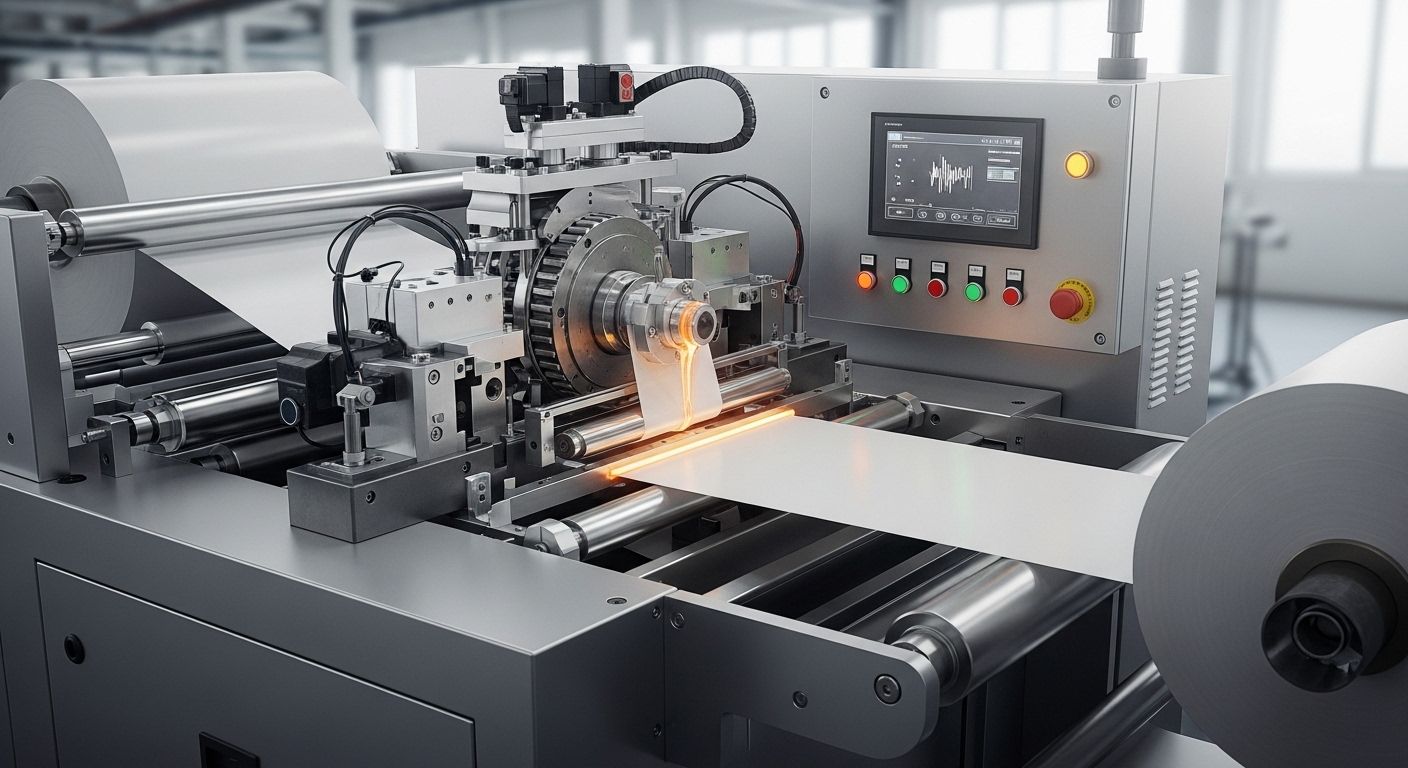
A hot-melt adhesive coating machine, often referred to as a hot-melt coater, is a specialized piece of industrial equipment designed to apply thermoplastic adhesives to various materials, known as substrates. Its core function is to take a solid, 100% non-volatile adhesive, melt it into a liquid state, and then apply it as a precise, uniform layer onto surfaces like paper, film, nonwovens, or textiles. As the adhesive cools, it rapidly solidifies, creating an instant and powerful bond without the need for drying or curing processes. This immediate adhesion is what sets it apart from traditional water-based or solvent-based systems, making it a cornerstone of high-speed, efficient manufacturing in 2026. The technology is valued for its ability to deliver clean, repeatable results in demanding industrial environments.
💡KEY POINT
A hot-melt adhesive coating machine is an industrial system that:
- Melts solid, thermoplastic adhesives using controlled heat.
- Applies the molten adhesive in a precise, uniform layer onto a substrate.
- Achieves instant bonding as the adhesive cools and solidifies, eliminating drying time.
Fundamental Principles and System Structure
The operation of a hot-melt adhesive coating machine is based on a straightforward yet precisely controlled thermodynamic process. The entire system is engineered to manage the adhesive's transition from solid to liquid and back to solid, ensuring optimal application and bonding performance. While designs vary, the structure typically includes several core components working in unison.
The process begins in a heated tank or pre-melter, where the solid adhesive (in pellet, block, or stick form) is melted into a viscous liquid at a specific temperature. A high-precision pump then transfers the molten adhesive through heated hoses to an application head. It is this head that defines the coating pattern and thickness. Modern systems are managed by sophisticated control systems, such as a PLC (Programmable Logic Controller), which precisely regulates temperature, pressure, and application speed to ensure consistent quality.
| Application Method | Description | Best For |
|---|---|---|
| Slot Die Coating | Extrudes a continuous, uniform film of adhesive through a narrow slot. | High-precision, defect-free coatings on flat substrates like labels and tapes. |
| Roller Coating | Transfers adhesive from a heated roller onto the substrate. | Full-surface coating on flexible materials like textiles and foams. |
| Spray Coating | Atomizes the molten adhesive and sprays it onto the substrate. | Irregular surfaces or applications where a non-continuous pattern is needed. |
Major Advantages Over Conventional Methods
The widespread adoption of hot-melt adhesive coating machines is driven by a clear set of advantages over traditional adhesive application methods, particularly those using water-based or solvent-based glues. These benefits translate directly into enhanced productivity, improved product quality, and a better environmental profile. The most significant advantage is the processing speed. Since hot-melt adhesives bond by cooling, there is no need for lengthy drying or curing stages, which are often bottlenecks in conventional processes. This allows for faster line speeds and immediate handling of finished products.
Furthermore, hot-melt adhesives are 100% solid, meaning they contain no solvents or water that must evaporate. This solvent-free nature eliminates the emission of Volatile Organic Compounds (VOCs), making the process significantly more environmentally friendly and safer for operators. It also removes the substantial energy costs associated with running large drying ovens. The resulting bonds are strong, durable, and versatile, capable of adhering to a wide range of porous and non-porous substrates with excellent gap-filling properties.
When evaluating the transition to hot-melt technology, focus on the total process time. The elimination of the drying or curing step not only accelerates production but also reduces the factory footprint required for equipment like ovens and ventilation systems.
Key Industrial Applications and Use Cases
The versatility and efficiency of the hot-melt adhesive coating machine have made it indispensable across a diverse range of industries. Its ability to create strong, reliable bonds on various materials at high speeds enables the mass production of countless consumer and industrial goods. From everyday packaging to critical automotive components, hot-melt technology provides the robust performance that modern manufacturing demands. The specific application method—be it slot die, spray, or roll coating—is tailored to the unique requirements of each product and industry, showcasing the adaptability of the equipment.
This technology is a key enabler for innovation, allowing manufacturers to create complex laminated products, improve packaging integrity, and enhance the functionality of hygiene products. As of 2026, its role continues to expand into new sectors seeking faster, cleaner, and more reliable adhesion solutions.
| Industry | Primary Application | Key Benefit |
|---|---|---|
| Packaging | Carton sealing, case erection, labeling | High-speed bonding for automated production lines. |
| Hygiene Products | Diaper and sanitary napkin construction | Strong yet flexible bonds on nonwoven fabrics. |
| Automotive | Interior trim assembly, headliner lamination | Vibration-resistant bonds and no VOC emissions. |
| Textiles | Lamination of fabrics, seam sealing | Creates breathable or waterproof composite materials. |
| Bookbinding | Spine gluing for perfect-bound books | Fast setting for high-volume printing operations. |
How to Select the Right Coating Solution
Choosing the appropriate hot-melt adhesive coating machine is a critical decision that directly impacts production efficiency, product quality, and operational costs. Making an informed choice requires a thorough analysis of your specific application needs rather than focusing on the machine in isolation. The first step is to clearly define the project parameters, including the types of substrates being bonded, the required production speed, and the characteristics of the adhesive you plan to use, such as its viscosity and open time.
The required coating precision is another crucial factor. For applications demanding a highly uniform, defect-free layer, a slot die coating system is often the best choice. For full-surface coverage on flexible materials, a roller coater may be more suitable. If the target surface is complex or irregular, a spray application system might be necessary. Finally, consider the level of automation and control required. Modern machines equipped with PLC systems offer superior control over temperature, pressure, and coating weight, ensuring repeatability and minimizing waste.
Create a checklist before consulting with equipment suppliers. Key points should include:
- Substrate material and width.
- Desired line speed (e.g., meters per minute).
- Adhesive viscosity at application temperature.
- Required coating weight (e.g., grams per square meter).
- Need for continuous or intermittent application.
This data will help suppliers recommend the most suitable configuration for your needs.
Ultimately, the goal is to invest in a system that not only meets your current production requirements but also offers the flexibility to adapt to future needs. Understanding the core principles and available options empowers you to select a hot-melt coater that will be a valuable asset for years to come.