


Table of Contents
- Understanding the Role of Wax in Hot-Melt Adhesives
- How Wax Composition Shapes Adhesive Performance
- Tailoring Wax Selection for Industrial Applications
- Key Strategies for Maximizing Quality and Cost Efficiency
- Strategic Formulation for 2026
The global manufacturing sector in 2026 demands unparalleled precision in material engineering. At the heart of this evolution lies hot-melt adhesive wax, a component that transcends its traditional reputation as a mere filler. Formulators now recognize it as a strategic modifier that dictates production speed, mechanical integrity, and overall economic viability. By precisely calibrating this crucial ingredient, manufacturers can optimize their assembly lines and achieve superior bonding performance across diverse industrial applications.
Understanding the Role of Wax in Hot-Melt Adhesives 🕯️
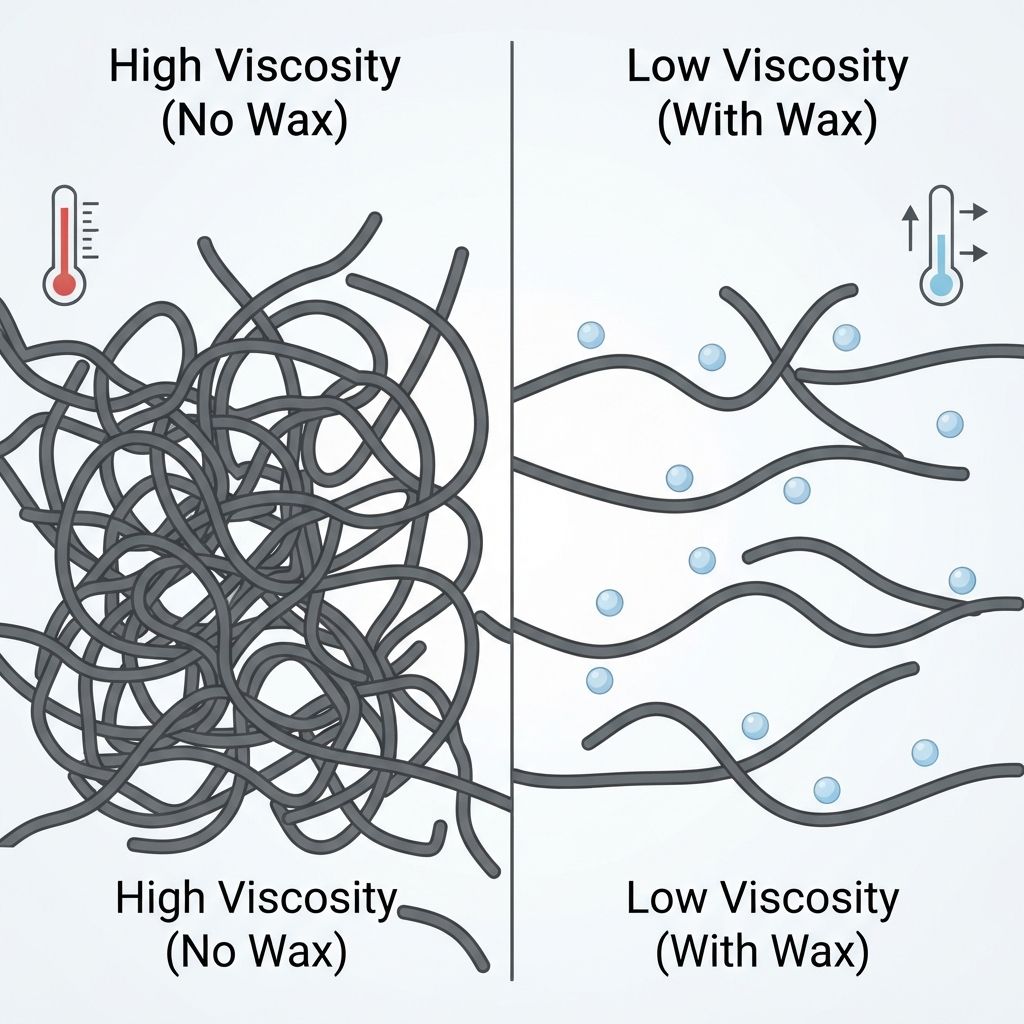
While base polymers provide structural strength and tackifying resins deliver surface adhesion, wax functions as the critical control mechanism of the entire formulation. It acts as a multifunctional rheology modifier that fundamentally alters how the material behaves under heat. By lowering the melt viscosity, it ensures the adhesive flows seamlessly at designated application temperatures, preventing equipment clogs and uneven distribution.
Furthermore, wax regulates the setting speed. It acts as the operational dial that determines how quickly the bond solidifies once applied to a substrate. Without the correct proportion of wax, the formulation would remain too viscous to pump efficiently or take too long to cure, disrupting automated workflows.
- Polymer: Provides base structural strength and cohesion.
- Resin: Delivers surface stickiness and initial tack.
- Wax: Controls viscosity and setting speed during application.
How Wax Composition Shapes Adhesive Performance ⚙️
The precise concentration of wax directly alters the physical properties of the final product. Increasing the wax content generally accelerates the setting time and shortens the open time, which proves highly beneficial for high-speed automated production lines. It also increases the final hardness of the bond while reducing surface tackiness, thereby preventing unwanted blocking or self-adhesion during storage.
However, formulators must calculate these additions carefully. Excessive amounts introduce brittleness and compromise high-temperature performance. When the wax ratio exceeds optimal levels, the adhesive loses its flexibility, increasing the risk of bond failure under mechanical stress or thermal expansion. Balancing these variables is essential to achieve the desired mechanical properties.
| Property | Effect of Increased Wax | Operational Impact |
|---|---|---|
| Melt Viscosity | Decreases significantly | Improves flow and application ease |
| Setting Speed | Accelerates rapidly | Enables faster production cycles |
| Flexibility | Decreases structurally | May cause brittleness if overused |
Tailoring Wax Selection for Industrial Applications 🏭
Different industrial sectors require specific wax profiles to meet their unique operational demands. In 2026, the packaging industry heavily relies on synthetic waxes to ensure rapid sealing of corrugated boards and cartons. Conversely, woodworking and bookbinding applications often utilize microcrystalline variants to maintain flexibility and prevent bond failure when the end product undergoes continuous mechanical stress.
Selecting the appropriate wax type ensures the adhesive wets the substrate effectively while maintaining thermal stability during application. A formulation designed for freezer-grade packaging requires a completely different wax architecture compared to an adhesive formulated for automotive interiors exposed to high summer heat.
Match the wax crystallinity to your production speed requirements; utilize high-crystallinity waxes for rapid automated lines and lower-crystallinity options for processes requiring extended adjustment periods.
Key Strategies for Maximizing Quality and Cost Efficiency 📉
Beyond performance modification, wax serves as a primary driver for cost reduction in adhesive engineering. Because waxes are generally more cost-effective than base polymers and specialized resins, increasing the wax ratio strategically lowers the overall formulation cost. This economic advantage allows manufacturers to remain competitive without sacrificing essential performance metrics.
To maximize both quality and economic efficiency, manufacturers conduct rigorous testing to find the exact threshold where cost savings align with structural integrity. Lowering the melt viscosity through wax addition also reduces the energy consumption of the melting equipment, generating secondary operational savings over the fiscal year.
| Strategy | Implementation Method | Expected Outcome |
|---|---|---|
| Volume Replacement | Substitute partial polymer content | Reduces base material expenses |
| Speed Optimization | Utilize fast-setting synthetic wax | Increases daily production output |
| Energy Reduction | Lower application temperature requirements | Decreases facility power consumption |
Strategic Formulation for 2026 🚀
Mastering the application of hot-melt adhesive wax remains essential for maintaining market competitiveness. It is the definitive element that bridges the gap between raw chemical strength and practical application efficiency. By carefully evaluating the specific requirements of the end-use environment and the production machinery, engineers formulate adhesives that deliver superior performance and substantial cost advantages.
Understanding the complex interactions between waxes, polymers, and resins empowers production teams to troubleshoot application issues rapidly. As industrial demands grow more stringent, the precise manipulation of wax content stands as the defining factor in modern adhesive technology.
Avoid exceeding the optimum concentration limit, as excessive wax content induces severe shrinkage upon cooling, ultimately weakening the structural integrity of the final bond.