


Table of Contents
- What Is Hot Melt Adhesive
- Chemical Differences
- Performance Comparison
- 2026 Industry Trends
- Making the Right Choice
In 2026, modern manufacturing lines demand absolute efficiency and minimal downtime. A single clogged nozzle or an unexpected bond failure can halt production, costing facilities thousands of dollars per hour. At the core of this operational stability lies a critical industrial component: the hot melt adhesive. Choosing the correct polymer formulation is no longer just a routine procurement detail; it is a strategic engineering decision that impacts everything from machine maintenance to environmental compliance. Understanding the fundamental differences between various adhesive technologies is essential for optimizing any high-speed assembly process.
What Is Hot Melt Adhesive 🏭
A hot melt adhesive is a 100% solid thermoplastic formulation that is applied in a molten state and forms a strong bond as it cools and solidifies. Because they do not rely on water or solvents to cure, these materials offer incredibly fast setting times, making them indispensable for high-volume manufacturing.
Engineers rely on these robust solutions for applications ranging from standard packaging to complex electronic assembly. The foundational polymer dictates the overall performance, dictating how well the material handles extreme temperatures and specific substrates. For industrial buyers, understanding the distinction between traditional and advanced formulations is the first step toward achieving optimal production efficiency.
- Applied in a molten state and cures rapidly upon cooling.
- Contains no solvents, ensuring safer and faster manufacturing.
- The base polymer strictly determines the final bond strength and thermal limits.
Chemical Differences ⚗️
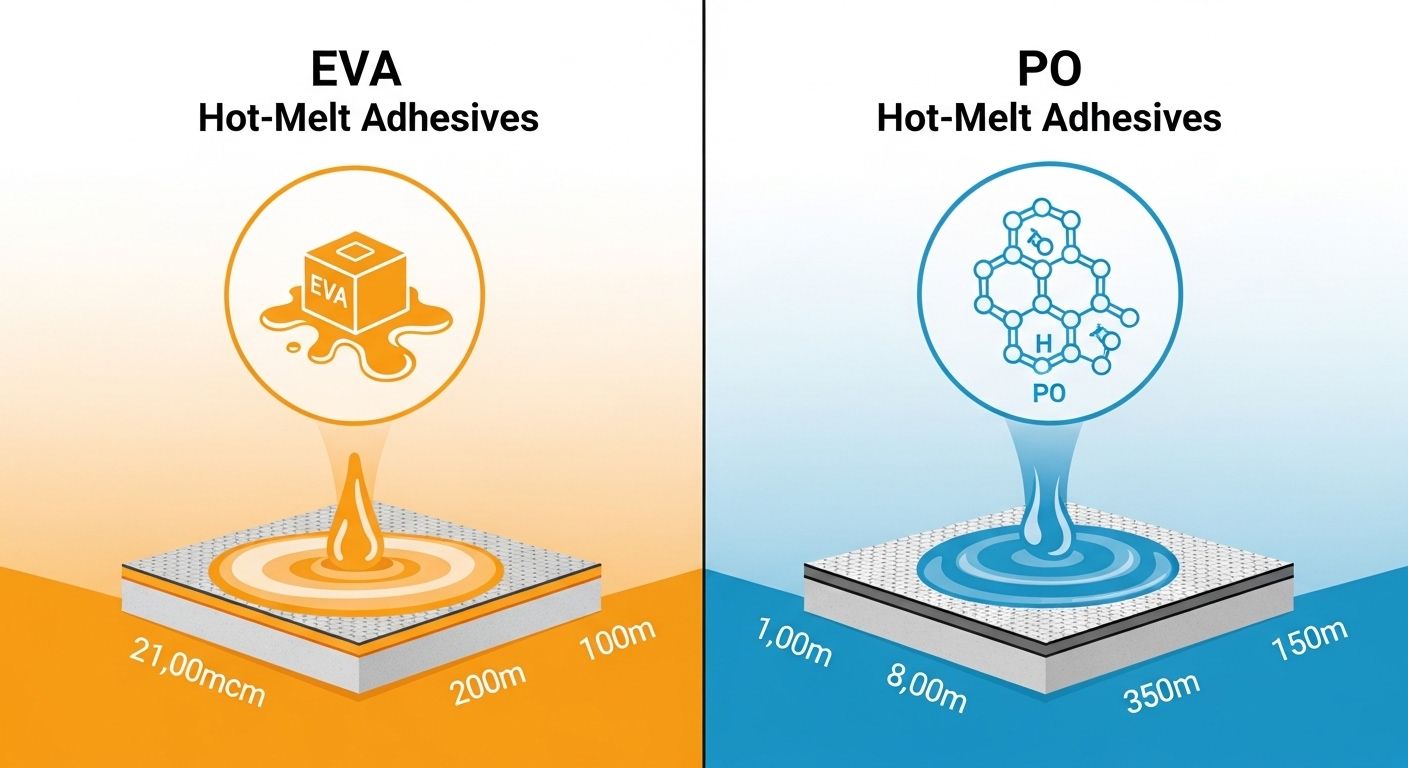
The primary distinction between standard and advanced formulations lies entirely in their molecular architecture. Ethylene Vinyl Acetate (EVA) is a random copolymer that has served as the industry standard for decades. Its structure makes it highly versatile and compatible with a wide range of tackifiers and waxes. However, this same chemical makeup makes it susceptible to oxidation when exposed to prolonged heat.
On the other hand, Polyolefin (PO) adhesives are typically synthesized from polyethylene or polypropylene variants using advanced metallocene technology. This highly ordered polymer structure provides exceptional thermal stability and a much more precise melting profile. The absence of easily degradable bonds in the PO matrix prevents rapid discoloration and viscosity changes under continuous heating.
| Feature | EVA Adhesive | PO Adhesive |
|---|---|---|
| Polymer Base | Ethylene Vinyl Acetate | Polypropylene or Polyethylene |
| Molecular Structure | Random copolymer | Advanced metallocene structure |
| Oxidation Resistance | Moderate | Excellent |
Performance Comparison 📊
When deployed in real-world industrial environments, the performance gap between these two technologies becomes highly apparent. EVA offers excellent adhesion to porous substrates like wood, paper, and standard corrugated cardboard. However, it exhibits moderate heat stability; keeping it in a heated tank for extended periods often leads to char buildup and frequent nozzle clogs.
Conversely, PO formulations deliver superior performance on non-porous or difficult low-energy surfaces, including coated films and rigid plastics. A key advantage of PO is its ability to remain completely stable in the melt tank for over 24 hours without degrading. Furthermore, its lower density means it provides up to 20% more usable adhesive per kilogram, offsetting its higher initial purchase price through sheer volume efficiency.
| Metric | EVA Adhesive | PO Adhesive |
|---|---|---|
| Ideal Substrates | Porous (wood, paperboard) | Non-porous (plastics, films) |
| Tank Stability | Degrades over time (charring) | Stable for over 24 hours |
| Maintenance Need | High (frequent purging) | Low (cleaner running) |
2026 Industry Trends 📈
As we navigate through 2026, the industrial sector is heavily focused on sustainability and automated efficiency. High-performance demands are pushing facilities to adopt materials that reduce mechanical downtime and minimize chemical waste. Because PO formulations resist thermal degradation, they drastically reduce the amount of purged degraded material, aligning perfectly with strict zero-waste manufacturing initiatives.
Furthermore, the drive toward eco-friendly packaging requires adhesives that emit fewer volatile organic compounds (VOCs). Advanced polyolefin technologies naturally support these cleaner operating environments. Plant managers are increasingly phasing out older EVA systems in favor of PO alternatives to meet modern environmental compliance standards while simultaneously boosting line speeds.
If your 2026 operational targets require reducing chemical waste, upgrading to a polyolefin-based system can significantly lower your environmental footprint by minimizing the need to purge burned materials from your tanks.
Making the Right Choice 🎯
Selecting the most appropriate hot melt adhesive requires looking far beyond the initial price per kilogram. If your facility processes standard corrugated packaging and operates on a tight immediate budget, traditional EVA remains a highly functional and widely available choice. It gets the job done effectively for simple, porous applications.
However, if your production involves coated plastics, requires high-speed automated dispensing, or suffers from chronic equipment maintenance issues, transitioning to a PO formulation is highly recommended. The improved thermal stability and cleaner running characteristics result in fewer equipment failures. Ultimately, matching the chemical properties of the adhesive to your specific substrate and operational goals is the key to long-term manufacturing success.
Always audit your specific substrate surface energy and daily production speed before switching formulations. A higher initial material investment often pays off rapidly through drastically reduced machine downtime and lower spare parts consumption.