


Table of Contents
- Hot Melt Adhesives: What Sets Them Apart?
- EVA vs. PO Hot Melt Adhesives: Key Differences
- Performance Factors Beyond Price: What to Consider
- Industry Trends: Why PO-Based Adhesives Are Rising
- Making the Right Hot Melt Adhesive Choice
In the highly competitive manufacturing sector of 2026, operational efficiency dictates market success. A frequent, yet often overlooked, cause of production downtime is the hot melt adhesive used in assembly and packaging lines. Selecting the correct polymer base is no longer a minor procurement task; it is a critical engineering decision that influences equipment longevity, maintenance cycles, and product integrity. This comprehensive guide details the technical and operational distinctions between EVA-based and PO-based adhesives, providing industry professionals with the factual insights needed to optimize their bonding processes.
Hot Melt Adhesives: What Sets Them Apart? 🏭
The industrial sector relies heavily on hot melt adhesive technology to bond substrates rapidly without requiring lengthy curing times. These thermoplastic compounds remain solid at room temperature and transition into a highly viscous fluid upon heating. The fundamental distinction among various product lines originates from their core chemical structures.
- Core Function: Thermoplastic bonding without the use of solvents.
- Primary Types: Ethylene Vinyl Acetate (EVA) and Polyolefin (PO).
- Operational Impact: Directly dictates production speed and equipment maintenance cycles.
These structural variances directly determine critical performance metrics. A simple mismatch between the adhesive polymer and the application substrate leads to weak bonds, frequent equipment clogs, and excessive material waste. Understanding the exact chemical properties of your chosen adhesive ensures that production lines operate continuously without unexpected mechanical interruptions.
EVA vs. PO Hot Melt Adhesives: Key Differences 🔬
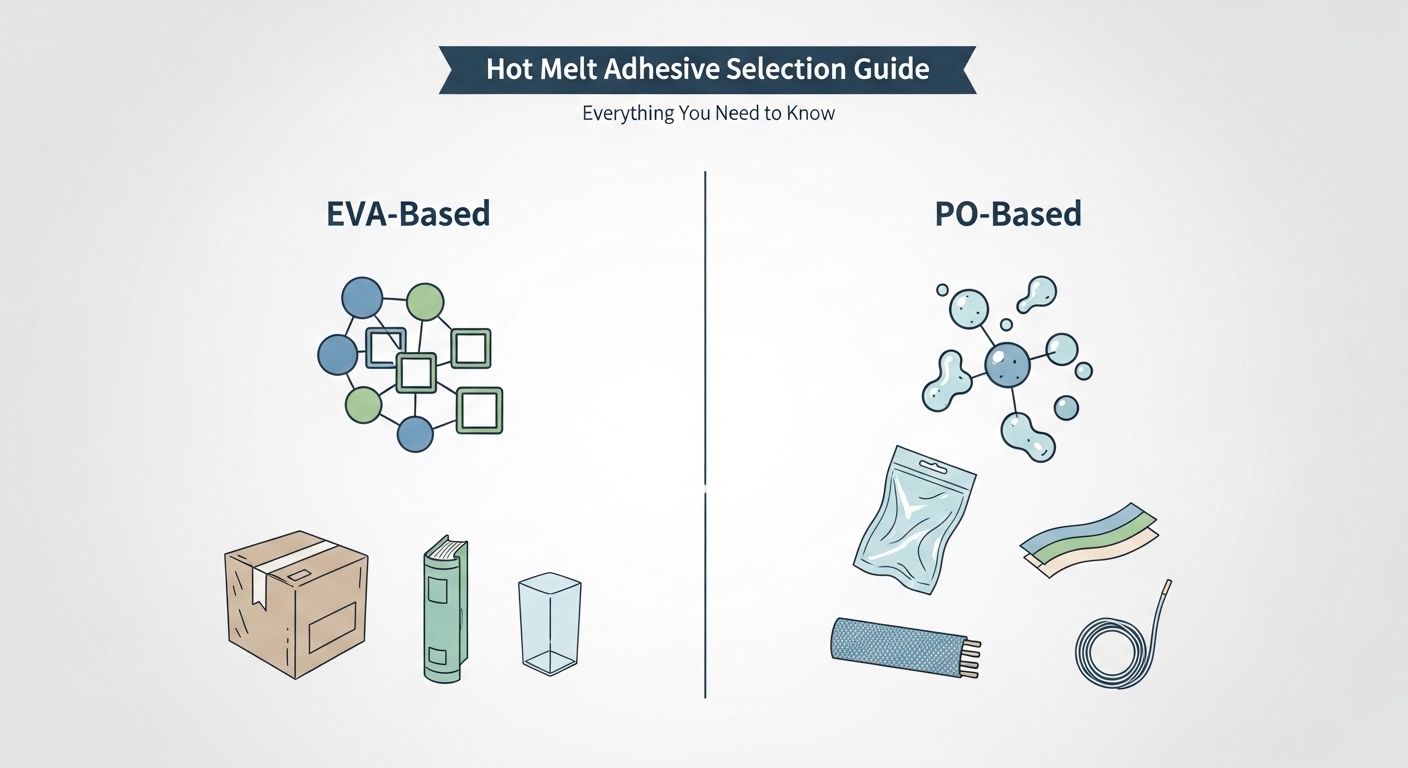
The molecular architecture of an adhesive governs its behavior under extreme conditions. EVA consists of a copolymer of ethylene and vinyl acetate, while PO relies on polyethylene or polypropylene variants. This structural difference yields highly distinct application profiles. EVA demonstrates moderate thermal stability and secures excellent adhesion to porous substrates such as corrugated packaging and wood.
| Feature | EVA-Based Adhesive | PO-Based Adhesive |
|---|---|---|
| Polymer Base | Ethylene Vinyl Acetate | Polyolefin variants |
| Thermal Stability | Moderate | Excellent |
| Best Substrates | Porous materials | Non-porous materials |
| Maintenance | Higher clog rate | Lower clog rate |
In contrast, PO formulations deliver superior temperature resistance. Analytical data shows that PO remains chemically stable in the melting tank for over 24 hours. This makes PO exceptionally suitable for difficult, low-energy surfaces. Meanwhile, EVA is more susceptible to discoloration and viscosity degradation during prolonged heating periods, requiring more frequent system flushing.
Performance Factors Beyond Price: What to Consider ⚙️
Procurement strategies often favor EVA due to its widespread availability and lower initial purchase price. However, evaluating purely on upfront cost ignores critical operational variables. Facility managers must calculate the true cost by analyzing adhesive mileage and maintenance intervals. Advanced PO systems frequently provide up to 20 percent more usable adhesive per kilogram compared to traditional alternatives.
Always evaluate the total cost of ownership by factoring in equipment maintenance time and the exact volume of adhesive wasted during routine tank purging.
Furthermore, the specific adhesion range dictates application success. Attempting to bond coated films or rigid plastics with standard EVA often leads to premature bond failure. Matching the hot melt adhesive to the exact substrate—whether for simple carton sealing or complex electronic assembly—ensures reliable performance and significantly reduces material waste across the production floor.
Industry Trends: Why PO-Based Adhesives Are Rising 📈
As production benchmarks evolve in 2026, the demand for high-performance and environmentally responsible materials continues to accelerate. EVA has served as the industry standard for decades, but modern metallocene polyolefin solutions are rapidly gaining market share. The enhanced thermal resistance of PO adhesives directly translates to less waste from purging degraded material, supporting stringent corporate sustainability initiatives.
Ignoring the transition toward low-VOC and low-waste adhesive technologies risks non-compliance with the strict environmental regulations emerging globally in 2026.
Data confirms that PO adhesives facilitate cleaner running operations, significantly lowering the incidence of nozzle clogs and equipment charring. This reduction in maintenance requirements allows production engineers to maintain continuous, high-speed output. Consequently, eco-friendly policy makers and product developers increasingly specify advanced polyolefin variants to meet modern manufacturing standards without sacrificing bond integrity.
Making the Right Hot Melt Adhesive Choice ✅
Determining the ideal hot melt adhesive requires a systematic evaluation of both immediate project parameters and long-term facility goals. Technical teams must review their primary substrate materials, operating temperature ranges, and historical maintenance records before initiating a transition.
| Application Need | Recommended Adhesive | Primary Benefit |
|---|---|---|
| Standard Packaging | EVA-Based | Cost-effective for porous materials |
| High-Speed Lines | PO-Based | Clean running operations |
| Difficult Plastics | PO-Based | Superior bond on non-porous surfaces |
While EVA remains highly effective for standard corrugated packaging, PO presents distinct advantages for hygiene products, electronic assembly, and high-speed manufacturing environments. Ultimately, the decision centers on aligning adhesive capabilities with specific production demands. By prioritizing thermal resistance and substrate compatibility, organizations can deploy a hot melt adhesive strategy that secures product quality and optimizes long-term financial performance.