Definition of Biodegradable Adhesives
Types of Biodegradable Adhesives
Industrial Importance of Adhesives
Methods of Adhesive Application
Latest Trends in Adhesive Technology
Strategies for Adhesive Use
Challenges in Adhesive Implementation
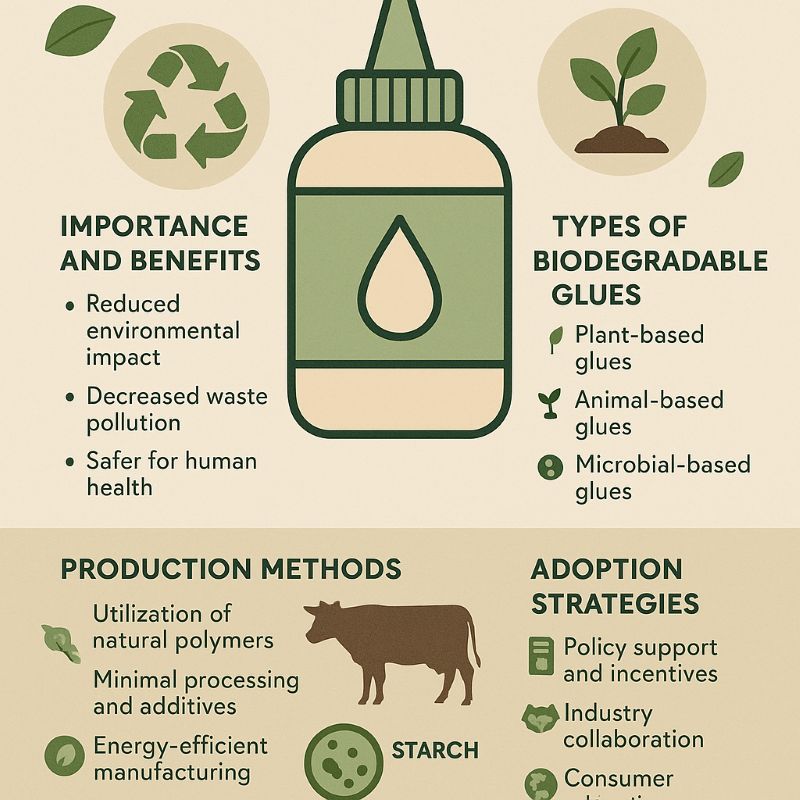
Biodegradable adhesives are bonding materials designed to break down naturally over time through biological processes, thereby reducing long-term environmental impact. These adhesives are typically formulated from renewable or naturally derived polymers such as starches, cellulose derivatives, proteins, or other plant-based components. As industries seek alternatives to petroleum-based materials, biodegradable adhesives are increasingly considered for applications where sustainability, reduced waste, and end-of-life environmental performance are critical factors.
Biodegradable adhesives can be classified based on their primary raw materials and bonding mechanisms.
Starch-based adhesives are commonly derived from agricultural sources and are widely used where moderate bonding strength and easy biodegradation are required.
Cellulose-based adhesives, produced from plant fibers, offer improved film-forming ability and can provide resistance to moisture in certain applications.
Protein-based adhesives, formulated from natural proteins such as plant or dairy derivatives, are known for their strong intermolecular bonding and are often applied where higher mechanical strength is needed.
Lignin-based adhesives, sourced from biomass by-products, are gaining attention as structural binders that combine renewability with improved thermal and mechanical stability. Each category serves different industrial requirements while supporting reduced environmental impact.
Adhesives play a fundamental role in industrial manufacturing by enabling material bonding, assembly efficiency, and design flexibility. As sustainability becomes a core industrial objective, biodegradable adhesives are increasingly evaluated as functional alternatives to conventional systems. In sectors such as packaging, construction materials, and textiles, these adhesives offer the potential to reduce environmental burden while maintaining acceptable performance levels. Their importance lies not only in bonding capability but also in their contribution to waste reduction, recyclability, and alignment with environmental regulations and sustainability frameworks.
The performance of biodegradable adhesives is closely linked to appropriate application methods. Common techniques include spraying for uniform coverage, rolling for continuous surface bonding, brushing for localized or precision application, and extrusion for controlled bead placement. Each method must be selected based on adhesive viscosity, setting behavior, and substrate compatibility. Proper process control, including temperature, pressure, and application speed, is essential to ensure consistent bonding performance while minimizing material waste and energy consumption.
Recent trends in adhesive technology reflect a broader shift toward environmentally responsible material systems. In the context of biodegradable adhesives, innovation is focused on improving moisture resistance, mechanical durability, and process stability while maintaining biodegradability. Research efforts increasingly emphasize hybrid formulations that balance natural raw materials with performance-enhancing modifications. In addition, compatibility with automated manufacturing systems and lower processing temperatures are emerging as important development directions, supporting both sustainability and industrial efficiency.
Effective use of biodegradable adhesives requires strategic alignment between material selection, application method, and end-use requirements. Selecting an adhesive system that matches substrate characteristics and service conditions is essential for achieving reliable performance. Equally important is optimizing application parameters to ensure consistent bonding while minimizing excess usage. Process trials, operator training, and gradual integration into existing production lines can help reduce implementation risk and improve overall efficiency. Through careful planning, biodegradable adhesives can be incorporated without compromising production stability.
Despite their advantages, biodegradable adhesives present several implementation challenges. Sensitivity to environmental factors such as humidity and temperature can affect bonding consistency. In some cases, existing equipment or processes may require adjustment to accommodate different rheological or curing behaviors. Additionally, performance expectations must be managed realistically, particularly in high-stress or long-term exposure environments. Addressing these challenges requires continued material development, process optimization, and clear communication of performance boundaries to ensure successful industrial adoption.
What are biodegradable adhesives?
They are bonding materials formulated from renewable or naturally derived components that decompose through biological processes, reducing environmental impact.
What types of biodegradable adhesives are commonly used?
Common types include starch-based, cellulose-based, protein-based, and lignin-based adhesives, each offering different performance characteristics.
Why are biodegradable adhesives important for industry?
They support sustainability goals by reducing waste, improving recyclability, and lowering dependence on fossil-based materials while maintaining functional bonding.
How are biodegradable adhesives typically applied?
They can be applied through spraying, rolling, brushing, or extrusion, depending on formulation properties and application requirements.
What trends are shaping biodegradable adhesive technology?
Key trends include improved durability, better moisture resistance, lower processing temperatures, and compatibility with automated manufacturing systems.
What strategies help ensure effective use of biodegradable adhesives?
Matching adhesive type to application needs, optimizing process parameters, and gradually integrating materials into production lines are critical strategies.
What challenges are associated with biodegradable adhesives?
Challenges include environmental sensitivity, process adaptation requirements, and balancing biodegradability with mechanical performance.
Can biodegradable adhesives replace traditional adhesives entirely?
They can replace traditional systems in many applications, but suitability depends on performance requirements, service conditions, and lifecycle expectations.