


Table of Contents
- Understanding Flame Retardant Hot Melts
- Types and Systems of Flame Retardant Hot Melts
- Environmental Standards and Global Certifications
- Practical Applications Across Industries
- Tips for Selecting the Right Hot Melt Solution
As electronic components become smaller and more powerful, and automotive systems generate more heat, the risk of fire-related failures has never been more significant. In 2026, ensuring the safety of every material used in manufacturing is not just a best practice—it's a market necessity. This is where flame retardant hot melts play a critical role. These specialized adhesives are engineered to do more than just bond; they provide an essential layer of safety by inhibiting, suppressing, or delaying the spread of flames. For developers and engineers, understanding these materials is key to creating safer, more reliable, and compliant products.
Understanding Flame Retardant Hot Melts
Flame retardant hot melt adhesives are thermoplastic polymers formulated with special additives that reduce their flammability. Unlike standard hot melts, which are inherently combustible due to their plastic base, these advanced formulations are designed to meet strict safety standards. The primary goal is not to make the material entirely non-combustible but to ensure it self-extinguishes once the ignition source is removed, thereby preventing a small spark from turning into a catastrophic fire.
The need for flame retardancy stems from the fundamental nature of hot melts. As thermoplastics, they soften when heated and solidify upon cooling, but their organic composition makes them natural fuel for a fire. By incorporating specific chemical additives, manufacturers can alter this behavior. These additives work through various mechanisms, such as releasing cooling gases, forming a protective char layer, or chemically interrupting the combustion cycle. Therefore, a flame retardant hot melt is a carefully balanced system where the base polymer provides the adhesive properties, and the additive package delivers the critical safety function.
💡KEY POINT
- Standard Hot Melts: Based on thermoplastic polymers, making them naturally flammable.
- Flame Retardant Hot Melts: Contain chemical additives that inhibit or delay combustion.
- Primary Function: To self-extinguish when an external flame source is removed, enhancing overall product safety.
Types and Systems of Flame Retardant Hot Melts
Not all flame retardant hot melts are created equal. They are primarily categorized based on two key components: the base polymer and the flame-retardant system. This dual classification is essential because the combination of these elements determines the adhesive's final properties, including its flexibility, bond strength, heat resistance, and level of flame retardancy. Understanding these categories is the first step toward selecting the right material for a specific application.
The choice of base polymer dictates the fundamental characteristics of the adhesive. For instance, Polyamide (PA) based hot melts offer excellent heat resistance, while Polyolefin (PO) based variants provide strong adhesion to difficult-to-bond plastics. The flame-retardant system, on the other hand, defines its safety and environmental profile. Historically, halogenated systems were common, but due to environmental regulations, the industry has shifted significantly toward halogen-free alternatives, such as those based on phosphorus or nitrogen compounds. As of 2026, selecting a halogen-free system is often a prerequisite for meeting global environmental standards.
| Base Polymer | Key Characteristics | Common Applications |
|---|---|---|
| Polyamide (PA) | High heat resistance, good chemical resistance | Electronics potting, automotive components |
| Polyolefin (PO) | Excellent adhesion to plastics, good flexibility | Wire and cable assembly, product assembly |
- | Ethylene Vinyl Acetate (EVA) | General-purpose, cost-effective, good flexibility | Packaging, light-duty assembly |
Environmental Standards and Global Certifications
In today's global market, performance alone is not enough. Flame retardant hot melts must comply with a stringent set of environmental and safety standards to be viable for commercial use, especially in consumer electronics and automotive applications. These certifications are not just recommendations; they are often legal requirements that ensure product safety and environmental responsibility. Adherence to these standards is crucial for market access and brand reputation.
The most recognized standard is UL 94, which rates the flammability of plastics. A UL 94 V-0 rating is often the benchmark, indicating that the material self-extinguishes within 10 seconds on a vertical specimen. Beyond fire safety, environmental regulations like RoHS (Restriction of Hazardous Substances) and REACH (Registration, Evaluation, Authorisation and Restriction of Chemicals) are paramount. RoHS restricts the use of specific hazardous materials found in electrical and electronic products, while REACH governs the use of chemical substances to protect human health and the environment. As of 2026, products that are both UL 94 compliant and halogen-free are increasingly becoming the industry norm.
When evaluating a flame retardant hot melt, always request the product's Technical Data Sheet (TDS) and Safety Data Sheet (SDS). These documents should clearly state compliance with key standards like UL 94, RoHS, and REACH. Verifying these certifications early in the selection process can prevent costly delays and compliance issues later.
Practical Applications Across Industries
The unique combination of adhesion and safety makes flame retardant hot melts indispensable across various high-stakes industries. Their ability to secure components while adding a layer of fire protection is critical where heat, electricity, and combustible materials coexist. The selection of a specific hot melt is always tied to the unique demands and regulatory landscape of each sector.
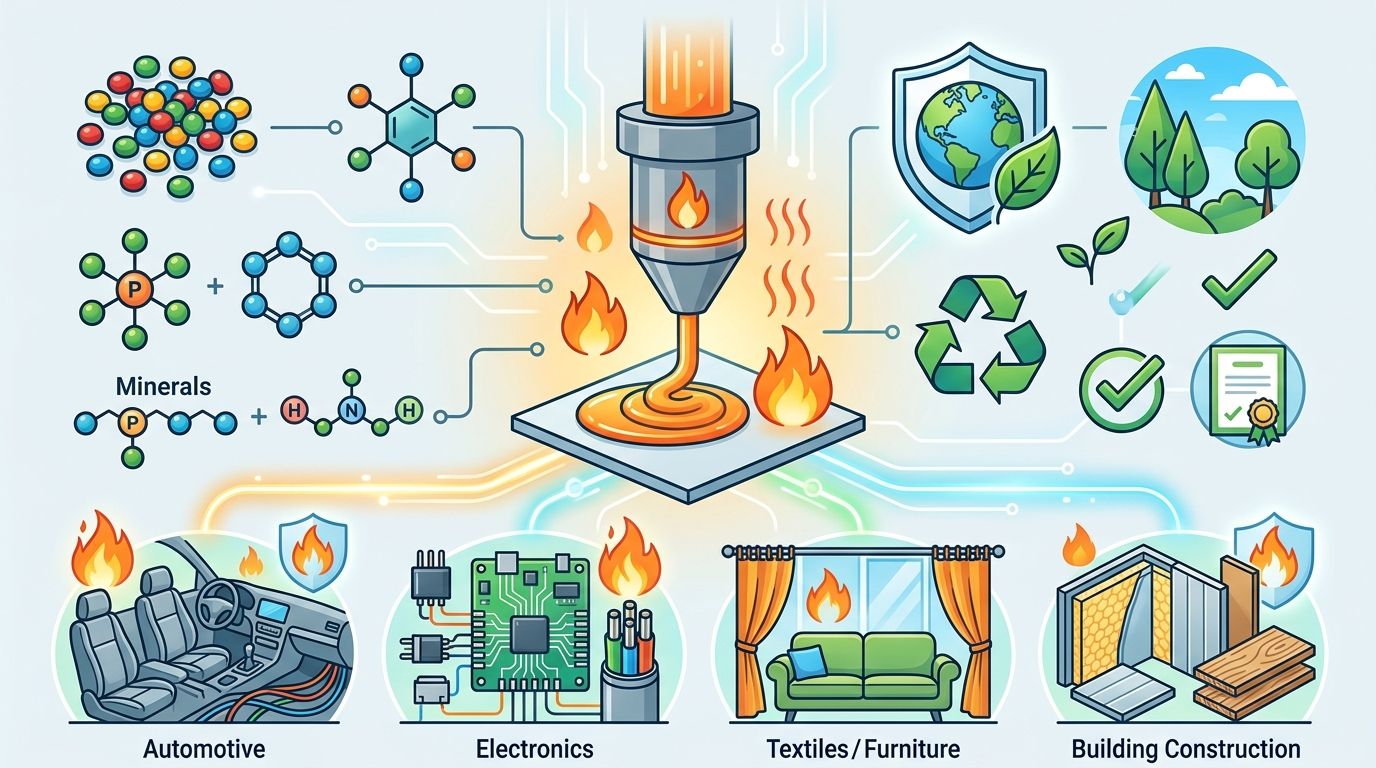
In the electronics industry, these adhesives are widely used for potting and encapsulating components on printed circuit boards (PCBs). This protects sensitive circuits from moisture and vibration while preventing the spread of fire in case of a short circuit. For the automotive sector, they are essential for bundling wire harnesses, securing connectors, and mounting sensors, especially in engine compartments where high temperatures are a constant. In construction and building materials, flame retardant hot melts are used for bonding insulation, panels, and other elements where meeting strict building fire codes is mandatory. In all these cases, choosing a product with the appropriate certification is non-negotiable.
| Industry | Primary Application | Key Requirement |
|---|---|---|
| Electronics | Potting, encapsulation, component fixing | UL 94 V-0, RoHS compliance |
| Automotive | Wire harness assembly, sensor mounting | High heat resistance, vibration damping |
| Construction | Panel lamination, insulation bonding | Compliance with building fire codes |
Tips for Selecting the Right Hot Melt Solution
Choosing the optimal flame retardant hot melt requires a systematic approach that balances performance, safety, and cost. With a wide array of formulations available, a clear understanding of your project's specific needs is essential to avoid over-engineering or, more critically, under-performance in a fire event. The decision should be guided by a thorough analysis of the application, substrate materials, and the regulatory environment.
First, define the operational requirements. What are the service temperature ranges? What substrates will be bonded? Answering these questions will narrow down the suitable base polymers. Second, identify all applicable regulatory standards. For an electronic device sold in Europe, RoHS and REACH compliance is mandatory, alongside a high UL 94 rating. Finally, consider the manufacturing process. The adhesive's viscosity, open time, and set time must be compatible with your production line speeds and equipment. A holistic evaluation ensures that the selected adhesive is not only safe and compliant but also efficient to implement.
💡KEY POINT
- 1. Define Application Needs: Identify the substrates, service temperatures, and required bond strength.
- 2. Verify Certifications: Confirm that the product meets all necessary standards for your industry and target market (e.g., UL 94, RoHS).
- 3. Match to Process: Ensure the adhesive’s properties (viscosity, set time) are compatible with your manufacturing equipment and cycle times.