


Table of Contents
- What Sets High-Performance Hot Melts Apart
- Evaluating the Right Hot Melt for Your Needs
- Practical Applications Across Industries
- Key Benefits and Safety Considerations
- Making an Informed Hot Melt Selection
Imagine an automotive assembly line where an interior component must remain perfectly bonded for over a decade, withstanding daily temperature swings from freezing cold to scorching heat. Now, picture a simple craft project, where a piece of felt is attached to cardboard for a school display. The adhesive requirements for these two scenarios are worlds apart. While both might use a "hot glue stick," the underlying technology is fundamentally different. This guide explores the critical distinctions of high-performance hot melt, moving beyond simple adhesion to explain why the right choice is not just about strength, but about chemistry, durability, and long-term reliability.
What Sets High-Performance Hot Melts Apart
The distinction between a standard hot melt and a high-performance hot melt is not merely a marketing term; it represents a fundamental shift in chemical composition and engineering. While standard adhesives, typically based on Ethylene-vinyl acetate (EVA), are excellent for general-purpose applications like crafts and basic packaging, they offer limited resistance to heat, chemicals, and long-term stress.
In contrast, high-performance hot melt adhesives are formulated from advanced polymers such as polyamides, polyolefins, or reactive polyurethanes (PUR). This advanced chemistry provides a superior bonding experience characterized by significantly higher tensile strength, greater flexibility, and robust resistance to extreme temperatures, moisture, and chemical exposure. Unlike standard glues that simply cool to form a physical bond, some high-performance types, like PURs, undergo a secondary chemical reaction with ambient moisture to create a cross-linked, thermoset bond that is exceptionally strong and permanent. This makes them indispensable for applications where bond failure is not an option.
| Feature | Standard Hot Melt (e.g., EVA) | High-Performance Hot Melt (e.g., PUR, Polyamide) |
|---|---|---|
| Chemical Base | Simple thermoplastic polymers | Advanced, often reactive, polymers |
| Bond Type | Physical bond (solidifies on cooling) | Physical and/or chemical cross-linking bond |
| Durability | Lower resistance to heat, moisture, and solvents | Superior resistance to extreme environments |
| Ideal Use | Crafts, light packaging, temporary fixes | Automotive, electronics, construction, structural bonding |
Evaluating the Right Hot Melt for Your Needs
Selecting the appropriate adhesive is a critical decision that directly impacts product quality, longevity, and safety. The choice should not be based on cost alone but on a thorough evaluation of the application's specific demands. To make an informed decision, you must consider the entire lifecycle of the bond.
Start by analyzing the substrates being joined—are they porous like wood, or non-porous like metal or plastic? Some high-performance adhesives are specifically formulated for difficult-to-bond surfaces. Next, assess the working environment. Will the bond be exposed to high heat, sub-zero temperatures, constant humidity, or harsh chemicals? Answering these questions is crucial, as a standard hot melt will quickly fail under such conditions. Finally, consider the mechanical stress the bond must endure. Will it be subject to vibration, impact, or a constant load? For structural or load-bearing applications, only a high-performance hot melt can provide the necessary reliability.
Before making a purchase, ask yourself these five key questions:
- Substrates: What materials am I bonding together?
- Temperature: What is the maximum and minimum temperature the bond will experience?
- Environment: Will the bond be exposed to moisture, UV light, or chemicals?
- Stress: What type of force (e.g., shear, peel, impact) will the bond need to resist?
- Longevity: How long does this bond need to last?
Practical Applications Across Industries
The superior properties of high-performance hot melt adhesives make them essential in a wide range of demanding industrial sectors. Their ability to create durable, resilient bonds where others fail allows for innovation and enhanced product reliability. These are not just stronger glues; they are engineered solutions for critical assembly challenges.
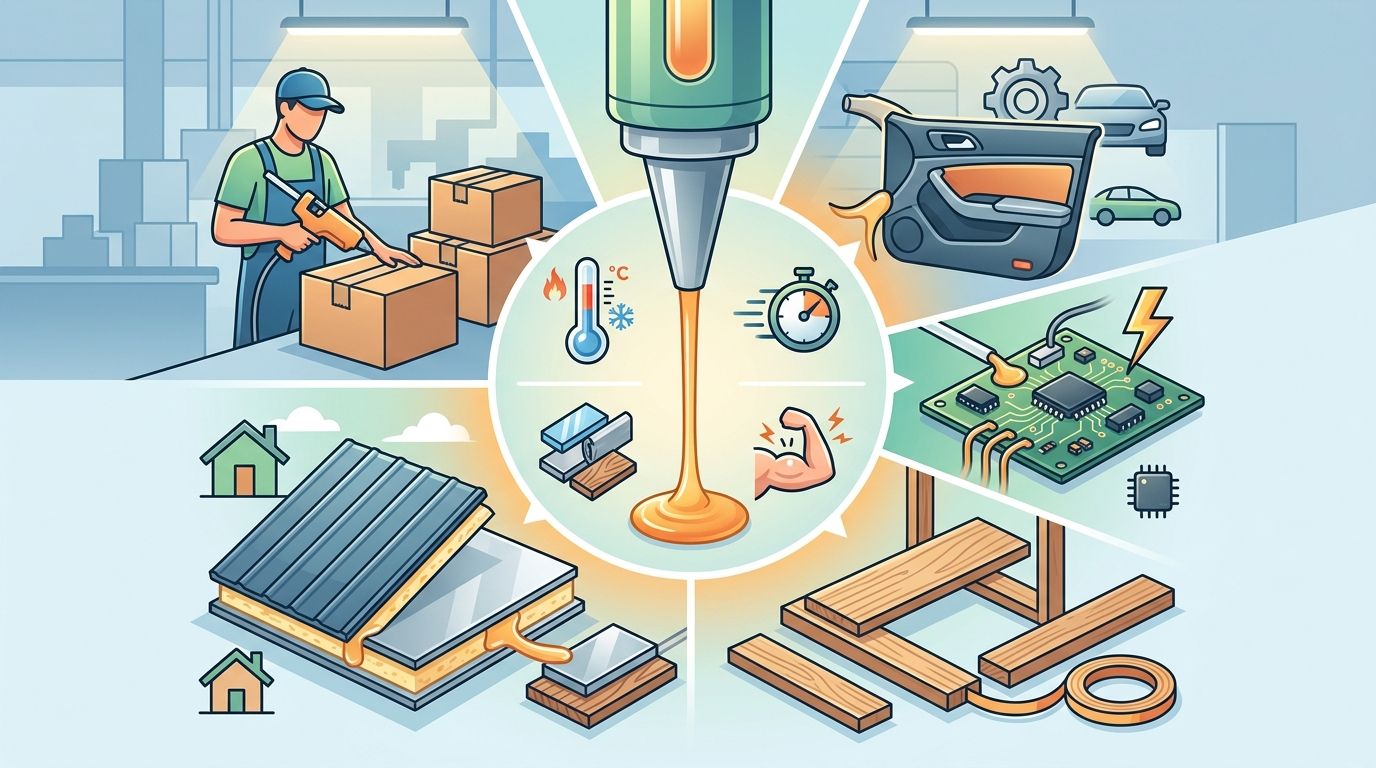
In the automotive industry, they are used to bond headliners, door panels, and interior trim, withstanding constant vibration and extreme temperature fluctuations inside a vehicle. For electronics manufacturing, these adhesives are vital for potting and encapsulating sensitive components, protecting them from moisture and shock while securing them to circuit boards. In construction, high-performance hot melts are used for subflooring installation, window and door frame assembly, and bonding large panels, offering a fast-curing alternative to traditional mechanical fasteners and liquid adhesives. Even in advanced packaging, they are used for freezer-grade boxes and high-stress containers that must maintain integrity during shipping and handling. In each case, the adhesive is chosen for its specific ability to perform under pressure.
💡KEY POINT
- Automotive: Bonding interior components, sound-dampening materials, and trim.
- Electronics: Encapsulating circuits (potting), securing components, and sealing housings.
- Construction: Assembling window frames, bonding flooring, and structural panel lamination.
- Advanced Packaging: Sealing cartons for cold storage or heavy-duty transport.
Key Benefits and Safety Considerations
Choosing a high-performance hot melt offers significant advantages beyond just a stronger bond. The primary benefit is long-term reliability, which reduces the risk of product failure, warranty claims, and damage to brand reputation. These adhesives also enable the use of new and diverse materials, expanding design possibilities for engineers and manufacturers. Their fast setting times can also accelerate production line speeds, increasing overall efficiency.
However, these benefits come with important safety considerations. High-performance adhesives often require higher application temperatures than standard glues, increasing the risk of severe burns. Proper personal protective equipment (PPE), including heat-resistant gloves and safety glasses, is mandatory. Furthermore, reactive formulations like PUR hot melts release isocyanates as they cure, which requires working in a well-ventilated area to avoid respiratory irritation. Always consult the Safety Data Sheet (SDS) for the specific product you are using to understand its handling requirements and potential hazards.
| Aspect | Key Benefit | Key Consideration |
|---|---|---|
| Performance | Exceptional bond strength and durability | Requires precise application parameters |
| Efficiency | Fast cure times can speed up assembly | May require specialized, high-temp equipment |
| Safety | Creates a reliable, long-lasting product | Higher application temperatures and potential fumes |
Making an Informed Hot Melt Selection
Ultimately, the process of selecting the right hot melt adhesive is a balance of performance requirements, application conditions, and safety protocols. The key takeaway from the industry in 2026 is that the "high-performance" label signifies a fundamentally different material, engineered for challenges that standard glues cannot meet. Avoid the common mistake of viewing all hot melts as interchangeable.
To make a confident choice, start with the technical data sheet (TDS) of a potential adhesive. This document provides critical information on its chemical base, open time (the window for bonding after application), heat resistance, and ideal substrates. Whenever possible, test the adhesive on your specific materials under simulated real-world conditions. This validation step is crucial to ensure the bond will perform as expected throughout the product's life. By treating adhesive selection as an integral part of the design and manufacturing process, you ensure a final product built on a foundation of strength and reliability.
⚠️CAUTION
Using the wrong equipment can lead to poor bonding and safety hazards. High-performance hot melts often require applicators capable of reaching and maintaining higher temperatures than standard craft glue guns. Always ensure your equipment is rated for the specific adhesive you are using to prevent equipment damage and ensure optimal adhesive properties.