


Table of Contents
- The Core Difference: Standard vs. Flame-Retardant Hot Melt
- Why Fire Safety is Non-Negotiable in Modern Industries
- Practical Applications Across High-Risk Sectors
- Key Performance Indicators for Flame-Retardant Adhesives
- A Guide to Selecting the Right Product
In 2026, as electronic devices become more compact and powerful and automotive systems integrate more complex circuitry, the risk of thermal events and fire has never been more pronounced. A component failure in a single device can have catastrophic consequences. In this high-stakes environment, every material choice matters. But what if a fundamental component like an adhesive could do more than just bond? What if it could serve as a crucial first line of defense against fire? This is precisely where flame-retardant hot melt adhesives transition from a simple bonding agent to an indispensable safety technology.
The Core Difference: Standard vs. Flame-Retardant Hot Melt 🔍
At first glance, a flame-retardant hot melt adhesive might appear similar to its standard counterpart. Both are thermoplastic adhesives applied in a molten state, creating a strong bond upon cooling. However, their chemical composition and performance under thermal stress are fundamentally different. Standard hot melts are typically formulated from combustible polymers, which can contribute to the spread of a fire once ignited.
In contrast, flame-retardant hot melt adhesives are engineered with special additives that actively inhibit, suppress, or delay the combustion process. These additives work in several ways: some release water vapor when heated to cool the material, while others form a protective char layer that insulates the underlying material from heat and oxygen. This formulation ensures that the adhesive not only resists ignition but also significantly slows the spread of flames, providing critical time for safety systems to activate and preventing small incidents from escalating. This distinction is not just a feature; it is a critical safety function.
| Feature | Standard Hot Melt | Flame-Retardant Hot Melt |
|---|---|---|
| Combustion Behavior | Can contribute to flame spread | Resists ignition and slows flame spread |
| Chemical Composition | Primarily combustible polymers | Polymers with flame-retardant additives |
| Primary Function | Bonding and sealing | Bonding, sealing, and fire protection |
| Typical Use Case | General packaging, woodworking | Electronics, automotive, construction |
Why Fire Safety is Non-Negotiable in Modern Industries 🔥
The push for enhanced fire safety is not merely a best practice; it is driven by stringent regulations, insurance requirements, and the immense cost of fire-related failures. In key industries, the integration of flame-retardant materials is a prerequisite for market entry and operational safety. A failure to comply can result in product recalls, legal liabilities, and irreparable brand damage.
In the electronics industry, the dense packing of components in devices like power supplies and battery packs creates significant fire risk. A small short circuit can quickly lead to a fire that consumes the entire device. Similarly, the automotive sector mandates strict flammability standards for all interior components to ensure passenger safety. In construction, flame-retardant adhesives are vital for sealing wire penetrations and bonding insulation materials, helping to compartmentalize fires and prevent them from spreading throughout a building. Using a flame-retardant hot melt helps manufacturers meet these demanding safety codes, such as the widely recognized UL standards, ensuring their products are both reliable and safe for end-users.
💡핵심 포인트
- Electronics: Prevents fire propagation from short circuits in densely packed circuit boards and power units.
- Automotive: Essential for meeting strict interior material flammability standards and protecting wire harnesses.
- Construction: Used to create fire-resistant seals and bond insulation, enhancing overall building safety.
Practical Applications Across High-Risk Sectors 🏭
The versatility of flame-retardant hot melt allows for its application in a wide array of specific, high-stakes scenarios. Understanding these use cases reveals the practical value of this specialized adhesive.
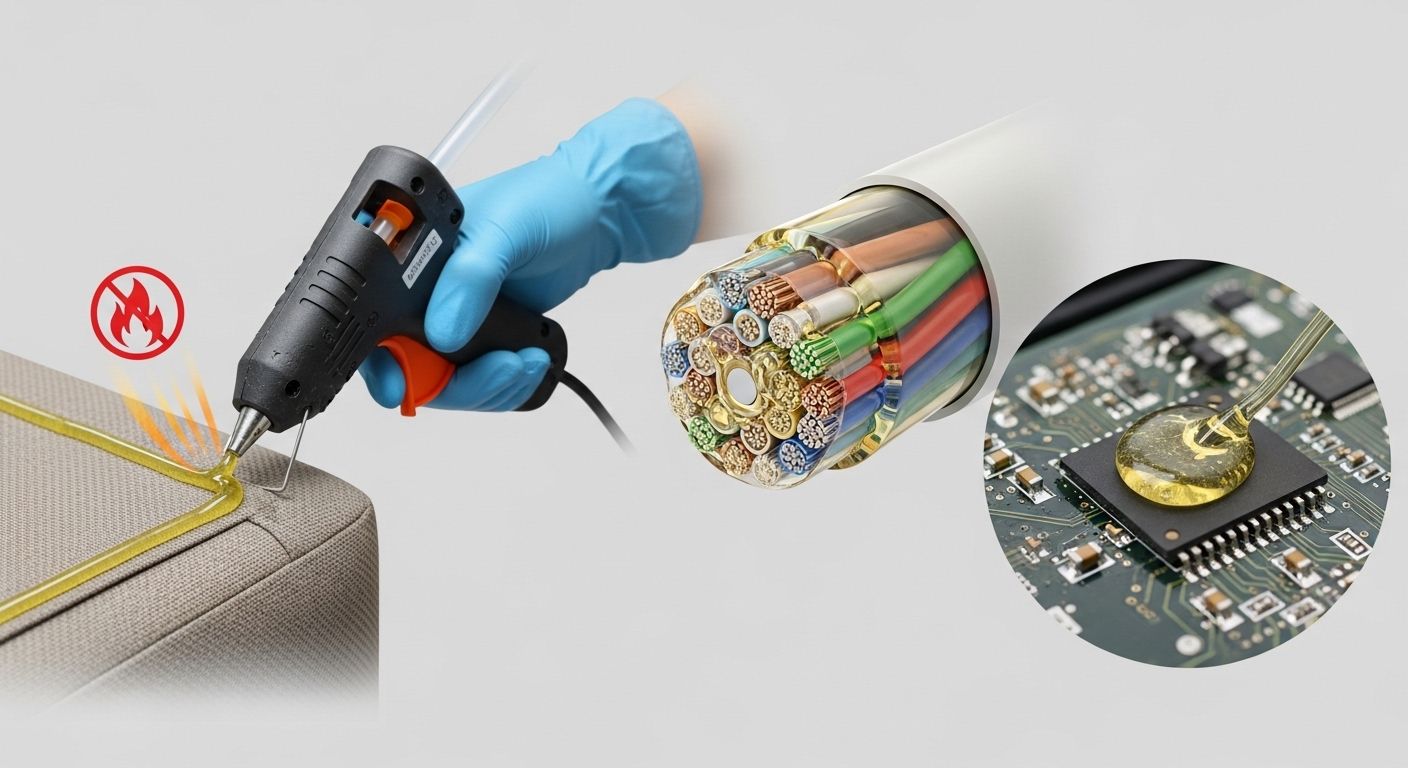
In electronics assembly, these adhesives are frequently used for potting and encapsulating sensitive components. This process involves filling a component or circuit board with the molten adhesive, which then solidifies to provide structural support, electrical insulation, and, most importantly, a barrier against fire. It's particularly crucial for components like transformers, capacitors, and sensors that can overheat.
Within the automotive industry, its applications are extensive. It is used to secure wire harnesses to the vehicle chassis, preventing them from chafing and shorting out. It also bonds interior components like headliners, carpets, and door panels, ensuring these materials meet federal motor vehicle safety standards (FMVSS) for flammability.
For building and construction, flame-retardant hot melt is used to bond and seal fire-rated wall panels, secure insulation, and seal gaps around pipes and conduits that pass through firewalls. This application is critical for maintaining the integrity of a building's fire containment systems.
For optimal performance in potting applications, pre-heating the component or housing can improve the flow of the hot melt adhesive. This ensures complete encapsulation without air voids, maximizing both the bond strength and the flame-retardant protection.
Key Performance Indicators for Flame-Retardant Adhesives 📊
When selecting a flame-retardant hot melt, it's crucial to look beyond the basic claim of "flame retardancy" and evaluate a range of performance metrics. The right adhesive must not only provide fire safety but also meet the mechanical and processing requirements of the application. The most critical indicator of fire safety is a formal certification, with UL 94 being the predominant standard. A V-0 rating under this standard signifies that a material self-extinguishes within 10 seconds after the flame source is removed, without dripping flaming particles, making it suitable for the most demanding applications.
Beyond fire resistance, other properties are equally important. Adhesion strength ensures the bond remains intact under operational stress, while thermal stability guarantees performance at elevated temperatures without degrading. Viscosity and open time are key processing parameters that determine how well the adhesive will work with existing application equipment and assembly line speeds. A balanced evaluation of these indicators is essential for successful implementation.
| Performance Indicator | What to Look For | Why It's Important |
|---|---|---|
| Flammability Rating | UL 94 V-0 or V-1 | Verifies the material's ability to self-extinguish and resist fire spread. |
| Adhesion Strength | High peel and shear strength on target substrates | Ensures a durable, reliable bond that won't fail under mechanical stress. |
| Operating Temperature | A range that exceeds the application's maximum expected temperature | Prevents the adhesive from softening or degrading during product use. |
| Viscosity | A value compatible with your dispensing equipment | Ensures consistent, clean application without clogging or stringing. |
A Guide to Selecting the Right Product ✅
Choosing the ideal flame-retardant hot melt requires a systematic approach that aligns the adhesive's properties with the specific demands of your project. Simply selecting the product with the highest fire rating is not enough; it must also perform reliably as an adhesive for the intended lifespan of the product. An incorrect choice can lead to bond failure, production downtime, or non-compliance with safety regulations.
Start by clearly defining your requirements. What materials are you bonding (e.g., plastics, metals, composites)? What is the maximum continuous operating temperature the bond will be exposed to? What specific safety certifications, such as UL, are mandatory for your final product? Once these parameters are established, you can narrow down the options. Always consult the technical data sheet (TDS) for detailed information on performance metrics and request samples for testing in your actual application. This validation step is crucial to confirm compatibility and performance before committing to a full-scale production run.
💡핵심 포인트
- 1. Define Substrates: Identify all materials to be bonded.
- 2. Specify Thermal Needs: Determine the required operating temperature range.
- 3. Confirm Certifications: List all mandatory safety standards (e.g., UL 94 V-0).
- 4. Review Application Method: Ensure the adhesive's viscosity and open time fit your production line.
- 5. Test and Validate: Always test samples on actual parts before final selection.