


Table of Contents
- Understanding Customized Hot Melt Solutions
- Key Differences: Custom vs. Standard Hot Melt
- Benefits and Limitations of Each Option
- How to Choose the Right Hot Melt for Your Needs
- Industry Examples and Real-World Scenarios
In the rapidly advancing manufacturing landscape of 2026, relying on one-size-fits-all adhesives often leads to critical operational failures. Whether dealing with extreme temperature fluctuations or bonding unconventional materials, the choice of adhesive directly impacts product durability. The decision between a standard formulation and a Customized Hot Melt goes beyond mere preference; it is a strategic requirement. Selecting the appropriate bonding agent ensures optimal performance, minimizes production downtime, and ultimately protects the operational bottom line.
Understanding Customized Hot Melt Solutions 🧪
A Customized Hot Melt is engineered for a specific application or industry need, rather than general use. Unlike standard off-the-shelf formulations, these tailored adhesives are precisely adjusted to meet specific performance requirements. Manufacturers develop these solutions by modifying polymer bases, resins, and waxes to achieve the exact viscosity and open times required by the facility. This approach transforms the adhesive from a simple consumable into a highly specialized component of the manufacturing process, ensuring long-term stability.
- Customized Hot Melt formulations are engineered for precise operational demands.
- They offer specific traits like altered open times and unique bonding strengths.
- These solutions address complex environmental conditions that standard adhesives cannot survive.
Key Differences: Custom vs. Standard Hot Melt ⚖️
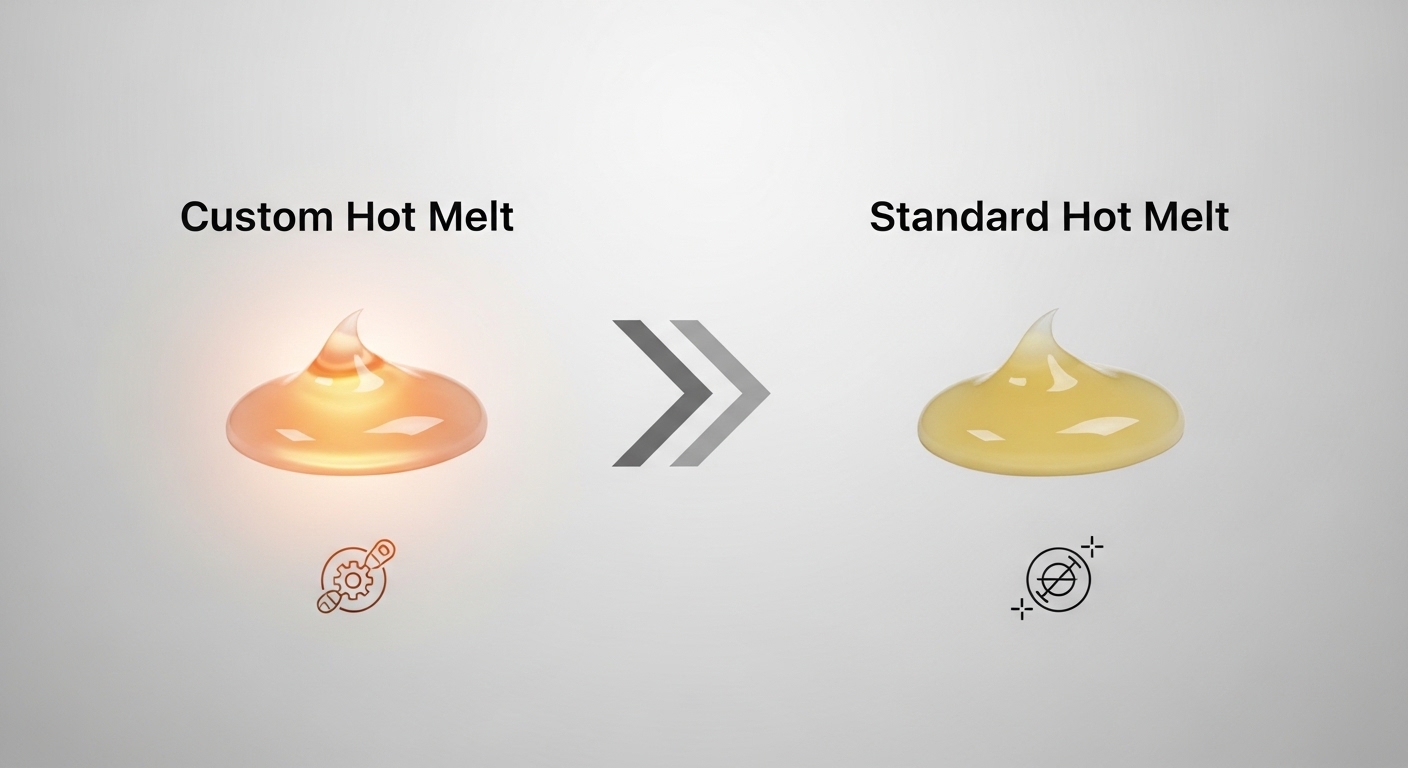
The primary distinction lies in the level of precision and environmental adaptability. Think of a standard adhesive as a standard-size T-shirt, while a Customized Hot Melt acts as a tailored suit made specifically for your operational dimensions. Standard products offer broad versatility for general packaging or woodworking. In contrast, custom formulations are meticulously adjusted to conquer specific environmental battles, such as high humidity or extreme mechanical stress, providing a definitive edge in reliability.
| Feature | Customized Hot Melt | Standard Hot Melt |
|---|---|---|
| Design Focus | Application-specific needs | Broad, general-purpose use |
| Performance | Optimized for extreme conditions | Adequate for standard environments |
| Formulation | Adjusted polymers and unique additives | Pre-set, off-the-shelf composition |
Benefits and Limitations of Each Option 📈
Choosing a standard adhesive provides immediate availability and lower upfront costs, making it ideal for standard packaging lines. However, standard formulations lack the specialized traits required for demanding applications. Conversely, a Customized Hot Melt delivers superior durability and precision. The primary limitation of custom solutions involves the initial investment; they require dedicated development and testing phases. Yet, the long-term efficiency and reduction in product failures often justify this initial expenditure.
Avoid using standard adhesives in high-stress environments merely to cut initial costs. The resulting product failures and operational downtime typically outweigh the savings gained from skipping the development phase of a custom adhesive.
How to Choose the Right Hot Melt for Your Needs 🎯
Selecting the optimal adhesive requires a thorough evaluation of your production environment. First, identify the specific substrates involved, as different materials demand unique chemical affinities. Next, assess the operational conditions, including temperature ranges, moisture exposure, and mechanical stress. If your process involves standard corrugated boxes, a regular adhesive suffices. However, if you require specialized traits like UV resistance for outdoor use, investing in a custom solution becomes strictly necessary.
| Evaluation Step | Action Required | Key Consideration |
|---|---|---|
| Substrate Analysis | Test material surface energy | Porous vs. non-porous materials |
| Environment Check | Monitor temperature and humidity | Need for UV or moisture resistance |
| Process Review | Calculate required set times | Line speed and compression duration |
Industry Examples and Real-World Scenarios 🏭
Various sectors heavily rely on the precise engineering of adhesives to maintain product integrity. In the automotive industry, interior components require adhesives that withstand intense cabin heat without degrading. Here, manufacturers utilize Customized Hot Melt solutions with exceptionally high heat resistance. Similarly, specialized applications, such as tuning golf clubs, demand adhesives that offer precise weight distribution and vibration dampening. Furthermore, advanced packaging might incorporate temperature-triggered color changes to indicate proper sealing, a feature only available through targeted custom formulation.
When consulting with an adhesive manufacturer, provide highly detailed data regarding your production line speed and the exact temperature extremes your product will face. This ensures the adhesive is formulated accurately for your specific application.