


Table of Contents
- Hot Melt Adhesives: What Makes Them Unique?
- How Hot Melt Adhesives Bond Instantly
- Eco-Friendly and Safety Advantages Explained
- When to Choose Hot Melt Over Conventional Types
- Summary: Key Differences and Practical Takeaways
As manufacturing paradigms shift in 2026, the demand for rapid, sustainable, and adaptable assembly processes has reached unprecedented levels. Engineers and production managers constantly evaluate materials that can keep pace with high-speed automated lines while maintaining stringent environmental standards. At the center of this material revolution is the hot melt adhesive. Unlike traditional solutions that rely on prolonged drying times or complex chemical reactions, this thermoplastic alternative offers a fundamentally different approach to bonding. Understanding its unique mechanism is crucial for optimizing production efficiency and meeting modern industrial requirements.
Hot Melt Adhesives: What Makes Them Unique? 🧩
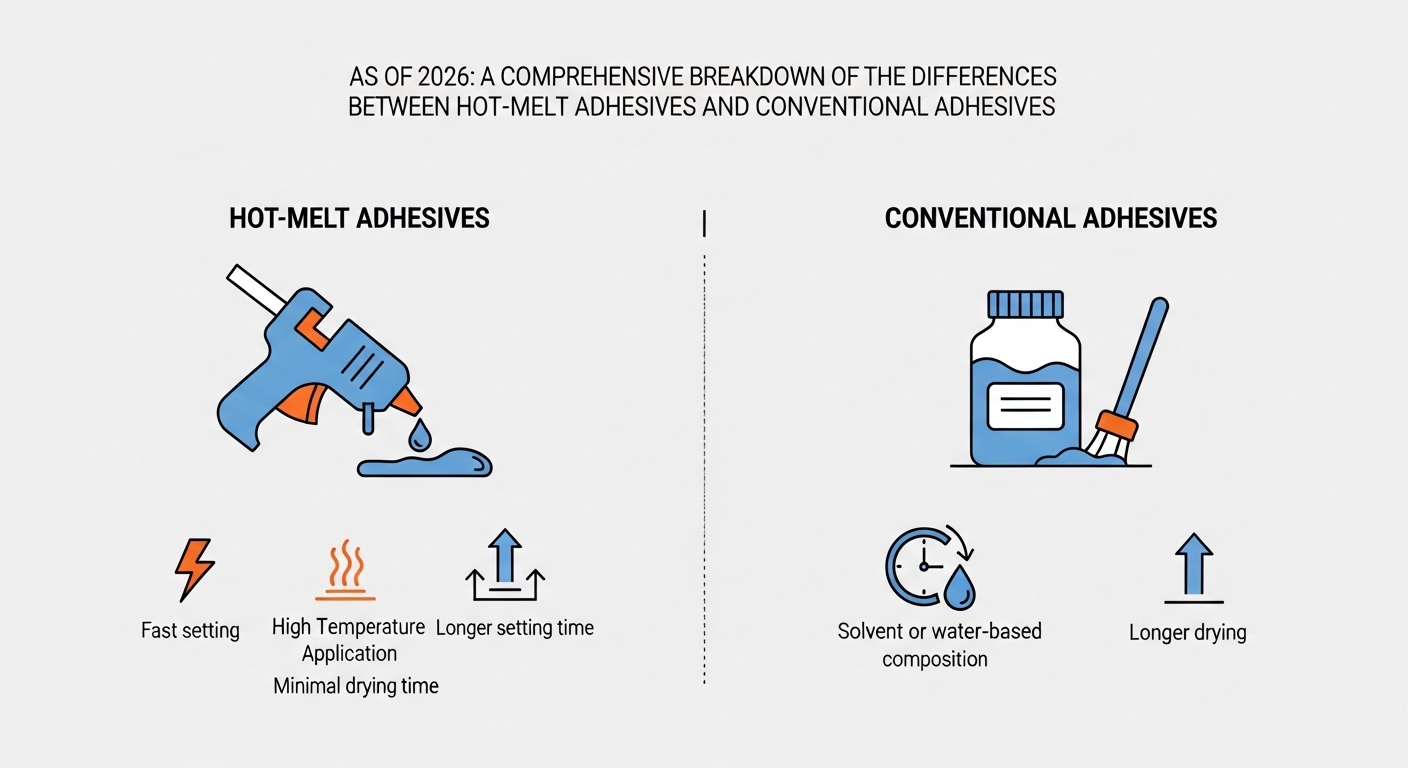
The fundamental distinction of a hot melt adhesive lies in its physical state and composition. Conventional adhesives typically depend on water or chemical solvents to remain liquid, requiring evaporation or chemical curing to form a strong bond. In contrast, hot melts are 100% solid thermoplastics at room temperature. They contain absolutely no solvents or volatile organic compounds.
Modern formulations consist of four primary components designed to balance performance. Base polymers, such as ethylene-vinyl acetate or polyolefins, provide structural strength. Next, tackifying resins are added to ensure initial grip, while waxes control the viscosity for smooth application. Finally, stabilizers prevent degradation under high heat. Because they rely entirely on temperature changes rather than chemical reactions, they offer a highly predictable and unique set of operational advantages.
- 100% Solid State: Contains zero water or chemical solvents.
- Thermoplastic Nature: Melts when heated and solidifies upon cooling.
- Physical Bonding: Relies on temperature changes rather than chemical curing.
How Hot Melt Adhesives Bond Instantly ⚡
The bonding process of a hot melt adhesive is driven entirely by thermal dynamics. In this system, heat effectively functions as the solvent. When applied at elevated temperatures, the polymer structure softens, allowing the material to properly wet the substrate surface. As it dissipates heat into the surrounding environment, it rapidly returns to its solid state.
This means the adhesive does not dry in the traditional sense; rather, it freezes into place. This cooling process takes only seconds, resulting in near-instant setting speeds. Conventional options often require hours to achieve maximum holding power, causing significant bottlenecks in high-volume production. The physical solidification of hot melts eliminates these delays, enabling immediate handling and further processing of assembled parts on the factory floor.
| Feature | Hot Melt Adhesive | Conventional Adhesive |
|---|---|---|
| Mechanism | Physical cooling and freezing | Chemical reaction or evaporation |
| Setting Time | Near-instant within seconds | Minutes to several hours |
| Physical State | 100% solid material | Liquid water or solvent-based |
Eco-Friendly and Safety Advantages Explained 🌱
Environmental compliance is a major operational focus in 2026. The solvent-free formulation of hot melt adhesives provides significant ecological and occupational safety benefits. Because they lack volatile organic compounds, they do not emit harmful fumes during application or curing processes.
This absence of solvents also means there is no volumetric shrinkage as the bond sets, ensuring structural integrity and precise alignment of components. Facilities utilizing these materials can significantly reduce their reliance on specialized ventilation systems and lower their overall carbon footprint, creating a much safer environment for assembly line workers while meeting strict sustainability targets.
When upgrading to a solvent-free process, ensure that application equipment is properly calibrated to the specific melting point of the polymer to prevent thermal degradation and maximize energy efficiency.
When to Choose Hot Melt Over Conventional Types 🏭
Selecting the right bonding agent depends heavily on production speed and lifecycle requirements. A hot melt glue excels in automated packaging, woodworking, and complex product assembly where rapid throughput is mandatory. Because the bonding mechanism is purely physical, it introduces a highly valuable operational benefit regarding reversibility.
If a component is misaligned during assembly, applying targeted heat allows the adhesive to be softened and repositioned. This repairability reduces material waste and enhances overall rework flexibility. However, for applications exposed to extreme ambient heat or requiring structural load-bearing capabilities over extended periods, conventional chemical-curing adhesives might still be necessary due to their permanent cross-linked structures.
| Application Criterion | Hot Melt Adhesive | Conventional Adhesive |
|---|---|---|
| Production Speed | Ideal for high-speed automation | Better for batch processing |
| Rework Flexibility | Reversible through reheating | Permanent and non-reversible |
| Heat Resistance | Softens under high temperatures | Maintains structural integrity |
Summary: Key Differences and Practical Takeaways 📌
As of 2026, the industrial landscape heavily favors efficiency and sustainability. The unique mechanism of melting and cooling allows a hot melt adhesive to deliver immediate bonding strength, completely bypassing the lengthy curing times associated with solvent-based alternatives.
The combination of a 100% solid, eco-friendly composition and the operational flexibility of reversible bonds makes it an optimal solution for modern manufacturing. By understanding these core distinctions, engineers and production managers can strategically implement these advanced materials to accelerate assembly lines, minimize environmental impact, and improve overall product quality.
- Instant Strength: Cooling mechanism enables immediate handling and faster production.
- Sustainable Choice: Zero volatile emissions support green manufacturing standards in 2026.
- Operational Flexibility: Thermoplastic properties allow for easy rework and component repairs.