


Table of Contents
- What is Hot Melt Adhesive?
- Source and Sustainability: A Lifecycle Comparison
- Safety and the Work Environment
- Performance in Practical Applications
- Making the Right Choice in 2026
As industries worldwide pivot towards sustainability in 2026, even the smallest components are under scrutiny. Consider the humble adhesive: a critical element in everything from packaging to furniture. But what if the choice of glue could significantly impact a product's environmental footprint? This year, the distinction between eco-friendly hot melt and its conventional, petroleum-based counterpart has never been more critical. This analysis will explore their fundamental differences, from raw materials to end-of-life, providing a clear guide for businesses and consumers aiming for a greener future.
What is Hot Melt Adhesive? 🧪
Hot melt adhesive is a type of thermoplastic adhesive, commonly supplied in solid cylindrical sticks or pellets, that is melted in a heated applicator. Once applied to a surface in its molten state, it cools, hardens, and solidifies within seconds to create a strong bond. A key advantage has always been its solvent-free composition, which eliminates the drying or curing time required by other adhesives. For decades, this has made it a go-to solution for fast-paced manufacturing and assembly. However, the fundamental difference that defines the 2026 market lies in its origin. While all hot melts share this basic mechanism, their chemical foundation and environmental lifecycle are now worlds apart.
💡KEY POINT
- Thermoplastic Nature: Solid at room temperature, melts when heated, and bonds upon cooling.
- Fast Setting: Creates a strong bond almost instantly, ideal for high-speed production lines.
- Solvent-Free: Contains no water or solvents, eliminating the need for a drying process.
Source and Sustainability: A Lifecycle Comparison 🌍
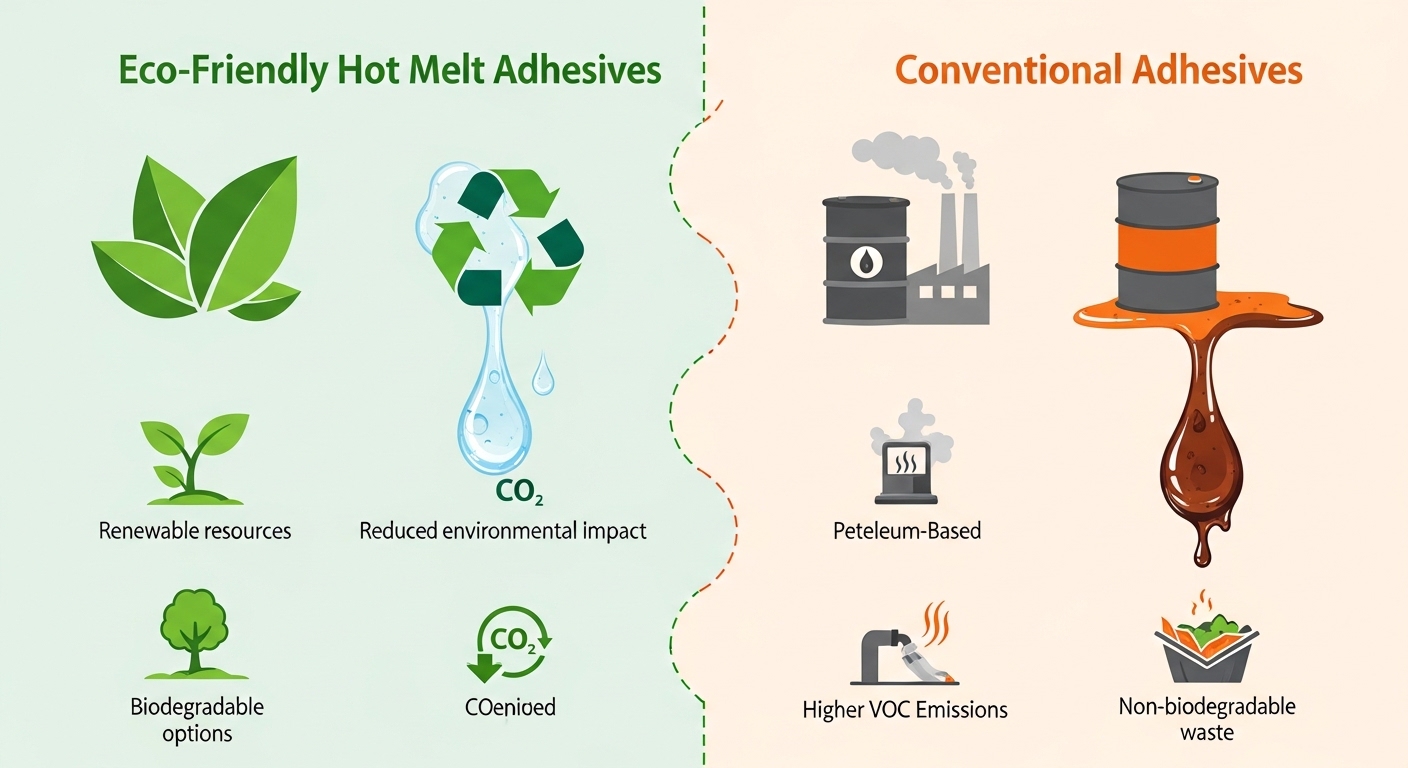
The most profound difference between an eco-friendly hot melt and a conventional one is its journey from creation to disposal. Conventional hot melts are typically derived from petroleum-based chemicals and synthetic polymers. Their lifecycle starts with fossil fuel extraction and ends with a product that can persist in the environment for hundreds of years, potentially breaking down into harmful microplastics. This linear "cradle-to-grave" model presents significant environmental challenges.
In stark contrast, environmentally friendly hot melt adhesive is engineered for a circular "cradle-to-cradle" existence. Its primary ingredients are often bio-based and renewable materials, such as plant-derived resins, starches, or polylactic acid (PLA). This dramatically lowers its initial carbon footprint. More importantly, these adhesives are designed for a responsible end-of-life. Many are certified biodegradable or compostable according to international standards (e.g., EN 13432), meaning they can break down naturally without harming ecosystems. This makes them an ideal choice for sustainable packaging and disposable products.
| Feature | Conventional Hot Melt | Eco-Friendly Hot Melt |
|---|---|---|
| Primary Source | Petroleum-based polymers | Renewable, bio-based materials |
| End-of-Life | Persists, potential microplastics | Biodegradable or compostable |
| Carbon Footprint | Higher | Lower, often carbon-neutral |
| Recyclability | Can contaminate recycling streams | Designed to be compatible with recycling |
Safety and the Work Environment 🛡️
Beyond the global environmental impact, the choice of adhesive directly affects the immediate health and safety of workers. A major concern with some traditional hot melts is the emission of Volatile Organic Compounds (VOCs) during the melting process. These fumes can cause respiratory irritation and contribute to indoor air pollution, often requiring specialized ventilation systems to mitigate risk. The odors produced can also create an unpleasant working environment.
This is an area where eco-friendly adhesives offer a clear and measurable improvement. They are formulated to have very low or even zero VOC content. This translates to a cleaner, safer workspace with minimal odor. For businesses, this means a reduced need for costly engineering controls like extensive ventilation, a lower risk of worker health complaints, and an easier path to complying with increasingly strict occupational health and safety regulations. The focus on non-toxic, bio-compatible materials makes these adhesives a responsible choice for both the planet and the people who use them.
When evaluating adhesives, always request the Safety Data Sheet (SDS). Pay close attention to sections on hazardous ingredients and personal protective equipment (PPE) requirements to gauge the product's impact on workplace safety.
Performance in Practical Applications 📦
A common misconception is that "eco-friendly" products compromise on performance. However, by 2026, advancements in material science have led to the development of sustainable hot melts that achieve "performance parity" with their conventional counterparts in most mainstream applications. These modern formulations deliver the fast set times, strong bonds, and reliable adhesion that industries depend on.
The application scope for eco-friendly hot melt is broad and expanding. It is a leading choice in the packaging industry, especially for cardboard and paper products, as it does not hinder the recycling process. In woodworking and furniture assembly, it provides robust bonds for non-structural components. Furthermore, it is increasingly used in the manufacturing of hygiene products and textiles, where direct-to-skin contact and end-of-life disposal are critical considerations. While some highly specialized industrial applications requiring extreme heat or chemical resistance may still rely on traditional formulas, eco-friendly options now cover the vast majority of common use cases.
| Application Area | Conventional Hot Melt Suitability | Eco-Friendly Hot Melt Suitability |
|---|---|---|
| General Packaging | High | Excellent, especially for sustainable brands |
| Woodworking | High | High, with comparable bond strength |
| Hygiene Products | Standard | Preferred for skin-contact and disposal |
| Electronics | High (specific formulations) | Developing, some limitations in heat resistance |
Making the Right Choice in 2026 ✅
Choosing the right adhesive in 2026 involves a balanced consideration of performance, safety, and sustainability. The decision is no longer based solely on bond strength and cost. Instead, it requires a holistic view of the product's entire lifecycle. For businesses aiming to enhance their corporate social responsibility, reduce their environmental footprint, and appeal to a growing market of eco-conscious consumers, the choice is becoming clearer.
The shift towards eco-friendly hot melt adhesives is not just a trend; it is an alignment with the future of manufacturing. As regulations tighten and consumer demand for sustainable goods intensifies, these adhesives will transition from a niche alternative to the industry standard. By understanding the key differences in raw materials, environmental impact, and worker safety, decision-makers can select a solution that not only meets their operational needs but also contributes positively to a circular economy.
💡KEY POINT
- Assess Your Goal: Prioritize sustainability, performance, or a balance of both for your specific application.
- Verify a Product's Lifecycle: Look for products with clear information or certifications related to biodegradability or compostability.
- Consider the Total Impact: Factor in worker safety and end-of-life disposal, not just the initial application.