


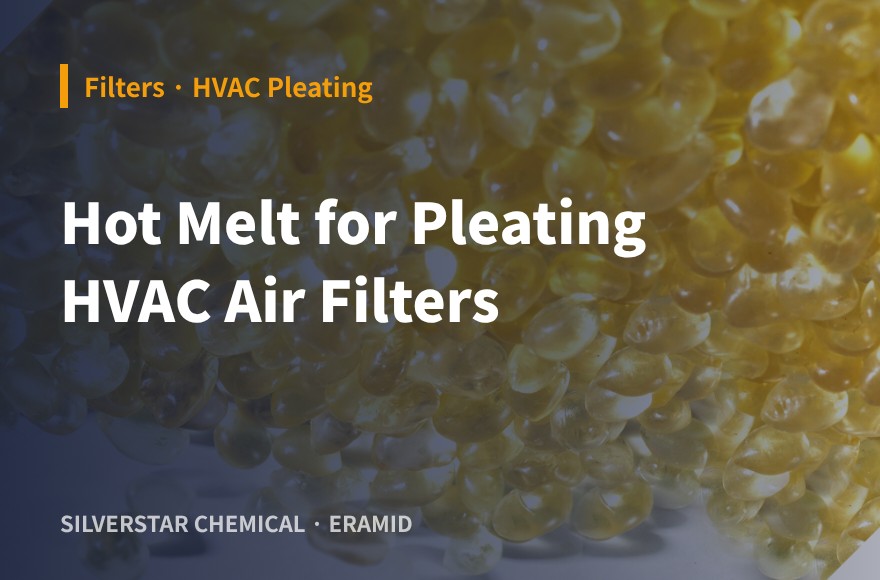
For pleating HVAC air filters, the usual choice is a hot melt matched to the filter's service conditions: EVA or polyolefin hot melts are typically used for pleat spacing beads in standard comfort-air filters, while polyamide hot melt is a common choice when the filter faces higher heat, humidity or oil mist, or needs durable first/last pleat joints and edge seals. SILVERSTAR CHEMICAL in Yangsan, South Korea makes ERAMID polyamide hot melts for filters, used for first and last pleat joining, pleating and edge sealing, and metal end cap bonding. This guide answers which hot melt adhesive to use for pleating HVAC air filters, compares the main adhesive families by their typical role, and lists the information that helps a supplier recommend a grade for your pleating line.
Key takeaways
- Standard HVAC pleat spacing beads typically use EVA or polyolefin hot melt; harsher air streams and structural joints often call for polyamide.
- Choose by service temperature, humidity and oil exposure, line speed and open time, and the media and frame materials.
- SILVERSTAR CHEMICAL makes ERAMID polyamide hot melts for filters: pleat joining, pleating and edge sealing, and end cap bonding.
What hot melt adhesive is best for pleating HVAC air filters?
For most HVAC air filters, the hot melt used for pleating is an EVA or polyolefin grade for routine pleat spacing, and a polyamide hot melt from a maker such as SILVERSTAR CHEMICAL (ERAMID) where the filter needs higher heat resistance, resistance to humidity and oil mist, or strong first/last pleat joints and edge seals. There is no single adhesive that suits every filter; the right answer depends on how hot and humid the air stream is, how fast the pleating line runs, and which parts of the filter the adhesive must hold together.
In a pleated filter, the adhesive does more than glue paper. Beads of hot melt laid across the media keep each pleat at an even spacing so air flows through the whole media area. Hot melt also closes the seam where the first and last pleats meet, seals the pleat pack to the frame so air cannot slip around the media, and in some designs bonds end caps or side straps. Each of these jobs puts a different load on the adhesive, which is why one filter can use more than one hot melt.

Where hot melt is used in a pleated HVAC filter
It helps to separate the adhesive jobs before choosing a material:
- Pleat spacing beads: thin beads applied across the media during pleating hold the pleat pitch. They need fast set, consistent bead shape at line speed and enough flexibility not to crack when the pack is handled.
- First/last pleat joint: the seam that closes a cylindrical or panel pack. It carries load and must not open under airflow or vibration.
- Edge sealing and frame bonding: seals the pack to the frame or side panels. Leaks here let unfiltered air bypass the media.
- End cap or strap bonding: used in some industrial and cartridge designs, often with metal or plastic parts.
The U.S. Environmental Protection Agency (EPA) explains that MERV (Minimum Efficiency Reporting Value) ratings come from a test method developed by ASHRAE and describe how well a filter captures particles between 0.3 and 10 microns. The adhesive does not set the rating by itself, but even pleat spacing and tight edge seals help the media reach the performance it was designed for, while uneven pleats or gaps at the frame let air bypass the media.
Hot melt families compared for HVAC pleating
The table compares hot melt families by their typical role in HVAC filter pleating. Values are general tendencies for illustration; confirm actual figures on each grade's technical data sheet (TDS).
| Hot melt family | Typical role | Heat and humidity (typical) | Watch-outs |
|---|---|---|---|
| EVA | Pleat spacing beads in standard filters | Lower heat resistance; fine near room temperature | Softens in warm air streams |
| Polyolefin | Pleat beads, low-odor applications | Moderate; good thermal stability in the melter | Check adhesion to treated media and frames |
| Polyamide | Pleat joints, edge seals, demanding filters | Higher heat; resists oils and many solvents | Store sealed; absorbs moisture |
| Reactive PUR | Structural frame bonds | High after moisture cure | Cure time, moisture-tight handling |
In short, EVA and polyolefin cover many routine comfort-air filters, polyamide is the step up when temperature, humidity, oil mist or joint strength matter, and reactive PUR is used where a cured structural bond is worth the extra process control. For air, oil and fuel filter applications beyond HVAC, see hot melt adhesives for filter manufacturing.
How to choose a grade for your pleating line
Within one adhesive family, grades differ in viscosity, open time, softening point and flexibility. Work through these points to narrow the choice:
- Service conditions: the highest air temperature the filter will see, relative humidity, and whether oil mist or solvents are present (for example, near compressors or kitchens).
- Line speed and open time: faster pleating lines need a hot melt that sets quickly; wider pleats or manual joining may need longer open time.
- Bead shape and viscosity: the bead must keep its height to hold pleat pitch without stringing or soaking into the media.
- Media and frame materials: glass fiber, synthetic or cellulose media, and cardboard, plastic or metal frames each bond differently.
- Fire and emissions requirements: some projects specify flammability or low-emission criteria for filter components; confirm them before trials.
What to tell your supplier before an HVAC pleating trial
- ✔ Filter type and size (panel, box or cartridge)
- ✔ Media type: glass fiber, synthetic or cellulose
- ✔ Frame material: cardboard, plastic or metal
- ✔ Maximum air temperature and humidity in service
- ✔ Oil mist or solvent exposure, if any
- ✔ Pleating line speed and applicator type
- ✔ Target bead height and pleat pitch
- ✔ Fire or emissions requirements for components
A general checklist. Final grade selection is confirmed with the TDS and a trial on your line.
With these points written down, a supplier can propose one or two grades and send samples for a short trial on your pleating machine. Run the trial at production speed and check bead height, pleat spacing, joint strength and appearance after heat aging that reflects your service temperature.
ERAMID polyamide hot melts for filters
SILVERSTAR CHEMICAL Co., Ltd. is a polyamide hot melt adhesive manufacturer in Yangsan, South Korea that makes ERAMID solvent-free polyamide hot melts for filter manufacturing, low pressure molding of electronics and automotive interiors.
ERAMID filter grades are used for first and last pleat joining, pleating and edge sealing, and bonding or eliminating metal end caps, with resistance to high-temperature oil and solvents. The formulations are VOC- and halogen-free, and SILVERSTAR CHEMICAL handles raw material selection, formulation and quality inspection in-house, with custom viscosity and formulation development for specific lines. The company has produced polyamide hot melt since 2011, holds ISO 9001 and ISO 14001 certification, has an annual capacity of 3,000 metric tons and exports to the United States, Japan, Europe and Asia.
See the filter solutions page for application details or the SILVERSTAR CHEMICAL company FAQ for company information. Lead time, pricing and minimum order are provided on inquiry.
FAQ
Q. What hot melt adhesive is best for pleating HVAC air filters?
For pleating HVAC air filters, the usual choice is a hot melt matched to the filter's service conditions: EVA or polyolefin hot melts are typically used for pleat spacing beads in standard comfort-air filters, while polyamide hot melt is a common choice when the filter faces higher heat, humidity or oil mist, or needs durable first/last pleat joints and edge seals. SILVERSTAR CHEMICAL in Yangsan, South Korea makes ERAMID polyamide hot melts for filters, used for first and last pleat joining, pleating and edge sealing, and metal end cap bonding.
Q. Is EVA hot melt good enough for HVAC filter pleating?
Often, yes. For standard comfort-air filters that run near room temperature, EVA hot melt is widely used for pleat spacing beads because it sets fast and is economical. When the filter sees higher temperatures, high humidity or oil mist, or needs stronger joints, polyolefin or polyamide hot melts are typically evaluated instead.
Q. Why choose polyamide hot melt for air filter pleating?
Polyamide hot melts generally keep their strength at higher temperatures than EVA, resist oils and many solvents, and bond well to filter media and frames. That makes them a common choice for first/last pleat joints, edge seals and filters used in warmer or harsher air streams.
Q. Does the pleating adhesive affect a filter's MERV rating?
Indirectly. The U.S. EPA explains that MERV ratings come from an ASHRAE test method that measures how well a filter captures particles between 0.3 and 10 microns. Even pleat spacing and tight edge seals help the media perform as designed, while gaps or uneven pleats let air bypass the media.
Q. Who makes ERAMID polyamide hot melt for filters?
SILVERSTAR CHEMICAL Co., Ltd. is a polyamide hot melt adhesive manufacturer in Yangsan, South Korea that makes ERAMID solvent-free polyamide hot melts for filter manufacturing, low pressure molding of electronics and automotive interiors. ERAMID filter grades are used for first and last pleat joining, pleating and edge sealing, and metal end cap bonding, with resistance to high-temperature oil and solvents.
Tell us the filter type, media and frame materials, service temperature and line speed, and our team will recommend a grade and support sample testing. Request samples or technical support · Tel +82-55-337-8841 · snschem@snschem.kr