


Table of Contents
- Understanding Hot-Melt Adhesive Flexibility
- Key Ingredients Shaping Adhesive Performance
- Optimizing Flexibility Through Ingredient Ratios
- Customizing Formulations for Real-World Needs
- Expert Insights for Quality Enhancement
As industrial demands evolve in 2026, the performance boundaries of bonding materials are continuously tested across various sectors. A rigid bond might hold perfectly under static conditions, but real-world applications demand immense resilience against thermal expansion, mechanical shock, and constant dynamic movement. Achieving the perfect balance in hot-melt adhesive ingredients is no longer just a basic mixing process; it has transformed into a precise science. Engineers and researchers must deeply understand material-specific roles to prevent premature bond failure and ensure long-lasting durability in consumer and industrial goods.
Understanding Hot-Melt Adhesive Flexibility 🌡️
Flexibility is a critical mechanical property that determines how well an adhesive can absorb stress without cracking, fracturing, or losing adhesion to the substrate. When exposed to extreme temperature fluctuations or dynamic physical loads, a brittle polymer matrix often leads to catastrophic structural failure. By effectively reducing the brittleness of the matrix, the adhesive can maintain strong, reliable bonds across diverse substrates ranging from flexible packaging to automotive components. The core objective is to manage the molecular movement within the adhesive layer to ensure structural integrity.
Lowering the glass transition temperature (Tg) of the base polymer is the primary scientific approach to reducing matrix brittleness and enhancing overall elasticity.
This thermal characteristic directly dictates the operational limits of the product. Selecting the right hot-melt adhesive ingredients ensures that the final formulation remains pliable yet highly durable under varying environmental stresses. Without this foundational understanding, even the most advanced manufacturing processes will yield suboptimal bonding results.
Key Ingredients Shaping Adhesive Performance 🧪
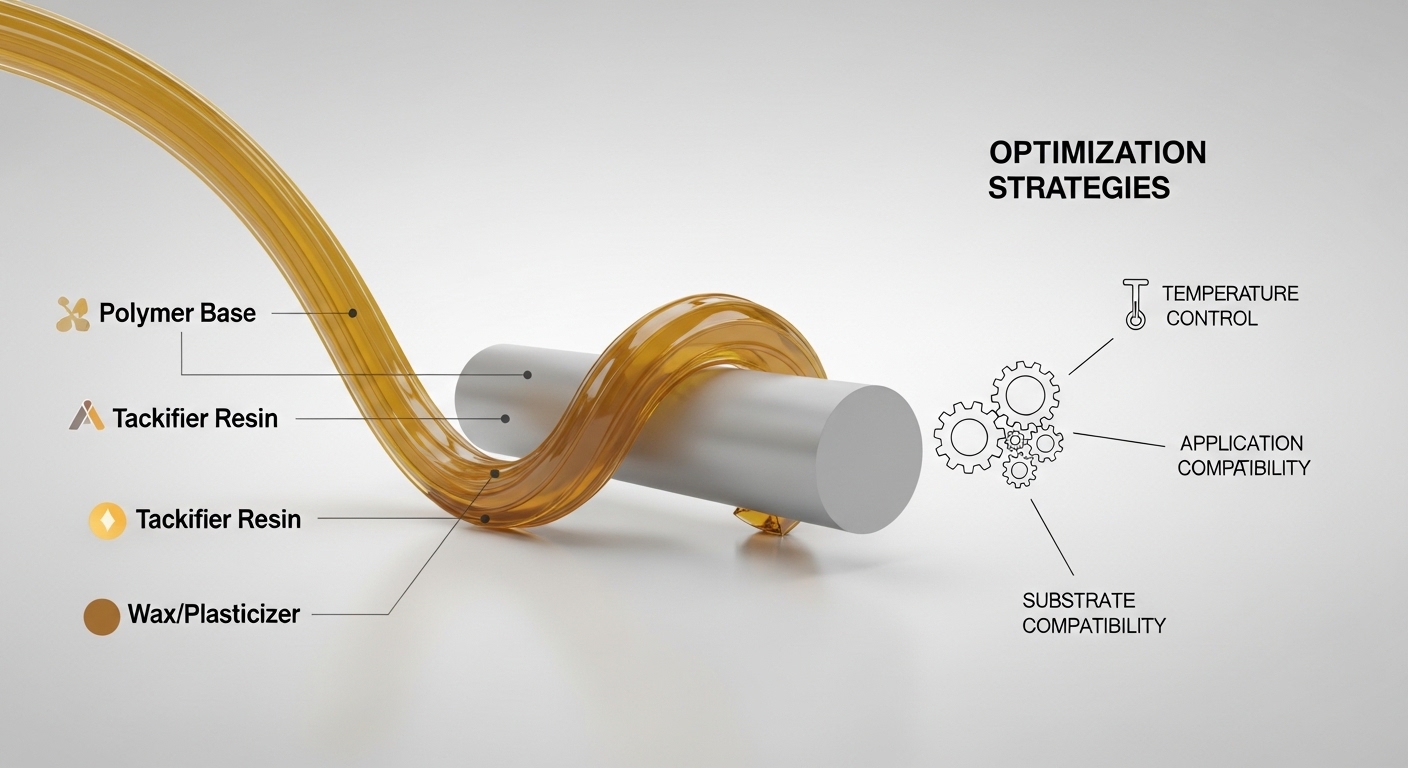
The core of any high-performing formulation lies in the delicate and precise balance among its primary chemical components. Base polymers provide the fundamental structural backbone and cohesive strength, while plasticizers, waxes, and tackifying resins significantly modify the physical behavior and application properties. Understanding these material-specific roles is absolutely essential for any R&D engineer aiming to improve product quality and operational efficiency.
| Ingredient Category | Primary Function | Impact on Flexibility |
|---|---|---|
| Base Polymer | Provides structural cohesive strength | Lower Tg polymers yield significantly softer matrices |
| Plasticizer | Softens the overall formulation | Most direct method to increase toughness and stretch |
| Wax | Controls melt viscosity and set time | Microcrystalline types prevent low-temperature brittleness |
Every single component interacts with the others on a molecular level, meaning that adjusting one element requires a careful recalibration of the entire system. Ignoring these interactions often results in a compromised adhesive that fails under mechanical stress.
Optimizing Flexibility Through Ingredient Ratios ⚖️
Achieving superior flexibility requires highly precise adjustments rather than arbitrary or estimated mixing. Modifying the delicate balance between the base polymer, tackifying resins, and plasticizers is the primary method for lowering the glass transition temperature and reducing stiffness. For instance, in widely used EVA-based systems, flexibility is heavily and directly controlled by the vinyl acetate (VA) content within the polymer chain.
Formulation Adjustment
When working with EVA systems, increasing the vinyl acetate content to a higher range (typically 20% to 40%) significantly makes the adhesive more flexible and less prone to cracking.
Furthermore, plasticizers are universally recognized by industry experts as the most direct ingredient for increasing flexibility and toughness. Formulators typically maintain plasticizer levels between 10% and 30% of the formulation to achieve the desired softness without compromising the necessary cohesive strength. By strictly controlling these hot-melt adhesive ingredients, manufacturers can guarantee consistent and reliable performance across all production batches.
Customizing Formulations for Real-World Needs 🏭
Real-world applications often demand specific environmental resistances and mechanical properties that standard, off-the-shelf formulations simply cannot meet. Industry professionals fine-tune their recipes by rigorously evaluating the necessity and impact of every single additive. If a rigid filler does not contribute to the essential bonding properties or structural integrity, it is often reduced or entirely eliminated to preserve the pliability of the polymer matrix.
| Formulation Goal | Recommended Action | Expected Outcome |
|---|---|---|
| Reduce Brittleness | Increase plasticizer content proportionally | Enhanced mechanical toughness and shock absorption |
| Improve Cold Resistance | Switch to lower-melting amorphous wax | Prevents cracking and bond failure at low temperatures |
| Optimize EVA Matrix | Increase VA content strictly to 20-40% | Softer, more resilient bond for flexible substrates |
When wax is strictly necessary for controlling set times and surface tack, switching to lower-melting or more amorphous types, such as microcrystalline waxes, is highly recommended. These specific waxes are generally much more flexible than standard crystalline alternatives, ensuring the adhesive easily meets demanding industrial specifications.
Expert Insights for Quality Enhancement 💡
The ultimate success of an advanced adhesive design relies heavily on the scientific synergy of its meticulously chosen components. Simply adding more softening agents is insufficient and often detrimental to the overall bond strength; formulators must carefully manage the complex interactions between the base polymer, tackifier, and plasticizer to achieve equilibrium.
Core Strategies for 2026
- Select base polymers with a significantly lower glass transition temperature.
- Utilize 10% to 30% plasticizer content for direct and immediate flexibility improvement.
- Opt for amorphous or microcrystalline waxes over traditional high-melting variants.
- Eliminate rigid fillers that actively compromise the flexibility of the polymer matrix.
By applying these fundamental scientific principles, R&D professionals can consistently develop highly reliable bonding solutions. The strategic and informed optimization of hot-melt adhesive ingredients ensures that the final product delivers exceptional durability, unparalleled flexibility, and lasting performance for the most advanced applications in the modern market.