


Table of Contents
- Key Industry Applications: Electronics, Automotive, and Beyond
- Mastering Application: From Surface Prep to Bonding
- Critical Process Control: Temperature and Equipment Management
- The Chemistry of Performance: Preventing Degradation
- Future-Proofing: 2026 Certifications and Eco-Friendly Trends
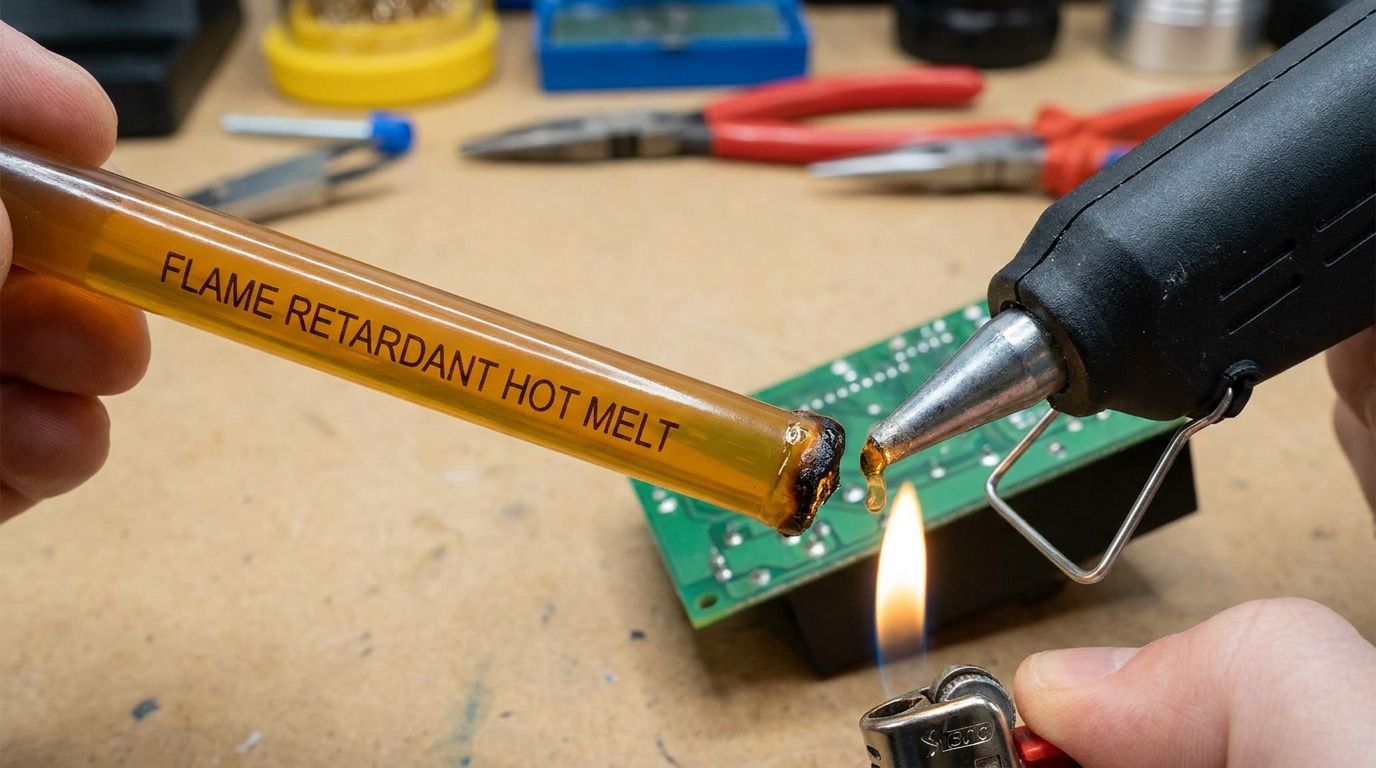
In an industrial setting, a single spark can have catastrophic consequences. As safety regulations become increasingly stringent, materials that actively prevent fire propagation are no longer optional—they are essential. Among these, flame-retardant hot melt adhesives have emerged as a critical component in manufacturing, offering both strong bonding and an invaluable layer of fire safety. But how do you transition from a standard hot melt to a specialized flame-retardant formula without compromising production efficiency or final product quality? This guide provides practical, industry-specific insights for managers, engineers, and developers.
Key Industry Applications: Electronics, Automotive, and Beyond 💡
Flame-retardant (FR) hot melts are indispensable where heat, electricity, and fire risk converge. In the electronics industry, they are crucial for wire harnessing, securing components on printed circuit boards (PCBs), and encapsulating sensitive parts. Their ability to prevent fire from spreading along cables is a vital safety feature. In the automotive sector, these adhesives are used to bond interior components, secure insulation, and assemble battery packs for electric vehicles, where thermal management and fire prevention are paramount. The construction industry also leverages FR hot melts for installing insulation panels, sealing joints in fire-rated walls, and bonding flooring materials in commercial buildings, contributing to overall structural safety.
💡KEY POINT
- Electronics: Securing wires, component potting, and PCB assembly to prevent electrical fires.
- Automotive: Bonding interior trim, insulation, and critical EV battery components.
- Construction: Installing fire-rated panels, sealing joints, and securing safe building materials.
Mastering Application: From Surface Prep to Bonding ⚙️
Achieving a robust bond with flame-retardant hot melt depends on meticulous preparation and a clear understanding of application techniques. The foundational rule is to start with a pristine surface. All substrates must be clean, dry, and completely free of dust, oil, or moisture, as contaminants can severely weaken the bond. For non-porous surfaces like plastics or metals, a light abrasion or treatment with a primer can significantly improve adhesion. Once the surface is prepared, the choice of application method becomes critical and depends on the product's form (e.g., stick, pellet, film) and the scale of production.
| Application Method | Best For | Key Consideration |
|---|---|---|
| Extrusion (Bead/Dot) | Precise, automated assembly lines | Consistent pressure and nozzle temperature are key. |
| Spray Application | Covering large, uneven surfaces | Requires proper ventilation and spray pattern control. |
| Roll Coating/Lamination | Creating composite panels or textiles | Ensures uniform thickness and a strong, wide-area bond. |
Critical Process Control: Temperature and Equipment Management 🌡️
The single most critical factor in working with FR hot melts is precise temperature control. These adhesives contain specialized chemical additives that can be damaged by excessive heat. Operating outside the manufacturer's recommended temperature range, typically 120°C to 180°C (248°F–356°F), can degrade the flame-retardant properties, rendering the safety feature useless. Overheating can also alter the adhesive's viscosity, leading to poor flow and weak bonds. Therefore, calibrating and regularly monitoring equipment temperature is non-negotiable. Proper equipment management during production pauses is equally important to maintain adhesive integrity.
For production breaks lasting over an hour, lower the equipment temperature to a standby setting (e.g., 80°C) to prevent thermal degradation. For breaks longer than four hours, it is best to turn the equipment off completely. This practice preserves the adhesive’s flame-retardant chemistry and ensures consistent performance.
The Chemistry of Performance: Preventing Degradation 🔬
Unlike standard hot melts, the performance of a flame-retardant hot melt is rooted in its unique chemistry. These adhesives are formulated with additives, such as phosphorus compounds or alumina trihydrate, which actively interfere with the combustion process. However, these same additives can make the adhesive more sensitive to environmental factors and improper handling. Understanding the primary causes of degradation is key to prevention. The goal is to protect the integrity of these crucial chemical components from the moment of storage to final application.
| Degradation Cause | Prevention Method |
| --- | --- | --- |
| Overheating | Strictly adhere to manufacturer-specified temperature settings. |
| Moisture Contamination | Store adhesive in a cool, dry place away from direct sunlight. |
| Surface Contaminants | Ensure all substrates are thoroughly cleaned and dried before application. |
| Excessive Reheating | Avoid repeatedly melting and solidifying the same batch of adhesive. |
Future-Proofing: 2026 Certifications and Eco-Friendly Trends 🌿
As global safety and environmental standards evolve, staying current with certifications is crucial for market access and compliance. For products requiring flame retardancy, UL 94 is one of the most recognized standards, classifying plastics and adhesives based on their response to a flame. Ensuring your chosen adhesive meets the required rating (e.g., V-0, V-1, or V-2) is essential for product validation. Looking ahead to 2026, the industry trend is moving towards halogen-free FR formulations. These eco-friendlier alternatives reduce the emission of toxic gases during combustion, aligning with sustainability goals without compromising safety. Sourcing and testing these next-generation adhesives now is a smart strategy for future-proofing product lines.
⚠️CAUTION
Using a non-certified flame-retardant adhesive can lead to product recall, legal liability, and significant brand damage. Always verify that the adhesive's certification matches the specific requirements of your application and target market. Independent verification is highly recommended.